Price per kg 70,400 won as of the 10th
Price per bird also falls below 200,000 won
Impact of blocked export routes to the US and Europe
The price of king crab, classified as a representative "premium ingredient," has plummeted to around 70,000 KRW per kilogram for the first time in four years. This is due to a significant increase in the volume of king crab entering South Korea after the war in Russia, as the United States and Europe banned imports of Russian seafood.
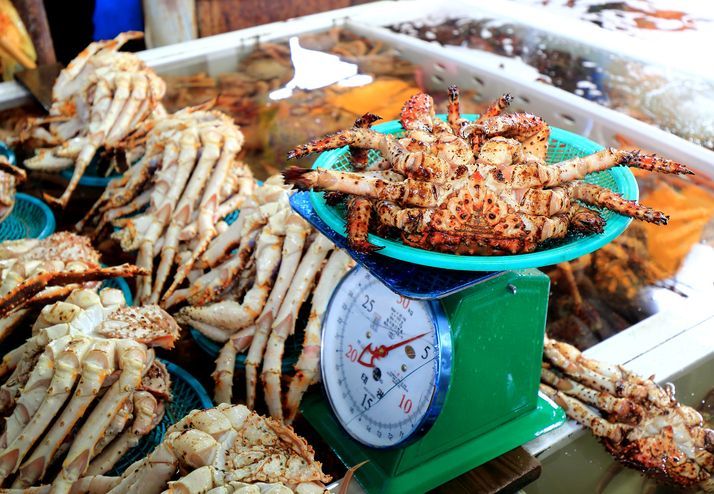 The price of king crab has dropped to around 70,000 won per kilogram for the first time in four years.
 [Image source=Getty Images]
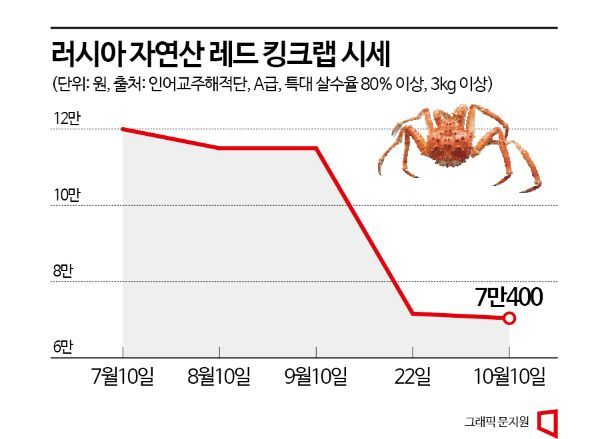
According to the seafood distribution platform Mermaid Pirate Crew on the 11th, the average price of Russian red king crab (wild, extra-large, meat yield over 80%, over 3 kg) on the 10th of this month was 70,400 KRW per kilogram, down 41.3% compared to 120,000 KRW on July 10, three months ago. The price of red king crab, which had maintained an appropriate level of 115,000 KRW until the 18th of last month, dropped nearly 40,000 KRW in just one day to 77,400 KRW on the 19th. The price of a single king crab (2.7 kg), which once soared to 300,000 KRW, also fell below 200,000 KRW to 175,000 KRW.
The main reason for the sharp decline in king crab prices is attributed to the "increase in supply" caused by the war in Russia. Major consumer countries such as the United States and Europe banned imports of Russian seafood after the war, significantly increasing the export share to Asian countries like South Korea and China. From Russia's perspective, if the fishing quota is not met this year, the quota for next year may also be reduced, so rather than stopping fishing, it is analyzed that they chose to greatly increase the export share of red king crab to Asian countries, which starts its first fishing season around September.
An industry insider said, "The price of Russian king crab had been continuously rising after China lifted its COVID-19 lockdown measures, but in the past three months, it recorded the lowest level in four years. Russia stored king crabs destined for the US and Europe in its own frozen warehouses, but it seems these warehouses have reached saturation."
However, experts say it is uncertain whether the downward trend in king crab prices will continue. Seafood prices are determined daily through auctions at production and consumption wholesale markets, and prices typically fluctuate depending on import volumes at different times. King crab is known to have a larger price volatility compared to other seafood.
Professor Eunhee Lee of the Department of Consumer Studies at Inha University said, "As long as the war in Russia continues, king crab prices will likely continue to decline for the time being, but prices can fluctuate due to various factors such as changes in catch volume and import volume."
© The Asia Business Daily(www.asiae.co.kr). All rights reserved.
![Clutching a Stolen Dior Bag, Saying "I Hate Being Poor but Real"... The Grotesque Con of a "Human Knockoff" [Slate]](https://cwcontent.asiae.co.kr/asiaresize/183/2026021902243444107_1771435474.jpg)

















