80% of Citizens Support Establishing Medical Schools and Affiliated Hospitals at Regional National Universities
Rep. Kim Won-i to Promote Medical School Establishment and Affiliated Hospital Construction in Jeonnam Region
As the government continues discussions to increase the number of medical school admissions, it has been revealed that the majority of the public believes the current quota of 3,058 should be increased by at least 300 to over 1,000 students. Additionally, 8 out of 10 people supported the establishment of medical schools at regional national universities to improve local healthcare standards.
Kim Won-i, a member of the Democratic Party of Korea (Health and Welfare Committee, Mokpo City), commissioned a public opinion research firm, Korea Research, to conduct the "2023 National Healthcare Issues Survey" from the 13th to the 19th of last month. The survey targeted 1,003 men and women aged 20 to 60 nationwide.
First, when asked how much the medical school quota should be increased in relation to the government's plan to increase the number of doctors, 24% (241 respondents) answered that it should be increased by more than 1,000. This was followed by 16.9% (170 respondents) who said around 300 to 500, and 15.4% (154 respondents) who said around 500 to 1,000.
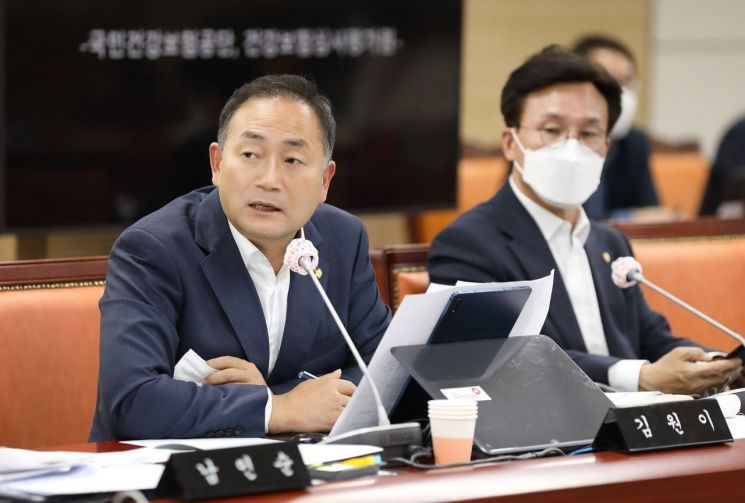 Democratic Party of Korea Representative Kim Won-i (Mokpo) [Photo by Representative Kim Won-i's Office]
More than half of the respondents answered that the current medical school quota of 3,058 should be increased by at least 10%. The medical school quota has been frozen since 2006.
When asked which medical field should be prioritized for increasing personnel, 78% (782 respondents) chose emergency medical services. This was followed by pediatrics and obstetrics/gynecology at 62.5% (627 respondents), and dementia and other geriatric diseases and elderly care at 36.9% (370 respondents).
Regarding the question of whether they support establishing medical schools and affiliated university hospitals at regional national universities (Mokpo University, Suncheon University, Andong University, Changwon University, Gongju University) to improve local healthcare standards, 79.7% (799 respondents) expressed support.
Among those who supported the establishment of medical schools at regional national universities, 74.8% (598 respondents) cited regional balanced development and revitalization of the local economy as the reason. This reflects expectations that establishing regional national medical schools will help prevent population decline in local areas and revive stagnant local economies amid the serious concentration of medical infrastructure in the Seoul metropolitan area.
Finally, when asked what is most needed to improve healthcare standards in non-metropolitan areas, 56.6% (568 respondents) chose improvement of local medical facilities and equipment. This was followed by attracting large medical institutions such as university hospitals at 54.8% (550 respondents), and training and producing medical personnel within the region at 49.4% (495 respondents).
Representative Kim Won-i explained, "We confirmed that public opinion overwhelmingly supports a sufficient increase in the medical school quota and the establishment of medical schools at regional national universities," and emphasized, "We will strongly push to ensure that the increased medical school quota includes a share for establishing a medical school in the Jeonnam region and to build an affiliated hospital."
Meanwhile, this survey was conducted online using the Korea Research panel, with a sampling error of ±3.1% at a 95% confidence level.
© The Asia Business Daily(www.asiae.co.kr). All rights reserved.

















