First Shock Inflation 25.2%, Second 28.7% Increase
Economic Growth Rate Down 5%P and 2%P Respectively
Concerns Over Domestic Consumer Price Inflation Impact
The war between the Palestinian armed group Hamas and Israel has raised the biggest concern about whether it will escalate into the 5th Middle East War. If this war spreads to Middle Eastern oil-producing countries like the 1st and 2nd Oil Shocks in the 1970s, it could inevitably intensify global inflationary pressures due to a sharp rise in international oil prices. The oil shocks following the 4th Middle East War in 1974 are remembered as the worst global inflation of the 20th century.
On the 9th (local time), West Texas Intermediate (WTI) crude oil futures prices on the New York Mercantile Exchange closed at $86.38 per barrel, up 4.3% ($3.59) from the previous session. This was the largest increase since April and the highest closing price since the 3rd of this month. On the same day, Brent crude futures prices on the London ICE Futures Exchange rose 4.2% ($3.57) to $88.15. International experts expect the impact on the market to be limited considering that neither Israel nor Palestine are oil-producing regions, but they see the rise in oil prices as reflecting concerns over the possibility of the conflict spreading to neighboring Middle Eastern countries.

Some have expressed concerns that this war could trigger global economic instability due to high inflation, similar to the 1st Oil Shock caused by the 4th Middle East War. The 1st Oil Shock began when Middle Eastern oil-producing countries, led by Saudi Arabia along with Egypt and Iraq, declared the "weaponization of oil" and cut production by 5% monthly. As a result, a supply disruption of up to 4.3 million barrels per day occurred, causing international oil prices to surge from an average of $3 per barrel to $13 per barrel within a month, more than quadrupling. At the time, South Korea issued a statement of support to the Middle Eastern oil-producing countries and was granted a production cut exemption, but could not avoid the global oil crisis's impact. According to Statistics Korea, the consumer price inflation rate rose from 3.5% in 1973 to 24.3% in 1974 and 25.2% in 1975.
The 2nd Oil Shock in 1979 also dealt a direct blow to the South Korean economy. It originated from the Iranian Revolution and the Iran-Iraq War in 1980. Due to strikes caused by the revolution, Iran reduced its daily oil production from 6 million barrels to 2 million barrels. International oil prices rose 2.6 times from $15 to $39 within five months, and domestic inflation surged to 28.7% in 1980 as a result.
Especially during the 2nd Oil Shock, South Korea was in a period of fostering heavy and chemical industries, making its economy more vulnerable due to high oil dependency. According to the Bank of Korea, the real gross national income (GNI) per capita dropped sharply from a 6.1% increase in 1979 to a -7.1% decrease the following year. The Korea Institute for International Economic Policy (KIEP) analyzed that the 1st and 2nd Oil Shocks caused the South Korean economic growth rate to fall by 5 and 2 percentage points, respectively. Bloomberg reported that the U.S. consumer price index (CPI) rose 12-14% in the 1970s. The oil price instability triggered by the Middle East wars thus affected the global economy.
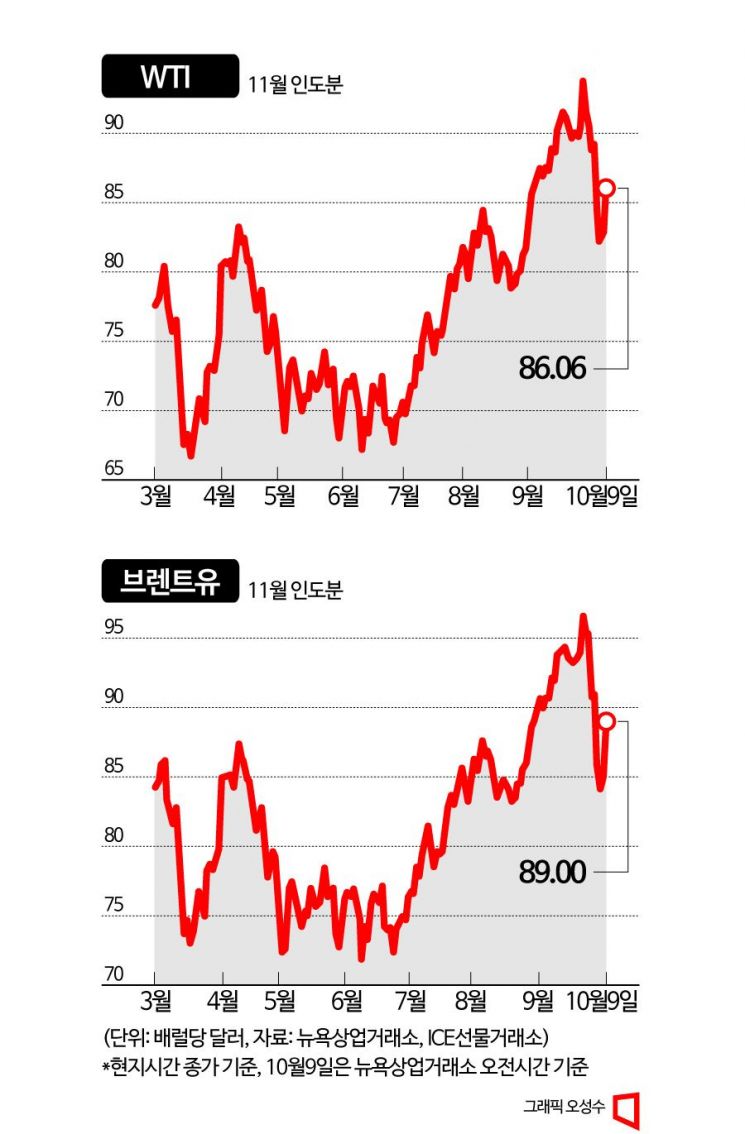
The problem arises if the war between Hamas and Israel prolongs. With domestic inflation still unstable due to the impacts of COVID-19 and the Russia-Ukraine war, there is growing concern that this Middle East crisis could significantly exceed the government's annual inflation forecast of 3.3%. Inflation slowed to 2.3% in July but showed an upward trend again in August (3.4%) and September (3.7%) this year. The South Korean government expects increased volatility in international oil prices due to this situation and plans to coordinate with relevant agencies to prepare response plans for various scenarios.
Oh Geon-young, a macroeconomics expert and team leader at Shinhan Bank WM Headquarters, stated, "The 4th Middle East War was centered on accumulated conflicts between oil-producing Middle Eastern countries and Israel. Similarly, if oil-producing countries like Iran are behind the current Hamas-Israel war, the situation could escalate further." He added, "With the Middle East crisis following the Russia-Ukraine war, if the U.S.'s hegemony in the Middle East weakens, it could cause problems in energy supply and demand."
© The Asia Business Daily(www.asiae.co.kr). All rights reserved.


















