Despite the prolonged outlook of a high-interest rate environment, a survey revealed that more than half of respondents plan to take out additional real estate-related loans within the year. By age group, those in their 20s and 30s primarily aimed to secure "jeonse or monthly rent deposits," while those aged 40 and above focused on "purchasing residential real estate."
On the 10th, real estate platform Zigbang conducted a survey of 716 app users (September 14?28, confidence level 95% ±3.66 percentage points), finding that 55.0% of respondents planned to take out additional loans this year for real estate purchases, jeonse deposits, or rent payments.
Regarding the type of interest rate for additional loans, 56.3% chose "fixed interest rate," the highest proportion. This was followed by "mixed interest rate" at 29.9% and "variable interest rate" at 13.7%. Compared to last year, the fixed interest rate preference decreased from 69.1% to 56.3%, while the mixed interest rate preference increased from 18.8% to 29.9%. Zigbang explained that this reflects expectations of a potential interest rate cut.
As for reasons for planning additional loans, 49.5% of respondents cited "purchasing residential real estate." This was followed by jeonse or monthly rent deposits (44.2%), real estate investment (4.6%), and others (1.8%). By age group, those under 20 had the highest proportion of "jeonse or monthly rent deposits" at 81.5%, and those in their 30s also showed a high rate at 52.9%. Respondents aged 40 and above relatively favored "purchasing residential real estate."
Currently, 39.0% of respondents reported having real estate-related loans. By age group, the proportions were highest among those in their 40s (43.5%), 60s and above (39.8%), 30s (39.3%), and 50s (38.4%).
More than half of these borrowers were paying interest rates exceeding 4% annually. Specifically, ▲13.3% paid between 4.0% and less than 4.5%, ▲12.9% paid 6.0% or higher, ▲12.5% paid between 5.0% and less than 5.5%, and ▲10.4% paid between 5.5% and less than 6.0%. Compared to last year, 58.1% reported an increased interest burden.
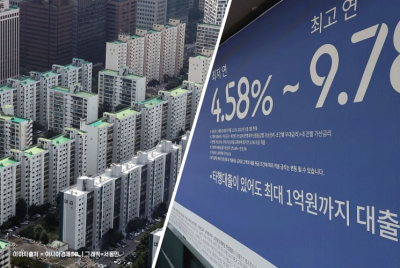
Interest rates are expected to act as a variable in the real estate market. In particular, with the U.S. Federal Reserve continuing its tight monetary policy, the high-interest rate trend is expected to persist long-term. Although the Bank of Korea’s base rate has been held steady at 3.50% since January, mortgage loan rates at commercial banks have risen to as high as 7% annually.
Ham Young-jin, head of Zigbang’s Big Data Lab, said, "In the case of purchasing a home, the burden of home prices has increased not only due to high interest rates but also because apartment sale prices have recovered. Nevertheless, loan demand remains significant, so it is important to choose an appropriate loan interest rate type considering one’s financial situation and loan repayment ability."
© The Asia Business Daily(www.asiae.co.kr). All rights reserved.

















