SanJawi, October 10 Ministry of Industry Audit Session
The National Assembly audit of the Ministry of Trade, Industry and Energy will take place on the 10th. Intense debates between the ruling and opposition parties are expected regarding Korea Electric Power Corporation's (KEPCO) 47 trillion won deficit resolution plan, the possibility of electricity rate hikes, nuclear power expansion, and other energy policies.
The Industry, Trade, Small and Medium Enterprises Committee will conduct the audit targeting the Ministry of Trade, Industry and Energy on the 10th, followed by audits of KEPCO and other power generation public enterprises and public institutions on the 19th, Korea Gas Corporation on the 24th, and a comprehensive audit on the 26th.
The main issues in this year's audit of the Ministry are likely to be electricity rates and nuclear power. The government plans to decide on whether to raise electricity rates after further monitoring KEPCO's restructuring efforts. On the 5th, Minister of Trade, Industry and Energy Moon Seong-wook stated in a broadcast, "I think we need to decide by comprehensively considering KEPCO's restructuring efforts, oil prices, and the domestic economy." Earlier, at the confirmation hearing on the 13th, Minister Moon said, "Before we can tell the public that a rate adjustment is necessary, a painful restructuring must precede; otherwise, we should not talk about it," citing restructuring as a prerequisite for a rate increase.
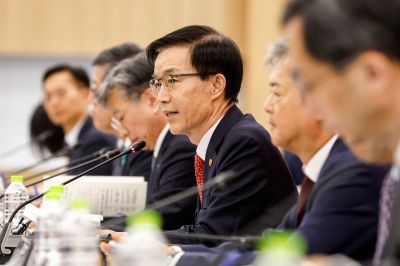
KEPCO President Kim Dong-chul insists that normalizing electricity rates is essential to improve the company's financial structure. At a press conference on the 4th, he said, "When the government implemented the fuel cost linkage system in 2021, it decided to raise the fuel cost by 45.3 won per kilowatt-hour this year, but the current level is below that," adding, "It is appropriate to raise electricity rates as much as possible within the 25.9 won range, excluding the 19.4 won increase in the standard fuel cost this year."
President Kim expressed concerns that delaying electricity rate hikes would increase the burden on the national economy. He explained, "Not raising electricity rates does not reduce the burden on inflation; if electricity rates are not appropriate, energy overconsumption occurs, and importing more energy puts pressure on the international balance of payments and inflation," adding, "Also, if KEPCO continues to increase bond issuance, it disrupts the bond market, causing bond interest rates to rise, which inevitably leads to higher interest rates and further burdens on the national economy."
KEPCO plans to release a 'second additional self-help plan' this month, including workforce efficiency improvements and additional asset sales. In May this year, KEPCO announced a financial improvement plan totaling 25.7 trillion won, expanding the existing 20.1 trillion won fiscal soundness plan by 5.6 trillion won for early management normalization. President Kim emphasized, "The scale of additional self-help efforts includes quantifiable amounts and non-quantifiable parts such as organizational downsizing and workforce efficiency," adding, "However, the scale will be unprecedented."
During this audit, questions are also expected to focus on the government's stance on nuclear power expansion. On the 20th of last month, Minister Moon stated in his inaugural speech, "We will complete the early restoration of the nuclear power ecosystem, which is being re-emphasized globally for carbon neutrality and energy security," and expressed his ambition to "develop small modular reactors (SMRs), carbon capture, utilization and storage (CCUS), hydrogen, and other new energy industries." He officially began his duties by visiting the Saewool Nuclear Power Plant, foregoing the inauguration ceremony.
Earlier in August, the Ministry of Trade, Industry and Energy began early preparations for the '11th Basic Plan for Electricity Supply and Demand' to respond to increased electricity demand from new investments in advanced industries such as semiconductors and secondary batteries, data center construction, and the spread of electrification in industry and daily life. The core agenda of the plan, to be finalized around July next year, is likely to be 'nuclear power expansion measures.' Former Minister Lee Chang-yang stated at the time, "To prepare for increased demand and ensure stable power supply capacity, it is necessary to consider expanding new supply capacity through nuclear power and hydrogen." According to the government's budget proposal submitted to the National Assembly for next year, the budget for revitalizing nuclear power is 662.2 billion won, an increase of 130.4 billion won from this year's 531.8 billion won.
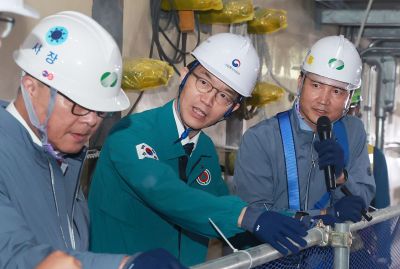 Visiting Minister of Trade, Industry and Energy Bang Moon-gyu (center) visited the Saeul Nuclear Power Headquarters of Korea Hydro & Nuclear Power located in Ulju-gun, Ulsan Metropolitan City, on the 20th of last month as his first field visit after taking office, touring the main facilities of the Saeul Nuclear Power Plant.
© The Asia Business Daily(www.asiae.co.kr). All rights reserved.


















