BMW Korea Partners with LG and GS to Expand Charging Infrastructure
"1,100 Units Built Over 10 Years, 1,000 More Added Next Year"
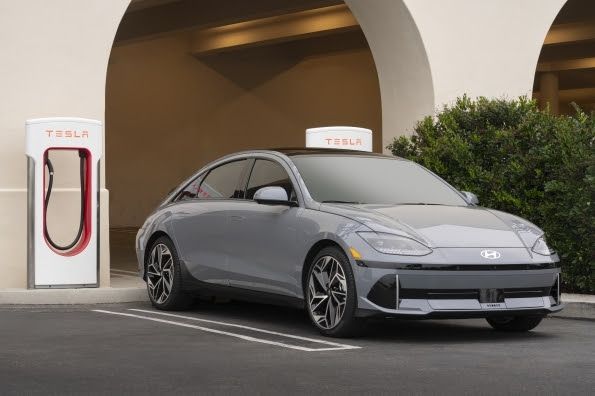
Hyundai to Use Tesla Supercharger for North American Launch Vehicles
Technical Issues Causing Charging Delays Likely Resolved
Cases of cooperation between companies to expand electric vehicle (EV) charging infrastructure are increasing. This is because many consumers cite the lack of charging stations as one of the reasons for hesitating to purchase electric vehicles.
BMW Korea announced on the 5th that it has decided to collaborate with LG Electronics and GS Energy to expand charging infrastructure, stating, "We will increase the number of chargers nationwide from around 1,100 units this year to 2,100 units next year."
LG Electronics plans to manufacture 350 kW and 200 kW fast chargers as well as stand-type and wall-mounted slow chargers. This is the first time BMW and LG are jointly engaging in the charger business. GS Energy will provide software services such as charging payment. GS has been expanding its charging business since acquiring the charging operator ChargeBee last year.
Kim Nam-gyun, head of the Charging Infrastructure Strategy Team at BMW Korea, said, "The ratio of chargers per electric vehicle is expected to worsen from 0.60 units last year to 0.52 next year and 0.46 the year after, indicating a deepening shortage of charging infrastructure. We judged that expanding charging infrastructure is as important as selling electric vehicles."
The company first introduced the pure electric vehicle i3 in Korea in 2014. At that time, the concept of electric vehicles was unfamiliar, and charging infrastructure was severely lacking. Over the past decade, the number of chargers built has reached 920, and by the end of this year, it will be about 1,100. The 1,000 new chargers to be installed next year will be roughly equivalent to what has been accumulated over the past ten years.
Kim said, "The chargers to be newly installed next year will be public infrastructure that can charge electric vehicles from other manufacturers as well. If the plan proceeds as scheduled, BMW chargers will account for about 57% of the charging infrastructure built by complete car manufacturers."
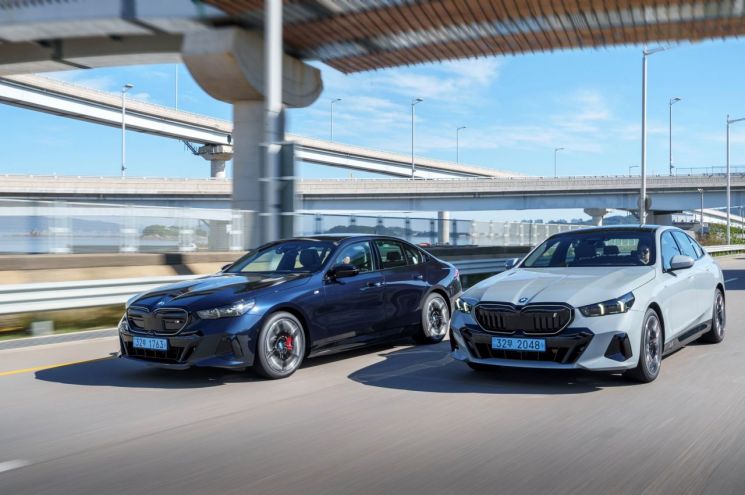 The new BMW 5 Series electric vehicle i5, launched by BMW Korea on the 5th. The company announced a domestic charging infrastructure expansion strategy in line with the launch of this new model. They plan to add 1,000 electric vehicle chargers next year, bringing the total to 2,100 chargers nationwide by the end of 2024.
 Hyundai Motor Group announced on the same day that it will apply the North American Charging Standard (NACS) to vehicles to be released in North America in the future. Starting from the fourth quarter of next year, Hyundai, Kia, and Genesis vehicles will gradually be able to use Tesla's charging network, Supercharger. Tesla is the world's largest electric vehicle manufacturer and has the widest charging network in North America, with twice as many fast charging stations as Hyundai Motor. There have been technical issues such as increased charging time when Hyundai’s dedicated electric vehicles use Tesla Superchargers, but Hyundai believes there is a way to resolve these internally.
Earlier, Hyundai Motor Group, along with BMW, General Motors (GM), Honda, Mercedes-Benz, and Stellantis, decided to establish a joint venture (JV) for a charging network in North America in July. They plan to build 30,000 high-power charging stations mainly in urban areas and on highways. These charging stations, expected to be launched around next summer, are being prepared to support various charging standards simultaneously.
Expanding charging infrastructure is considered a prerequisite for the transition to vehicle electrification. Although the number of chargers has increased compared to the past, many electric vehicle owners still feel it is insufficient. In South Korea, the number of slow chargers alone has surpassed 100,000, showing rapid growth in visible figures. However, since support measures have been implemented mainly in the form of subsidies to charging operators, the increase appears to be superficial without considering actual demand. Conflicts over charger usage have arisen in urban areas with high electric vehicle adoption and on highways with high fast-charging demand, which is attributed to this background.
© The Asia Business Daily(www.asiae.co.kr). All rights reserved.



















