Ahn Cheolsang Acting Chief: "Please Conduct Swift Trials with a Sense of Duty"
121 newly appointed judges received their commissions as judges, but due to delays in the National Assembly's consent procedure, they received their appointment letters bearing the name of Acting Chief Justice Ahn Cheol-sang.
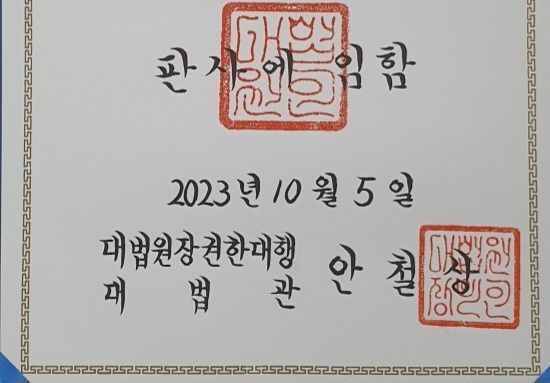 Appointment certificates in the name of Acting Chief Justice Ahn Cheol-sang, received by newly appointed judges on the 5th./
The judges who received their commissions on the 5th will undergo accident training and judgment writing training at the Judicial Research and Training Institute before being assigned to frontline courts in March next year.
At the appointment ceremony held at the Supreme Court that day, Acting Chief Justice Ahn said, "The people's right to a trial is not sufficiently guaranteed by fair and thorough hearings and reasonable judgments alone," adding, "As judges, you must have a sense of duty and communicate faithfully with the parties and other litigation-related persons, striving for prompt trials."
He continued, "There is an increasing trend of blaming and attacking individual judges simply because the trial results differ from their expectations," emphasizing, "While rational and sound criticism deserves respect and attentive listening, we must protect judicial independence with the will and courage to withstand unjust attacks and criticisms."
He further stated, "You must be especially careful in your conduct and speech both inside and outside the courtroom to avoid unnecessary misunderstandings," adding, "Judges' personal activities unrelated to their duties can sometimes become subjects of public interest and significantly affect the trust in the conclusions of the trials they preside over."
Among the newly appointed judges, the proportion of women (63) was higher than that of men (58), and the average age was 35.4 years, slightly higher than last year. Those in their 30s numbered 105, the largest group, followed by 15 in their 40s, and one under 30.
By alma mater, Seoul National University led with 47, followed by Yonsei University with 15, Korea University with 13, Ewha Womans University with 10, Sungkyunkwan University with 7, and Hanyang University with 5. Among law schools, Seoul National University had the most with 13, followed by Sungkyunkwan University with 12, Korea University with 9, Hanyang University with 8, Pusan National University with 7, and Yonsei University with 6.
By previous occupation, lawyers were the largest group with 73. Among major law firms, Kim & Chang produced 9, Yulchon 7, Daeryook Aju and Hwawoo 4 each, and Kwangjang, Logos, Barun, Sejong, and Taepyungyang 3 each. Seven were former in-house counsel. Additionally, 13 were former prosecutors, 16 from government and public institutions, 11 public defenders, and 8 judicial researchers at various courts were appointed as judges.
Under the unified legal profession system, to be appointed as a judge, one must hold lawyer qualifications for a certain period. Based on the appointment date, at least 3 years of experience is required from 2013, 5 years from 2018, 7 years from 2025, and 10 years from 2029.
© The Asia Business Daily(www.asiae.co.kr). All rights reserved.

















