Government to Announce 'Corporate On-Site Regulation Improvement Plan' on the 5th
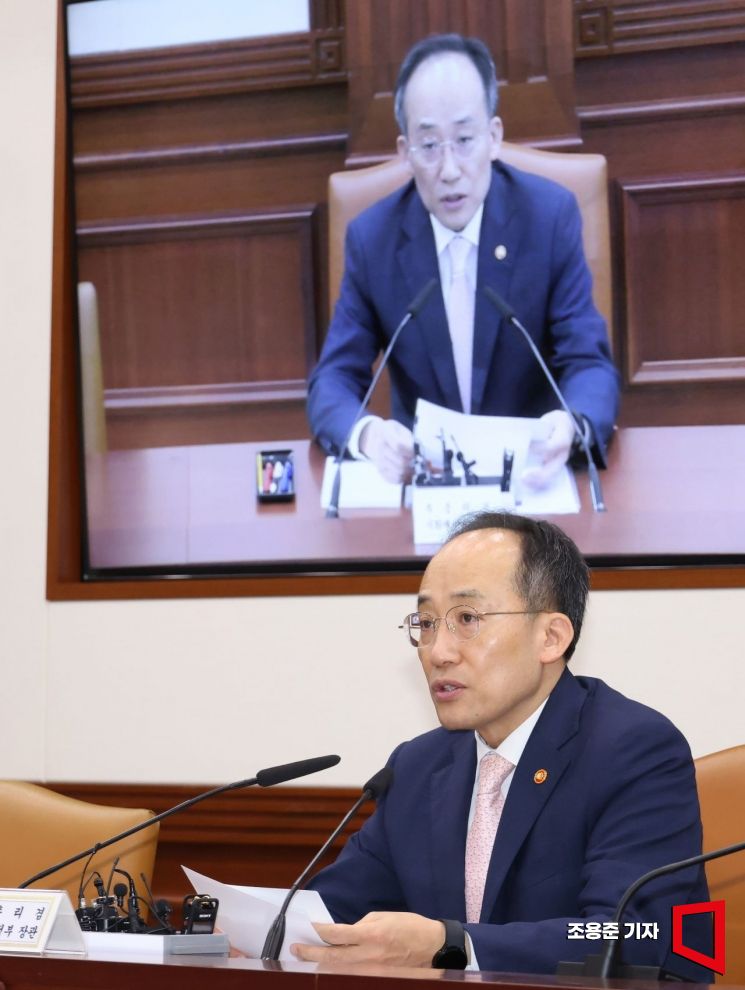 Deputy Prime Minister and Minister of Economy and Finance Choo Kyung-ho is delivering opening remarks at the 'Emergency Economic Ministers' Meeting' held on the 5th at the Government Seoul Office in Jongno-gu, Seoul. Photo by Jo Yong-jun jun21@
The government will enhance the competitiveness of advanced industries by easing excessive safety regulations that have been obstacles to industrial activities such as secondary batteries and semiconductors. Additionally, a regulatory sandbox will be introduced in the mobility sector to promote technological innovation in future transportation methods.
On the 5th, the government announced the "Corporate On-site Regulation Improvement Plan" at an emergency economic ministers' meeting chaired by Deputy Prime Minister and Minister of Economy and Finance Choo Kyung-ho. This regulatory improvement plan was prepared to reflect suggestions raised from various industry sites.
Deputy Prime Minister Choo stated, "Following support for the swift execution of approximately 15.8 trillion won in corporate investments through the operation of the Economic Regulation Innovation Task Force, we have now prepared measures to resolve regulations and difficulties in industrial sites to actively support innovation in advanced industries such as semiconductors and mobility."
First, regulations will be improved to strengthen the competitiveness of advanced strategic industries such as semiconductors and secondary batteries. In particular, new safety standards specialized for hazardous material handling facilities in secondary battery manufacturing processes will be established. Under current law, secondary battery manufacturing plants handling hazardous materials are subject to the "general safety standards" applicable to general handling facilities. It has been assessed that excessive safety standards beyond necessity have caused undue costs. By establishing special standards considering the unique characteristics of secondary battery processes, types of glass currently prohibited from installation will be allowed if they are fire-resistant glass, etc. If leak prevention measures for hazardous materials are implemented, slopes will no longer be required.
The government will also classify semiconductor scrubbers, which are harmful gas purification facilities, as reaction facilities that do not require mandatory thermometers, thereby reducing the burden on companies to install thermometers. The permit and reporting procedures for air pollutant emission facilities will be simplified from frequent reporting to once annually at year-end. Exceptions will be recognized for the obligation to separately subcontract national advanced technology-related fire protection works. Currently, fire protection facility works must be ordered separately from other types of construction. Regarding fields such as environment and chemical substances, criteria will be established to exempt registration if recycled chemical substances are identical to already registered chemicals, reducing registration cost burdens.
To respond to rapidly changing transportation environments, a regulatory sandbox specialized for the mobility sector will be newly established. Deputy Prime Minister Choo said, "Starting from the 19th of this month, we plan to implement a regulatory sandbox system specialized for the mobility sector so that new technologies such as late-night autonomous buses and automatic parking robots can be utilized more quickly in people's lives. We will also promptly promote demonstration projects and establish installation standards for wireless electric vehicle charging facilities to enable convenient electric vehicle charging at nearby gas stations."
A regulatory sandbox is a system that temporarily suspends or exempts existing regulations for a certain period when new products or services are launched. The mobility regulatory sandbox covers ▲means such as bicycles, automobiles, and trains ▲facilities such as roads, railways, airports, ports, and terminals ▲services that move people or goods using mobility means and infrastructure. Examples of demonstration exemption projects include ▲autonomous late-night shuttles and taxis ▲shared platforms for parking robots in apartment complexes.
Kim Jin-myung, Director of Policy Coordination at the Ministry of Economy and Finance, explained, "With the introduction of this regulatory sandbox, demonstration exemption projects will become possible in the mobility sector, including autonomous late-night shuttles and taxis, parking robots, amphibious passenger services, and autonomous cleaning vehicles."
© The Asia Business Daily(www.asiae.co.kr). All rights reserved.
![Clutching a Stolen Dior Bag, Saying "I Hate Being Poor but Real"... The Grotesque Con of a "Human Knockoff" [Slate]](https://cwcontent.asiae.co.kr/asiaresize/183/2026021902243444107_1771435474.jpg)
















