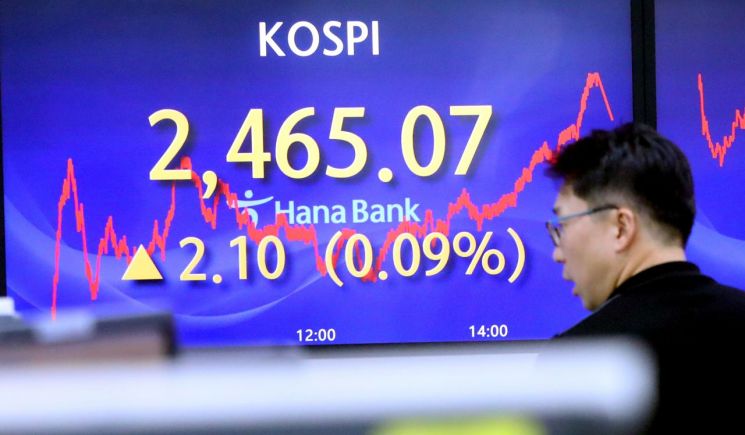
Market attention is focused on the direction of the stock market following the Chuseok holiday. Just before the holiday, the KOSPI closed slightly higher after five trading days, and the KOSDAQ, which rebounded after nine trading days, recovered the 840 level before entering the holiday. Major economic indicators released during the holiday are expected to be reflected in the stock market after the opening on the 4th, and the postponed concerns over a U.S. government shutdown are also likely to affect investor sentiment, which had been cautious ahead of the holiday.
During the holiday period, the New York stock market showed mixed trends and remained in a box range, but experienced a sharp decline at the end due to a surge in Treasury yields. On the 3rd (local time) at the New York Stock Exchange (NYSE), the Dow Jones Industrial Average fell 1.29%, the S&P 500 dropped 1.37%, and the Nasdaq declined 1.87% compared to the previous session. Notably, the Nasdaq, which had risen for four consecutive days during the holiday, reversed to a downward trend due to rising interest rates, giving back all the gains made over the four days. The U.S. 10-year Treasury yield, which serves as a benchmark for global bond yields, surpassed 4.8% that day, hitting its highest level since 2007. The 30-year yield stood at 4.93%, approaching 5%, while the 2-year yield, sensitive to monetary policy, rose to around 5.15%.
Researcher Ahn Young-jin of SK Securities analyzed, "The first thing our financial market must do upon returning from a long holiday is to withstand the weight of interest rates. The U.S. 10-year Treasury yield touched 4.8%, Japan's 10-year yield continues its upward trend to 0.77%, and the dollar is also rising relentlessly, which is burdensome."
The U.S. federal government's shutdown issue, which was considered a concern for the stock market, has been temporarily resolved. On the 30th, the deadline for the U.S. federal government's budget processing for the next fiscal year, the Senate passed a temporary budget bill for 45 days following the House of Representatives. The temporary budget bill freezes the federal government budget until November 17. With the shutdown risk postponed for 45 days, the market, which had been worried about a shutdown, is expected to show relief.
During the domestic stock market's holiday break, major economic indicators from the U.S. and China were released. The U.S. Personal Consumption Expenditures (PCE) price index for August, released on the 29th, rose 0.4% month-on-month, marking the largest increase in seven months. This was influenced by rising gasoline prices due to high oil prices. However, the core PCE price index, which excludes volatile energy and food prices, increased by only 0.1% month-on-month, falling short of the market expectation of 0.2%. Kim Jung-yoon, a researcher at Daishin Securities, said, "As confirmed by the market reaction after the recent Consumer Price Index (CPI) release, more emphasis is expected to be placed on the continued slowdown in core PCE inflation rather than the PCE inflation itself," adding, "If the PCE inflation comes out within the expected range, there will be no special shock to the market."
The U.S. Institute for Supply Management (ISM) Manufacturing Purchasing Managers' Index (PMI) for September, released on the 2nd, stood at 49.0, surpassing both the market forecast of 48 and the previous month's 47.6. Although the contraction phase has continued for 11 consecutive months since November last year with the index below 50, the figure exceeded market expectations, showing signs of improvement.
China's Caixin Manufacturing PMI for September was 50.6, down 0.4 points from 51.0 in the previous month.
Although the stock market may experience increased volatility in the short term after the holiday, it is expected to gradually regain price resilience. Han Ji-young, a researcher at Kiwoom Securities, said, "The domestic stock market, which opens on the 4th immediately after the holiday, will reflect external events that occurred during the holiday all at once in the early trading hours, leading to increased short-term price volatility," adding, "However, as time passes, the market will digest these events and focus on fundamentals such as the upcoming employment data and Samsung Electronics' preliminary earnings next week, thereby recovering price resilience."
There are also opinions that the mood of the stock market in October could differ from that in September. Kang Jae-hyun, a researcher at SK Securities, said, "Recently, the frequency of U.S. economic indicators falling short of market expectations has been increasing, raising the likelihood of a halt to the recent surge in long-term interest rates, and the shutdown issue is also likely to be resolved in some way," adding, "If these factors that have been dragging down the stock market recently enter a lull, the stock market atmosphere in October could unfold differently from that in September."
© The Asia Business Daily(www.asiae.co.kr). All rights reserved.

















