South Korea Tops OECD in Elderly Poverty and Suicide Rates
Basic Pension and Basic Security Benefits Alleviate Depression
National Pension and Child Support Negatively Impact Depressive Symptoms
With the elderly poverty rate and suicide rate ranking first among the Organization for Economic Cooperation and Development (OECD) countries, highlighting the severity of elderly issues, a study has found that public transfer income, a form of government financial support, reduces depression among the elderly.
However, unlike basic pensions or basic security benefits, the effect of the National Pension was not confirmed among public transfer incomes. Among private transfer incomes, support from private insurance and family (parents and children) was found to have a negative impact on depression.
According to the paper titled "An Exploratory Study on the Moderating Role of Transfer Income in the Effect of Multidimensional Elderly Poverty on Depression" (Catholic University, Song Chi-ho), presented at the "2023 Korea Welfare Panel Academic Conference" on the 2nd, the effects of public transfer incomes?National Pension, Basic Pension, Basic Security Benefit?and private transfer incomes?private insurance benefits and family support?on depression caused by poverty were examined. The results showed that the Basic Pension and Basic Security Benefit alleviated the impact of poverty on depression, and this moderating effect was greater among elderly individuals at risk of poverty than those without poverty risk.
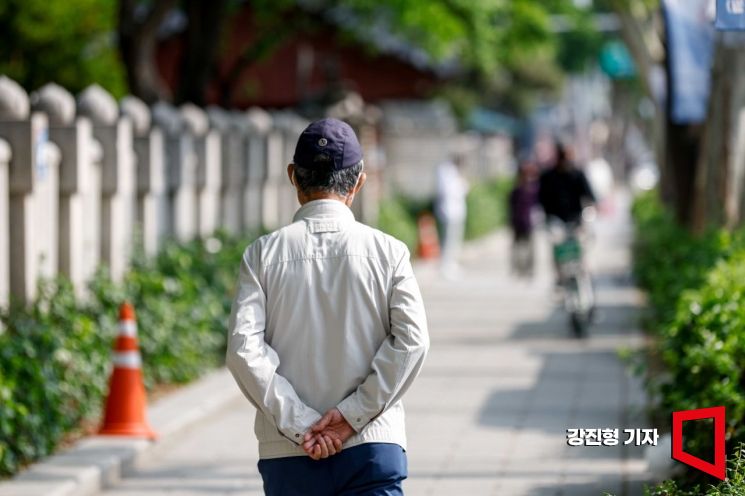 On the 30th, elderly people are walking on the streets near Tapgol Park in Jongno-gu, Seoul. Photo by Jin-Hyung Kang aymsdream@
The study constructed variables related to elderly multidimensional poverty, depression, and transfer income based on three years of data from the 15th to 17th waves (2019?2021) of the Korea Welfare Panel. Examining the correlation between poverty in four dimensions?income, housing, medical care, education?and depression among 3,636 elderly respondents aged 65 and older who participated in the panel survey over three years, it was confirmed that poverty had a positive (+) effect on depression. In other words, those experiencing poverty showed higher levels of depression.
The researchers defined poverty as follows: income poverty if household disposable income was less than 50% of the median; housing poverty if housing costs exceeded 30% of household income or if the housing area did not meet minimum standards based on household size; medical poverty if medical expenses exceeded 40% of household income; and educational poverty if the individual had less than a high school education. Depression was measured using the 'CES-D,' consisting of 11 items.
When examining the influence of public and private transfer incomes on the transition from poverty to depression, the study found that only the Basic Pension and Basic Security Benefit among public transfer incomes alleviated the degree of depression. Those receiving either the Basic Pension or Basic Security Benefit showed lower levels of depression compared to non-recipients, regardless of poverty risk. The Basic Pension and Basic Security Benefit are representative cash benefits provided by the government.
On the other hand, the National Pension recipients exhibited higher levels of depression than non-recipients, regardless of poverty status. This was analyzed as being due to insufficient benefit levels, which failed to reduce depression.
Private insurance benefits and family support also did not show effects in reducing depression caused by poverty. Depression levels were actually higher among those receiving family support compared to those without support, regardless of poverty risk. The paper analyzed that "private transfers from family may act as economic stressors, implying that even if they somewhat help improve living standards economically, they may have negative effects mentally."
The paper emphasized that "economic insecurity in old age is a social-level issue that is difficult to resolve through individual-level approaches," and stressed the need to "develop and implement policies to reduce Korea's extreme elderly poverty, which is embarrassingly high compared to other advanced welfare countries."
© The Asia Business Daily(www.asiae.co.kr). All rights reserved.
![Clutching a Stolen Dior Bag, Saying "I Hate Being Poor but Real"... The Grotesque Con of a "Human Knockoff" [Slate]](https://cwcontent.asiae.co.kr/asiaresize/183/2026021902243444107_1771435474.jpg)
















