Lake Tepe Water Temperature Rises to 39 Degrees
Over 100 endangered Amazon river dolphins have died in a mass mortality event in the Brazilian Amazon.
According to foreign media including the British daily The Guardian on the 29th of last month (local time), the Brazilian social organization Mamirau? Institute for Sustainable Development (IDSM) recently discovered the carcasses of over 100 river dolphins in Lake Tepe in the Amazon.
Known as 'Boto' or 'Pink Dolphin,' the Amazon river dolphin is the largest species among river dolphins, measuring 2 to 2.5 meters in length and weighing between 85 and 185 kilograms. The International Union for Conservation of Nature (IUCN) classifies the Amazon river dolphin as an endangered species.
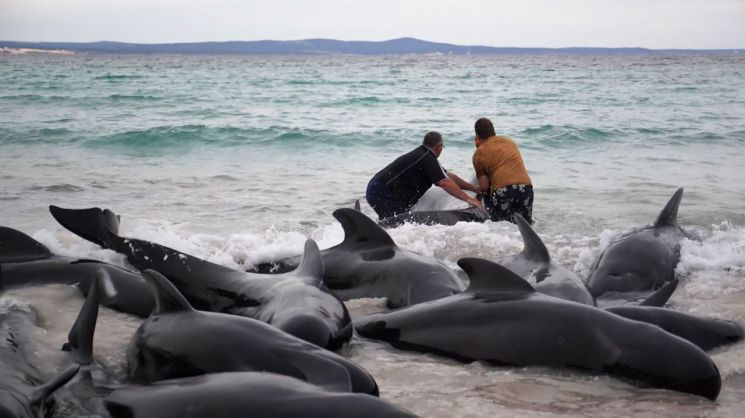 Citizens are rescuing a pod of dolphins stranded on Chains Beach in southwestern Australia on July 26 (local time).
 [Image source=Yonhap News]
Experts believe the cause of the mass mortality is related to extreme climate phenomena such as heatwaves and drought. IDSM researcher Ayang Playcesimang said, "As of 6 p.m. on the 28th of last month, the water temperature of Lake Tepe exceeded 39 degrees Celsius, making it extremely hot."
Daniel Trezego, a British researcher residing in Amazonas state, said, "For the past month, Tepe has looked like a climate change scenario from science fiction (SF)," adding, "It is sad to learn of the death of one dolphin, but having to see over 100 carcasses due to drought is a tragedy."
In particular, the depth of the Amazon River has rapidly decreased by 30 cm per day over the past two weeks due to drought accompanied by the El Ni?o phenomenon. The average water level in the Manaus area at this time of year usually falls 4.4 meters below the rainy season level, but this year the difference reached 7.4 meters.
Miraana Passhoalini Frias, a researcher at the World Wide Fund for Nature (WWF), said, "Amazon river dolphins have been exposed to many stresses such as hydroelectric power plants, mercury pollution, and conflicts with humans," adding, "Now they are being affected more directly by the consequences of climate change."
© The Asia Business Daily(www.asiae.co.kr). All rights reserved.

















