Based on Grade 9, Step 1 for General Positions: 1,062,480 KRW
60% of the current monthly salary paid twice annually
Around the Chuseok holiday this year, civil servants at grade 6 and below will receive at least 1.06 million KRW in holiday allowance.
According to the Ministry of Personnel Management on the 29th, all civil servants receive holiday allowance around the day of Chuseok. Each agency head pays 60% of the current monthly salary within 15 days before or after the Chuseok holiday, which is the payment reference date.
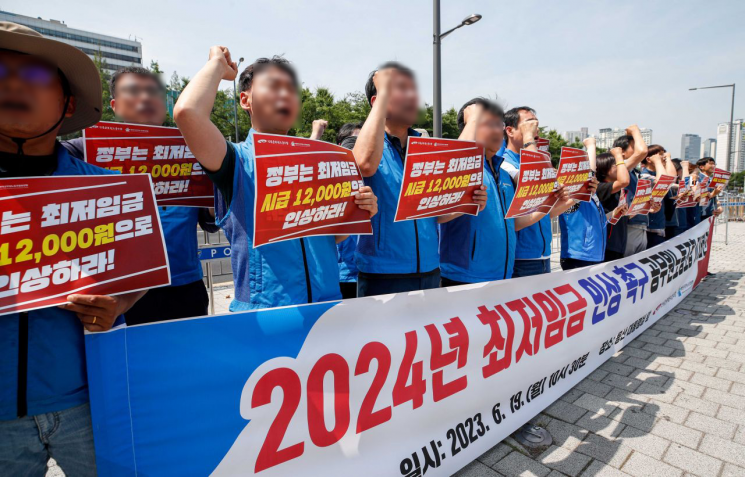 Near the Presidential Office in Yongsan-gu, Seoul, members of the National Public Officials Labor Union and the Federation of Korean Public Officials Labor Unions are shouting slogans demanding a minimum wage increase at the "2024 Minimum Wage Increase Urging Press Conference."
Based on a general grade 9, step 1 civil servant who receives 1,770,800 KRW this year, the pre-tax holiday allowance amounts to 1,062,480 KRW. This is about 50,000 KRW more than last year and is paid twice annually. Mandatory police officers, police university students, cadets and candidates, and police officer candidates are excluded.
Since 2017, the performance-based pay system has been introduced for all grade 5 civil servants, and holiday allowance is included in the annual salary, so no separate holiday allowance is paid. According to the guidelines on civil servant compensation, the base salary includes salary, longevity allowance, longevity bonus, and holiday allowance. The holiday allowance is calculated at 120%, covering both Lunar New Year and Chuseok holidays.
The two holiday allowances constitute a significant portion of civil servant compensation. The Ministry of Personnel Management estimates that when converted to a monthly amount, grade 9 receives an effect of 180,000 KRW and grade 7 receives 200,000 KRW from the two holiday allowances. Adding position allowance (175,000 KRW), fixed meal allowance (140,000 KRW), and overtime pay (96,200 KRW), a grade 9, step 1 civil servant effectively receives 2.36 million KRW per month.
However, civil servants themselves feel uncomfortable with this interpretation. After deducting pension contributions of 160,000 KRW, which is 9% of the salary, as well as income tax, local tax, health insurance premiums, and various membership fees totaling about 300,000 KRW, the actual take-home pay for the remaining 10 months, excluding the two months with holiday allowance, is only about 1.9 million KRW. This amount is far below this year’s minimum wage monthly equivalent of 2,010,580 KRW, which explains the ongoing dissatisfaction among civil servants.
The government has decided to raise civil servant salaries next year by 2.5%, the same rate as the minimum wage increase, regardless of rank. Accordingly, the base salary for a general grade 9, step 1 civil servant next year will be 1,815,070 KRW. Although this is the largest increase since 2020’s 2.8%, it falls short of civil servants’ expectations. This year, the union demanded a final increase of 4.2% (377,000 KRW) reflecting inflation and other realities.
This year, the total number of applicants for the national grade 9 civil service exam was 121,526, with a competition ratio of 22.8 to 1, marking the lowest level in 31 years. If the treatment of lower-level civil servants does not improve, the preference for civil service among young people is expected to continue declining.
© The Asia Business Daily(www.asiae.co.kr). All rights reserved.

















