Bank Sector Mortgage Fixed-Rate Share Maintains at 70% Range
Impact of Authorities' Recommendation to Expand Fixed Rates
As high interest rates persist for a long time, the 'fixed interest rate trend' is solidifying in bank mortgage loans. With the possibility of further rate hikes in the second half of the year, the proportion of fixed interest rates is expected to continue increasing.
According to the Bank of Korea on the 28th, the proportion of fixed interest rates in newly issued bank mortgage loans in August was 76.5%. This marks a continuous rise for two months, increasing from 73.1% in June to 73.7% in July. The fixed interest rate proportion, which was only 54.2% in August last year, surpassed 70% in December of the same year and has remained in the 70% range since peaking at 80.7% in April this year.
The upward trend in fixed interest rates is due to the ongoing rate hike trend from the end of last year to recently. Generally, when there is a possibility of interest rates rising, preference for fixed interest rates is higher than for variable rates. Although fixed rates may initially be higher than variable rates, the rate remains unchanged for five years even if rates increase afterward. The relatively low fixed interest rate proportion in the second half of last year was due to expectations that the rate hike trend would soon end.
The financial authorities' raising of fixed interest rate targets to reduce interest rate fluctuation risks has also had an impact. This year, the special Bogeumjari Loan, a fixed-rate policy loan, was popular, and the 'Stress Debt Service Ratio (DSR) system' was introduced, which applies a certain level of additional interest rate to variable rate loans to reduce loan limits. Furthermore, banks have lowered fixed mortgage loan rates in preparation for a market rate decline, encouraging borrowers to choose fixed rates. The interest rate gap between variable and fixed mortgage loans widened from 0.23 percentage points in July to 0.25 percentage points in August.
Seo Jeong-seok, head of the Financial Statistics Team at the Bank of Korea's Economic Statistics Bureau, explained, "The increase in fixed interest rate proportion is due to strengthened expectations of rate hikes and the widening interest rate gap in mortgage loans."
In the banking sector, it is expected that the increase in fixed-rate loans will continue for the time being, in line with the prolonged high interest rates and government policy stance. Although expectations for a base rate cut have risen this year due to a global slowdown in inflation, the U.S. consumer price index has remained higher than the initial target, making rate cuts difficult.
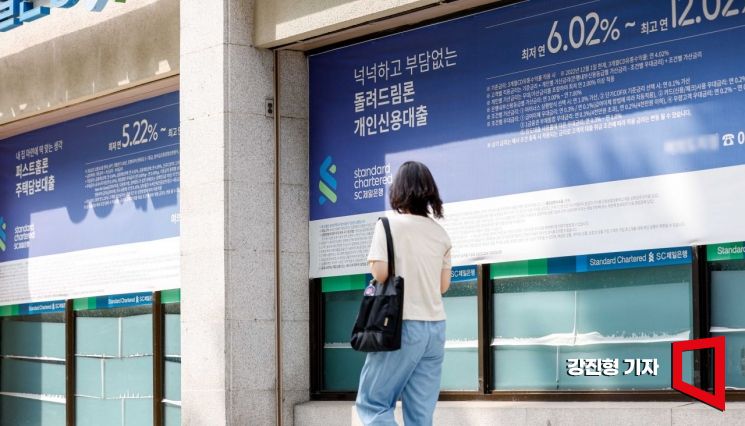 As the average loan interest rate in the banking sector has been rising for two consecutive months, a banner displaying mortgage loan and personal credit loan interest rates is hung on the exterior wall of a commercial bank in Seoul on the 31st. Photo by Jinhyung Kang aymsdream@
© The Asia Business Daily(www.asiae.co.kr). All rights reserved.

















