Fair Trade Commission imposes fine on Kakao Entertainment
Issue with 'secondary derivative work rights' in contest
Revenue sharing issue is a different matter from 'Geomeun Goshin'
The domestic content industry is paying close attention to the Fair Trade Commission's fine imposed on Kakao Entertainment. This is because the Fair Trade Commission judged the secondary derivative work creation rights contracts signed with writers who won contests to be unfair contracts. The industry, which is fiercely competing to secure intellectual property (IP), expressed its bewilderment.
‘Geomeongomusin’ and a Different ‘Rights Infringement’ Issue
On the 24th, the Fair Trade Commission imposed a corrective order and a fine of 540 million KRW on Kakao Entertainment. The reason was that Kakao Entertainment had signed unfair contracts restricting the secondary derivative work creation rights of contest-winning writers. This case is the first instance where the Fair Trade Commission has sanctioned unfair practices related to contest copyrights.
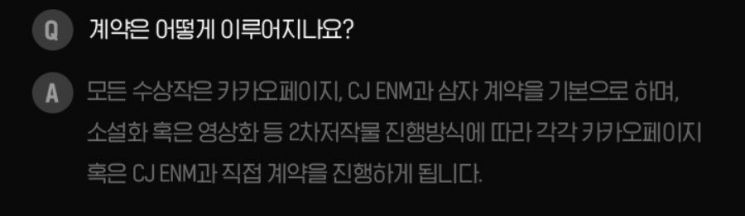
The issue began when Kakao Entertainment included the condition in the 2018?2020 web novel contest announcements that "the secondary derivative work creation rights for award-winning works belong to KakaoPage." Secondary derivative work creation rights refer to the rights to create and use original works by translating, arranging, modifying, adapting, producing videos, or other methods based on the original work. Typical examples include creating webtoons, movies, and dramas from web novels.
This case differs somewhat in nature from the ‘Geomeongomusin’ issue. In the ‘Geomeongomusin’ case, the representative of a character company, not the original author, was listed as a co-author of nine major characters in the comic and abused this to cause an imbalanced profit distribution during secondary business processes. However, in the Kakao Entertainment contest-winning web novels, the secondary business profits went to the original authors, so there was no issue with profit distribution.
Despite no problems with profit distribution, the Fair Trade Commission focused on ‘rights infringement.’ It viewed that since Kakao Entertainment held the secondary derivative work creation rights for the winning works, the authors could not freely decide on drama or movie adaptations of their own works in the future. Furthermore, although other production companies might have opportunities to create secondary derivative works under better conditions, Kakao Entertainment could block these opportunities, making the contract unfair.

Desperate to Secure IP... Industry in a Dilemma
The content industry is expressing difficulty with the Fair Trade Commission's recent decision. Contests are intended to discover excellent works. However, behind this is also the purpose of securing outstanding works to expand into various businesses.
The original work of JTBC's drama ‘The Youngest Son of a Chaebol Family,’ which recorded a 26.94% viewership rating last year, is a web novel from Munpia. Also, the globally successful Netflix drama ‘All of Us Are Dead’ is based on a webtoon from Naver Webtoon. As cases of secondary creations of popular originals becoming huge hits continue, the content production industry is fiercely competing to secure IP. Contests are a representative means.
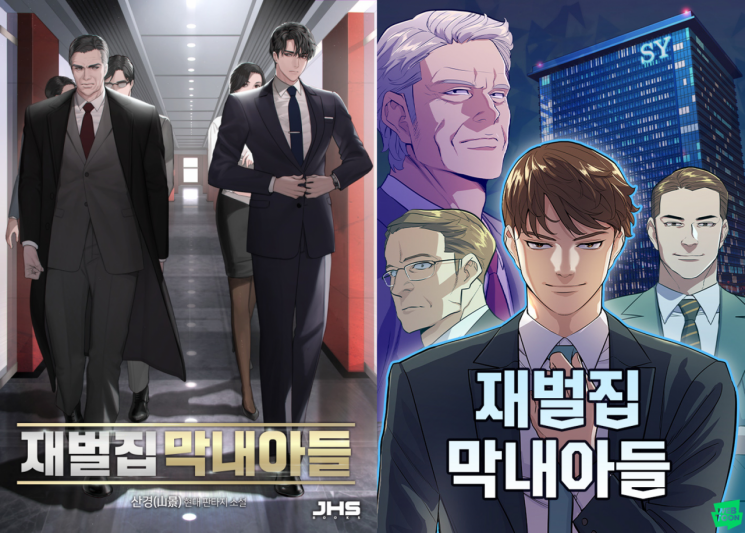 The webtoon version of 'The Youngest Son of a Conglomerate Family,' which gained great popularity as a drama.
In the case of the Kakao Entertainment contest in question, although the condition "the secondary derivative work creation rights for award-winning works belong to KakaoPage" was attached, it is known that the winning works were later adjusted regarding secondary derivative work creation rights through separate contracts. During this process, there were cases where contracts were not signed with Kakao Entertainment or were terminated after signing.
The industry ultimately interprets this as a signal that the Fair Trade Commission intends to scrutinize each contract between contest organizers and winning writers. The content industry explains that this could inevitably shrink the related ecosystem. There is also a counterargument that, given the structure where contest organizers inevitably hold superior positions, it would have been difficult for writers not to sign contracts containing the terms demanded by the organizers.
Seo Beom-gang, chairman of the Webtoon Industry Association, said, "Both contest organizers and participants inevitably have expectations for opportunities and benefits gained through contests, so the Fair Trade Commission needs to consider this comprehensively," adding, "This issue should not lead to a reduction in opportunities."
Meanwhile, Kakao Entertainment has announced plans to file an administrative lawsuit against the Fair Trade Commission's decision. It is expected that in court, Kakao Entertainment will dispute whether what it effectively acquired through the secondary derivative work creation rights contracts was the creation rights themselves or exclusive usage licenses. If Kakao Entertainment acquired the creation rights themselves through individual contracts, whether there was pressure due to superior bargaining position during this process will also be a point of contention.
© The Asia Business Daily(www.asiae.co.kr). All rights reserved.
![Clutching a Stolen Dior Bag, Saying "I Hate Being Poor but Real"... The Grotesque Con of a "Human Knockoff" [Slate]](https://cwcontent.asiae.co.kr/asiaresize/183/2026021902243444107_1771435474.jpg)


















