Failure to Pass Four Laws to Restore Teacher Authority, Protective Childbirth System, and Mugshot Law
Nomination Consent for Supreme Court Chief Justice Candidate Lee Gyun-yong Stalled
Prolonged Vacancy of Judiciary Head Expected to Last Over a Month
With the arrest warrant for Lee Jae-myung, leader of the Democratic Party of Korea, being dismissed, attention is focused on whether this year's regular National Assembly session will normalize. Since the approval of the arrest consent bill for Lee last month, the leadership vacuum in the Democratic Party has caused the plenary session and standing committees to repeatedly halt, delaying the appointment consent bill for Supreme Court nominee Lee Yong-gyun and the processing of livelihood bills aimed to be handled before Chuseok.
According to the National Assembly on the 30th, the ruling and opposition parties have agreed to hold a plenary session on the 6th of next month to process the appointment consent bill for the nominee. Hong Ik-pyo, the new floor leader of the Democratic Party, told reporters after a meeting of floor leaders chaired by Speaker Kim Jin-pyo on the 27th that he had tentatively agreed on this with Yoon Jae-ok, floor leader of the People Power Party. Since the next plenary session originally scheduled for November 9 raised concerns that the Supreme Court vacancy would be prolonged for over a month, it is interpreted that the plenary session schedule was promptly added.
Floor leader Hong Ik-pyo said, "The ruling and opposition parties share the recognition that the judicial vacancy should no longer continue," adding, "We plan to further discuss the bills and other pending issues that could not be processed inevitably on the 21st."
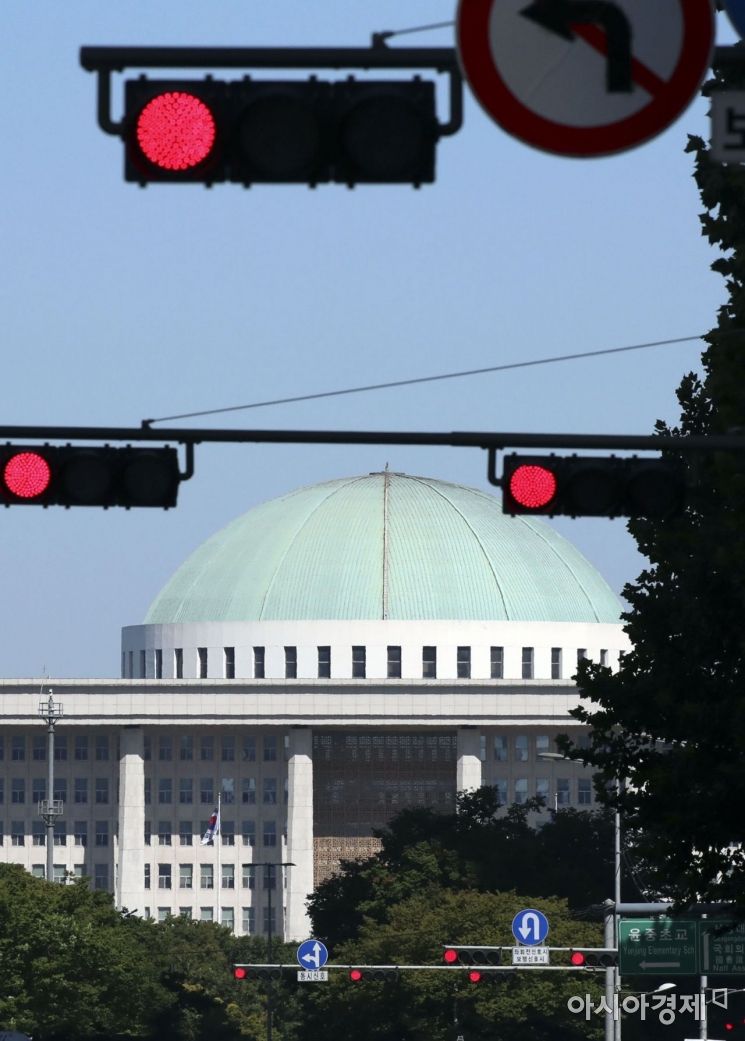 On the 2nd, as the prosecution notified Lee Jae-myung, leader of the Democratic Party of Korea, to appear on charges of making false statements regarding the 'Baekhyeon-dong suspicion' case, the political climate rapidly cooled, and all traffic lights in front of the National Assembly building showed red. Photo by Yoon Dong-joo doso7@
Earlier, after the arrest consent bill for Lee was approved at the National Assembly plenary session on the 21st, the Democratic Party ended the session early citing a party meeting. Although 98 agenda items were scheduled to be processed that day, the session was interrupted, indefinitely postponing the processing of the remaining 90 bills.
The livelihood bills that were not processed at the time included the four bills to restore teachers' rights, which have emerged as socially significant, as well as the Special Adoption Act and the Mugshot Act. The Special Adoption Act allows pregnant women to give birth anonymously in hospitals without revealing their identity and hand over the child to local governments to address the issue of unregistered infants. The Mugshot Disclosure Act includes provisions to publicly disclose the faces of suspects of serious crimes, similar to foreign countries.
Additionally, the Simplification of Claims for Actual Loss Insurance Act, which allows hospitals to electronically send patients' medical records to insurance companies to reduce the hassle of patients having to obtain documents for insurance claims, and the Road Traffic Act mandating the installation of ignition interlock devices on vehicles habitually involved in drunk driving, were also left unprocessed.
The National Assembly plenary session scheduled for the 25th also did not take place. This was due to the absence of floor leadership after Park Kwang-on resigned on the 21st, causing the session to be canceled. On that day, the ruling and opposition parties were supposed to process the appointment consent bill for Supreme Court nominee Lee Gyun-yong, successor to former Chief Justice Kim Myung-soo who retired on the 24th, but the session was not held, making the Supreme Court vacancy a reality. The judicial leadership vacancy is the first in 30 years since Chief Justice Kim Deok-ju resigned amid real estate speculation controversy after disclosing his assets in 1993.
© The Asia Business Daily(www.asiae.co.kr). All rights reserved.

















