Government Conducts Multiple Feedback Reviews on 'Housing Supply Activation Measures'
Presidential Office Hopes to Unlock Private Housing Supply Held for Years
"Approach with Adjustments Rather Than Drastic Changes"... Aiming for a Predictable Market Environment
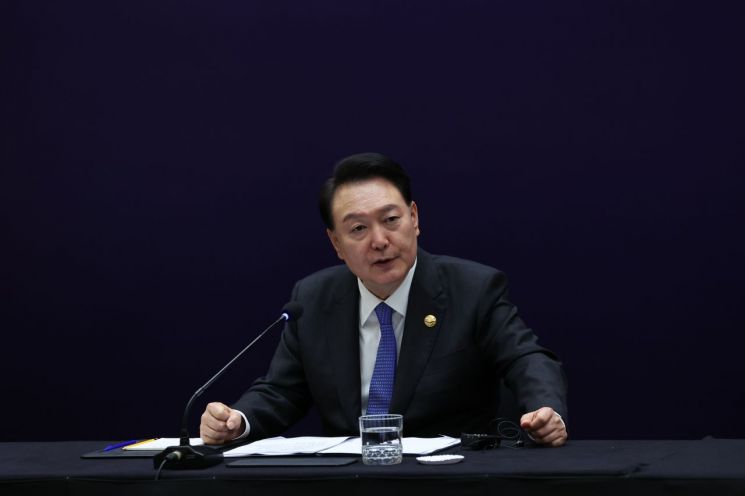
President Yoon Suk-yeol instructed to "thoroughly check to ensure there is no instability in housing supply" to stabilize housing for the common people. President Yoon, who had received multiple preliminary reports on the 'Housing Supply Activation Plan' announced by the government the day before (26th), also reviewed the draft measures and provided detailed feedback while attending the United Nations General Assembly in New York last week.
According to the Presidential Office on the 27th, President Yoon expressed expectations for the government's announced 'Housing Supply Activation Plan for National Housing Stability' but also urged attention to the implementation to address housing difficulties and supply instability for the common people. A Presidential Office official said, "From the early stages of establishing this plan, (President Yoon) received reports on each issue," adding, "At the time the final plan was prepared, he even checked the details directly from the U.S. to examine factors causing supply instability."
The reason President Yoon is focusing on 'housing supply' lies in the real estate failures of the previous Moon Jae-in administration. The focus on 'expanding regulations' to stabilize housing prices led to a contraction in both supply and demand, resulting in a surge in housing prices. Although the administration hastily sought new sites and announced supply measures toward the end of its term, considering the housing market cycle that takes several years from groundbreaking to occupancy, this too was a failure.
A bigger problem is that the repercussions of the previous administration's policy failures continue. In the first half of this year, housing permits totaled 189,213 units, a 27.2% decrease compared to the same period last year, and groundbreaking dropped by 50.9% to 92,490 units. This raises concerns about a supply shortage in 2 to 3 years.
The government's measures announced the day before emphasize 'effective supply' in the same context. The core is securing about 120,000 units in the public sector, including an additional 55,000 public housing units by the end of the year. To accelerate supply, a 'fast track' will be introduced to simplify various administrative procedures. The goal is to shorten the project period by 4 to 6 months or more by approving district plans and housing project plans simultaneously. Additionally, to activate private housing supply, restrictions on resale of public land will be temporarily lifted for one year. Furthermore, to facilitate smooth financing, the guarantee scale for project financing (PF) loans will be increased by 10 trillion won, from 15 trillion won to 25 trillion won.
The Presidential Office views the government's announcement as laying the foundation for rapid housing supply. It places great significance on unlocking the shackles on a total of about 530,000 units tied up in the market, including 330,000 units where private companies have obtained permits but have not started construction, and 200,000 units awaiting permits from local governments. A Presidential Office official added, "The urgent matter is the units tied up in the private sector, and resolving this to open the bottleneck was urgent."
Internally, there is high expectation for the increase in the guarantee ratio for interim payment loans for new housing occupants. The Korea Housing & Urban Guarantee Corporation raised the guarantee responsibility ratio for interim payment loans from 90% to 100%, enabling smooth access to interim payment loans and significantly reducing the burden on construction companies, financial institutions, and the common people. A government official explained, "The previous administration repeatedly lowered this ratio, causing banks to bear the risk, making loans difficult, and naturally increasing the interest burden on contract holders as a side effect."
The Presidential Office has indicated that future government real estate measures will proceed sequentially, focusing on 'adjustments' rather than drastic changes. Given the current National Assembly situation with a minority government, it is difficult to repeal regulatory laws, so the intention is to correct the previous administration's policies to fix side effects. Earlier this year, President Yoon also stated during a briefing from related ministries, "The government should manage housing prices to rise and fall predictably to some extent." This reflects the judgment that if the government approaches the market ideologically, the market will be distorted, and ultimately, housing will not be properly supplied due to regulations on both demand and supply.
© The Asia Business Daily(www.asiae.co.kr). All rights reserved.
![Clutching a Stolen Dior Bag, Saying "I Hate Being Poor but Real"... The Grotesque Con of a "Human Knockoff" [Slate]](https://cwcontent.asiae.co.kr/asiaresize/183/2026021902243444107_1771435474.jpg)











