- More than half of young single-person households live in guaranteed monthly rent one-room units such as multi-family, multi-unit, and officetels
- Top reason for housing choice (42.3%) is 'proximity to work'... Interest in 'Coliving Houses' with professional management know-how
As the housing environment for young single-person households is concentrated in studio-type units with monthly rent, ‘co-living houses’ managed by professional operators are gaining attention as a new housing alternative for young single-person households.
According to the ‘2022 Youth Life Survey’ released by Statistics Korea, the majority of young single-person households reside in studio-type units within multi-family and multi-unit houses, officetels, and similar accommodations. Young single-person households living in multi-family and multi-unit houses account for 44.2% of the total, while officetels account for 24.1%. When asked whether their current residence is a studio-type unit, 56.8% answered ‘yes,’ and 52.7% of all young single-person households were found to be living under monthly rent with a deposit.
Additionally, young single-person households show a strong tendency to choose residences located close to their workplaces or schools. According to Statistics Korea’s ‘2022 Reasons for Housing Choice of Youth Living Independently from Parents (Non-cohabiting),’ the largest share, 42.3%, chose their residence because it was ‘a convenient location for commuting to work or school.’ The second most common reason was ‘affordable housing costs (25.9%).’
In this context, recently, ‘co-living houses’ located within major business districts not only offer proximity to workplaces but also provide various community facilities, resulting in high resident satisfaction and absorbing the housing demand of young single-person households.
In fact, ‘co-living houses’ have expanded as a new housing form since the Ministry of Land, Infrastructure and Transport amended the related Building Act in February this year to introduce the ‘rental dormitory’ designation, enabling large-scale supply that can provide various services affordably through economies of scale.
Especially, ‘co-living houses’ managed by professional operators and brands are more popular because they have lower monthly rent burdens than traditional studios or officetels, are safe in terms of security management, and offer diverse community facilities.
Existing co-living operators such as Share House Wooju’s ‘Cellip,’ SK D&D’s ‘Episode,’ MGRV’s ‘Mangrove,’ and Homes Company’s ‘Homes Studio,’ as well as specialized co-living house brands like ‘Heyy,’ jointly established by Yanolja Cloud and KT Estate, are emerging one after another.
‘Cellip,’ a representative ‘co-living house’ brand, operates ‘Cellip Gadi,’ a co-living house in Gasan Mobius Tower that began full-scale operation last August. Cellip has opened and operates the largest number of share houses in Korea, with a cumulative total of 1,980 beds and 10,596 residents. With its abundant know-how, it is a specialized co-living house brand with high resident satisfaction in terms of management.
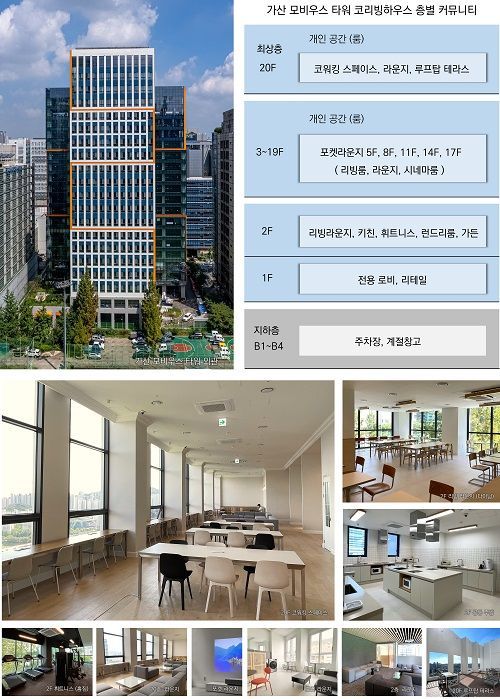
‘Cellip Gadi’ in Gasan Mobius Tower is a 20-story building with a total of 386 private rooms and various community facilities. It is located in G-Valley, the largest industrial complex in the southwestern part of Seoul, home to about 12,000 companies and 140,000 workers, and boasts proximity to work with an 8-10 minute walk to Gasan Digital Complex Station on subway lines 1 and 7.
By synthesizing various global co-living house cases and domestic trends, they devised a ‘compact private room, abundant community facilities, and professional operator service’ three-solution model called the ‘urban lifestyle center-type co-living house.’ It also reflects the ‘WE DO, All in Vill, All in Room’ trends from the ‘7 Space Trends’ announced by Fides Development, highlighting practical space planning.
Private spaces vary in size from 10.6 to 28.33 square meters. Most private spaces are designed with ceilings expanded to over 3 meters (3.7 to 3.1 meters) to enhance creativity. Lofts are applied in duplex rooms, and combined with service balcony areas, the actual usable space can be about 1.5 to 2 times the exclusive area.
The full-furnished system is also noteworthy. Built-in wardrobes and storage cabinets, kitchens equipped with sinks, system air conditioners, refrigerators, washing machines, and portable hobs are provided as standard. Additional daily necessities can be accessed through various services offered by the professional operator according to residents’ needs.
Community activity spaces are located on pleasant, well-viewed ground floors, which is a major advantage. They are arranged diversely and three-dimensionally across several floors by purpose, providing facilities and professional management services on a different level.
The second floor houses active community spaces. It offers a comfortable dining area with a spacious kitchen equipped with premium appliances and dining tables of various sizes. The laundry room is equipped with large washers and dryers, making it easy to handle bulky laundry. The fitness room (home gym) with rooftop garden views and an outdoor garden for fresh air are community facilities that enhance lifestyle.
The top floor, the 20th floor, features a sky lounge and co-working space where residents can use seats for telecommuting, meetings, reading, and more, ranging from single seats to 2-3 person seats and large conference rooms. The outdoor rooftop terrace offers views of Anyangcheon, allowing gatherings or relaxation.
From the 5th to the 17th floors, pocket lounges are installed every three floors in five locations, enabling residents on nearby floors to use them easily. These include reception rooms and lounges that can be used like living rooms for inviting friends, as well as home cinemas for immersive viewing on large screens.
The basement floor includes parking and seasonal storage that residents can use as needed. Residents can conveniently and affordably use all community spaces within the building without having to go outside from their private spaces.
Compared to complexes without such diverse community facilities, residents can enjoy a lifestyle on a different level. In terms of cost, it is much cheaper and more convenient to use these facilities anytime compared to separately paying for shared offices or shared kitchens.
An industry insider said, “Co-living houses are understood not just as shared residences but as communities where people can interact with each other, and demand among young people in their 20s and 30s is steadily increasing. Since management fees and other housing-related costs are shared, it is effective in saving living expenses.”
© The Asia Business Daily(www.asiae.co.kr). All rights reserved.
![Clutching a Stolen Dior Bag, Saying "I Hate Being Poor but Real"... The Grotesque Con of a "Human Knockoff" [Slate]](https://cwcontent.asiae.co.kr/asiaresize/183/2026021902243444107_1771435474.jpg)











