Visiting Bangsin Traditional Market in Gangseo-gu, Seoul
Merchants Concerned About Shrinking Traditional Market Locations
Delivery Service Limits... Consumer Usage Declines
"As more convenience facilities and supermarkets are established, traditional market merchants inevitably suffer a hit in sales. Looking at the long term, it feels bleak." (Song Young-guk, 33, male, working at a butcher shop in Bangsin Traditional Market, Gangseo-gu, Seoul)
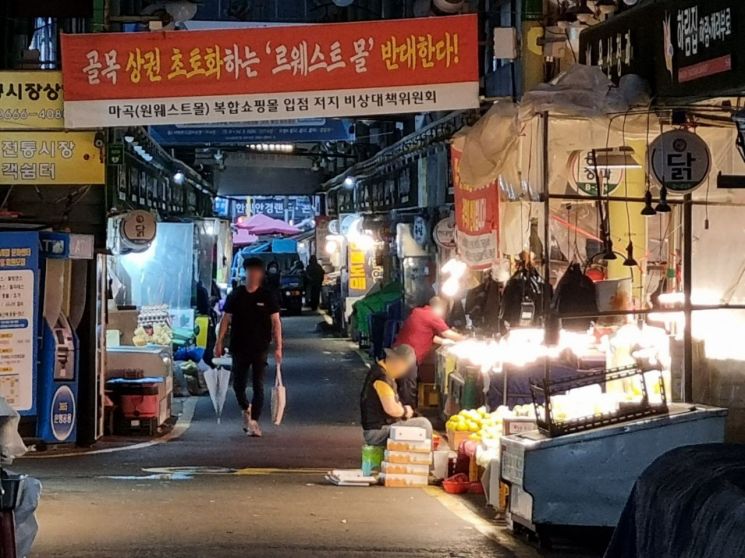 At 7:33 a.m. on the 26th, Bangsin Traditional Market in Gangseo-gu, Seoul was visited. A fruit shop merchant is placing fruits on the stand.
 Photo by Hwang Seoyul chestnut@
At 7:30 a.m. on the 26th, the reporter visited Bangsin Traditional Market in Gangseo-gu, Seoul. Two days before the Chuseok holiday, merchants who arrived earlier than usual were busy filling their stalls. In a rice cake shop, a female merchant was carefully stacking freshly steamed rice cakes with sesame oil against a backdrop of white steam. The fruit and vegetable vendor was organizing fruits to the rhythm of trot music, and from the jeon (Korean pancake) shop came the sizzling sound of skewers being grilled. Baek Min-ho (61, male), who sells vegetables, also came out an hour earlier than usual and was unloading boxes of vegetables from the truck trunk in front of his store. Baek said, "I came out at 4 a.m. today," and smiled sheepishly, adding, "You have to come early to get good products from the agricultural wholesale market."
Although the merchants were filled with anticipation ahead of Chuseok, they also carried worries in their hearts. The position of traditional markets in the consumer market is gradually shrinking. Shinjin Market has been affected by Lotte Mart within a 1.2 km radius and by E-Mart, which ceased operations last year. Baek said, "With the arrival of large supermarkets, small business owners have also taken a big hit," adding, "Although it is gone now, the impact after E-Mart opened was significant." In addition to existing large supermarkets, three complex shopping malls and outlets are scheduled to open in Gangseo-gu.
The shrinking presence of traditional markets is a nationwide phenomenon, not limited to Shinjin Market. According to the Small Enterprise and Market Service, as of 2020, the number of traditional markets nationwide was 1,401, a decrease of 209 (13.0%) compared to 1,610 in 2006. The number of stores also dropped by 18,580 (8.2%), from 225,725 in 2006 to 207,145 in 2020.
Potential changes to the Distribution Industry Development Act are also a concern for merchants. The ruling party recently proposed an amendment to the Act allowing online delivery during nighttime and mandatory closure days when large supermarkets are restricted from operating. Im Han-beom (63, male), who works at a side dish shop, said, "We are already suffering a lot because of Coupang and online platforms," adding, "Large corporations are important, but small business owners have nowhere to rely on."
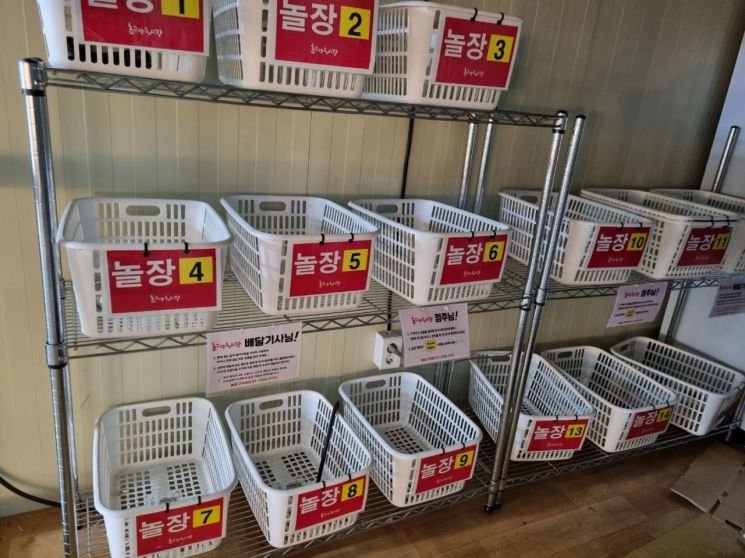 Bangsin Traditional Market has installed baskets for goods in a corner of the market to use the 'Come to the Market (Noljjang)' delivery service. Photo by Hwang Seoyul chestnut@
Although a delivery system for traditional markets has been introduced, it seems insufficient to revive them. Bangsin Market uses the traditional market delivery service called Nolleowayo Market (hereafter 'Noljang'). However, merchants here said that consumers rarely use the delivery service in practice. Cho Sang-hyun, chairman of the Bangsin Traditional Market Merchants Association, said, "Promotion is insufficient and there is no promotional staff, so cases of using the delivery service are rare," adding, "When delivery fees were subsidized, usage was somewhat higher, but after the support stopped, it decreased significantly." Baek said, "Prices go up because of delivery fees, so it's not easy," and added, "We tried free delivery on our own, but that was also a big burden."
Merchants said that alternatives are needed to revive traditional markets, which play a vital role as the capillaries of the national economy. Song said, "It would be good if the market developed its own characteristics with many food options, but even if merchants want to start such businesses, the risk seems too high for them." Im also said, "In this situation, small business owners have no choice but to work hard and succeed on their own," adding, "I hope the government will prepare long-term alternatives for traditional markets to survive."
Experts said changes such as emphasizing the unique characteristics of traditional markets or improving facilities are necessary. Professor Lee Eun-hee of Inha University’s Department of Consumer Studies said, "Even though online is the trend, there is still a desire for offline experiences, and in this regard, traditional markets have greater potential than large supermarkets to satisfy those desires," adding, "Traditional markets can easily add attractions or emotional value in addition to affordable goods." She continued, "The government should support not just one-off aid but also environmental improvements and renovations that add tradition and emotion."
Professor Hwang Jin-joo of Seoul National University’s Department of Consumer Studies said, "Nowadays, consumers seek convenience, so they visit traditional markets less often because it is difficult to receive services at the level of large supermarkets," adding, "Traditional markets need to take the initiative in improving their environment to meet consumer expectations, but unlike large corporations, they have financial limitations, so local governments should consider collaborating with or supporting traditional markets."
© The Asia Business Daily(www.asiae.co.kr). All rights reserved.
![Clutching a Stolen Dior Bag, Saying "I Hate Being Poor but Real"... The Grotesque Con of a "Human Knockoff" [Slate]](https://cwcontent.asiae.co.kr/asiaresize/183/2026021902243444107_1771435474.jpg)

















