Doosan Construction and WooMi Construction have gone head-to-head for the construction rights of the redevelopment project in Toegyewon 2 District, Namyangju City, Gyeonggi Province. Both companies are expected to engage in fierce bidding competition by offering benefits such as construction costs and relocation expenses.
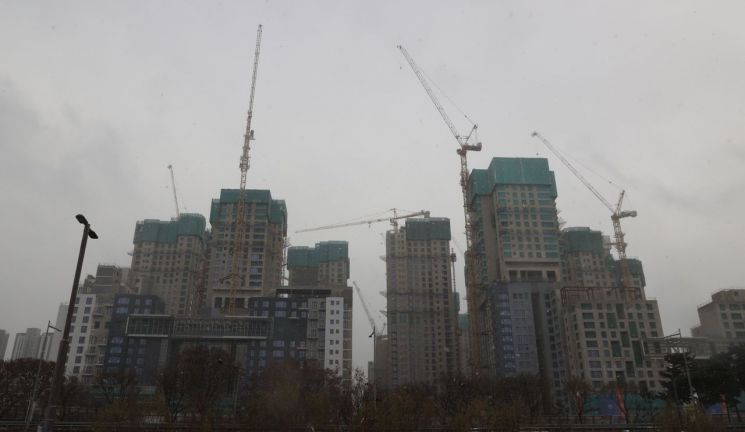
The Toegyewon 2 District Maintenance Project Committee closed the bidding for the selection of the constructor on the 18th, concluding with bids from Doosan Construction and WooMi Construction. The Toegyewon 2 District plans to hold the first joint briefing session on the 7th of next month, followed by the second joint briefing and the selection general meeting on the 14th.
The Namyangju Toegyewon 2 District redevelopment project covers an area of 19,383㎡ in Toegyewon-eup, Namyangju City. It involves constructing four apartment buildings with 405 households ranging from two basement floors to 27 floors above ground, along with auxiliary welfare facilities. The area is noted for its excellent transportation environment due to its proximity to Toegyewon Station on the Gyeongchun Line subway, and it is equipped with educational facilities such as Toegyewon Elementary School, Toegyewon Middle School, and Toegyewon High School.
Doosan Construction and WooMi Construction, having officially entered the bidding competition, proposed exceptional bidding conditions to gain an advantage over their competitor in terms of construction costs and relocation expenses.
Doosan Construction emphasized that its construction cost per 3.3㎡ is 79,000 KRW cheaper than WooMi Construction’s. When converted based on the total floor area, Doosan Construction’s proposed construction cost is approximately 1.39 billion KRW less than WooMi Construction’s. Regarding relocation expense (loan) support, Doosan Construction proposed a loan-to-value ratio (LTV) of about 100%, while WooMi Construction reportedly proposed around 70%. Relocation expenses in redevelopment refer to the funds lent by the constructor to the union members to secure new housing.
To reduce the financial burden on union members, Doosan Construction proposed a payment method for union members’ contributions where 100% of the contribution is paid upon move-in. In redevelopment and reconstruction maintenance projects, union members must pay the contribution amount, which is the difference between the union member’s sale price and the right value. Typically, payments are made in the order of down payment (20%), interim payment (60%), and balance payment (20%), but Doosan Construction offers to allow the balance payment to be paid 100% at move-in. This means union members who find it difficult to obtain relocation or interim loans due to loan regulations can effectively enjoy interest-free loans. Regarding the construction period, Doosan Construction proposed 33 months, while WooMi Construction proposed 35 months.
Regarding the general sale price, a key factor in determining union members’ contributions, Doosan Construction proposed 23 million KRW per pyeong, while WooMi Construction proposed 19 million KRW per pyeong. Doosan Construction explained that this is to maximize general sale revenue and use it as a resource to reduce the burden on union members.
Additionally, Doosan Construction stated in its business participation proposal that it would provide 10 billion KRW as a project promotion fund to the Maintenance Project Committee. This amounts to about 50 million KRW per household, but some have pointed out that Doosan Construction’s proposal may be illegal, effectively constituting a disguised director’s loan.
However, according to the Maintenance Project Contract Work Processing Guidelines, Doosan Construction’s project promotion fund proposal is confirmed to be a legitimate bidding condition under Article 30. Furthermore, a similar proposal was included in Doosan Construction’s bid for the Garak Plaza Reconstruction project in Songpa-gu, Seoul, which closed on the 20th, and it was also concluded to be lawful.
© The Asia Business Daily(www.asiae.co.kr). All rights reserved.
![User Who Sold Erroneously Deposited Bitcoins to Repay Debt and Fund Entertainment... What Did the Supreme Court Decide in 2021? [Legal Issue Check]](https://cwcontent.asiae.co.kr/asiaresize/183/2026020910431234020_1770601391.png)















