World Cup Award Ceremony: Male Association President Sexually Harasses Female Athlete
Player Long Suffering from Gender Discrimination Demands Change
Global Attention... Female Athletes Worldwide Join Solidarity Movement
"Now we can finally focus on the soccer we have long desired."
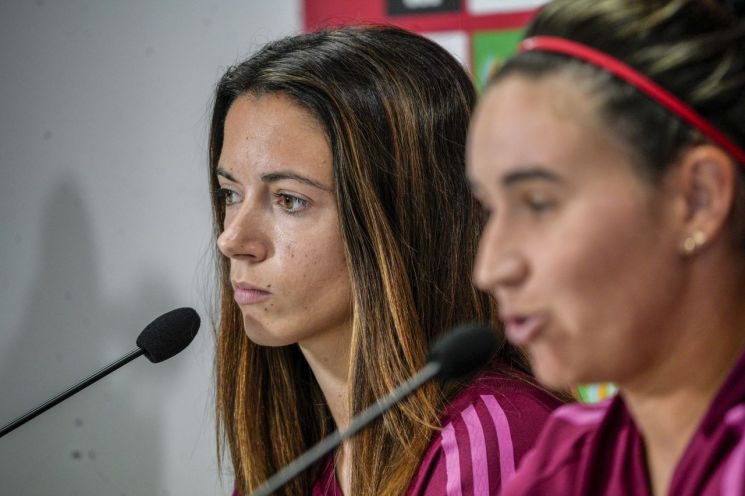
Aitana Bonmat?, Spain's star midfielder and the tournament's Most Valuable Player (MVP) at the Women's World Cup, said this on the 24th (local time). After winning the FIFA Women's World Cup held last month in Australia and New Zealand, the Spanish national team endured weeks of various controversies, and after much emotional hardship, they were finally able to take the field, prompting her sigh of relief.
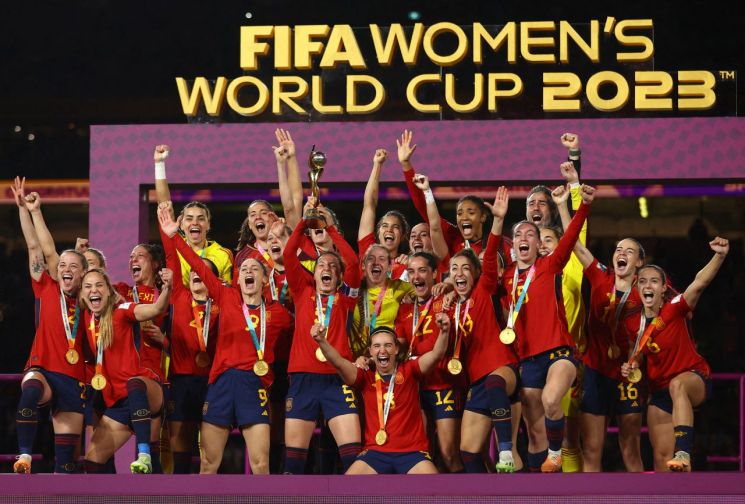
The Spain women's national soccer team went through a tough time after the World Cup last month. On the 20th of last month, Luis Rubiales, the male president of the Spanish Football Federation, caused controversy by forcibly kissing a female player during the victory ceremony. When a sexual offense occurred at a ceremony watched by the whole world, issues of gender discrimination that female soccer players and female athletes had long faced began to receive significant attention.
Following the incident, President Rubiales resigned, and the national team coach Jorge Vilda was dismissed, with Montserrat Tom? appointed as the first female coach. Although the Spanish Football Federation appeared to be making changes, the players demanded fundamental reforms within the federation and declared a boycott of A matches, standing firm. Eventually, an agreement was reached to form a joint committee for federation reform, and the players returned to the field.
According to BBC, Bonmat?, who played against Sweden on the 22nd, said, "We are setting an example in sports and society that men and women should be treated equally," adding, "The first few days were very complicated, stressful, and anxious, but over time the situation changed."
The Forced Kiss Was 'Only Part'... The Struggle Lasted Over a Year
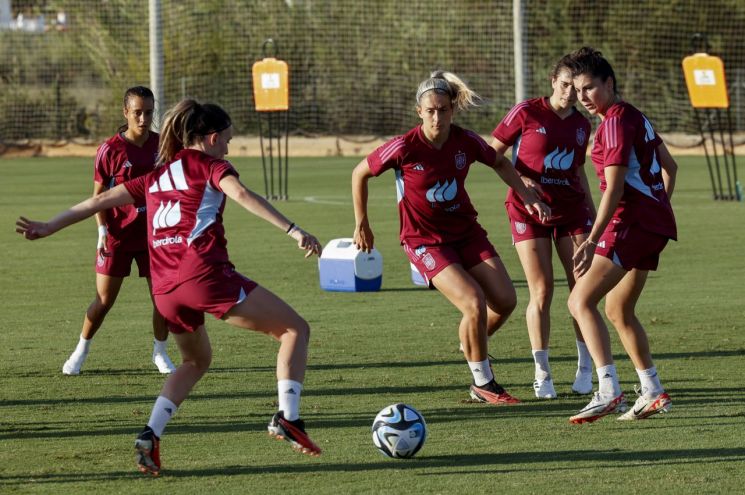
The events experienced by the Spain women's national soccer team over the past year following the forced kiss incident have drawn global attention. Rubiales' forced kiss was seen as a catalyst that brought the deeply rooted gender discrimination issues within the federation to the surface. It was pointed out that the discrimination female players had endured in Spanish soccer for decades was finally being revealed.
The New York Times (NYT) reported on the 6th, citing over ten sources, that players and Spanish soccer officials had to endure various forms of gender discrimination, from patriarchy to verbal abuse. At that time, Coach Vilda reportedly required players to report their bedtime and instructed them to keep their hotel rooms open at night. They were also told to eat and drink under the supervision of the coaching staff. It was said that Vilda wanted to control every move of the players.
Moreover, discriminatory treatment by the federation was rampant. Ana Mu?oz, who joined the Spanish Football Federation as the vice president of integrity, resigned after one year in 2019, stating that she was hired merely to promote the fact that there was a female executive without any real authority. She described herself as a "decoration" or "flowerpot." She also revealed that after a match, the federation gave female players tablet PCs instead of prize money. She recalled hearing Rubiales say, "I have a daughter. I know what women want."
There were also allegations of frequent sexual harassment and assault within Spanish soccer. Before the recently dismissed Coach Vilda, Ignacio Quereda, who coached the women's national team for over 20 years, reportedly told female players, "What you really need is a good man and a big penis." During the final against England on the 20th of last month, when Spain scored the opening goal, Vilda was caught on camera hugging and touching the chest of a female coaching staff member beside him.
NYT reported that players were reluctant to speak out publicly about these incidents due to fear of retaliation.
NYT described the Spanish players' World Cup victory as "stolen glory." The players had worked for years to win the World Cup and should have enjoyed the moment at the ceremony, but instead, they were caught up in controversy and stress due to the sexual scandal. Nevertheless, they engaged in intense negotiations with the federation for nearly a month and ultimately secured a promise for significant change, which was seen as a major achievement.
"We Support You" ? Sweden Players, A-Match Opponents, Show Solidarity
The gender discrimination faced by female players is not unique to Spain, a common consensus holds. Until the 1970s, women's soccer matches were banned in European powerhouses like the UK and Germany, now considered soccer giants. In 2004, then-FIFA President Sepp Blatter sparked controversy by saying, "If female players wear hot pants during matches, soccer's popularity will increase."
With the growing emphasis on gender equality over time, these situations have gradually improved. However, the sexual harassment incident involving the Spain women's national soccer team has once again drawn global attention to gender discrimination in sports.
Female players from other countries who empathize with Spain's situation have expressed their support.
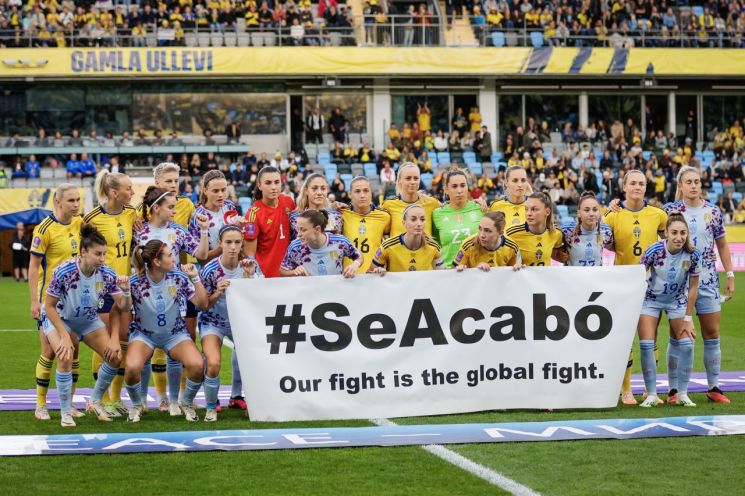
On the 22nd, the Sweden women's national soccer team, who played an A match against Spain, showed solidarity with the Spanish players. When the Spanish players took a commemorative photo before kickoff holding banners and bracelets with the phrases "Our fight is the global fight" and "#SeAcabo" (It's over), the Swedish players joined in to share the sentiment.
Sweden women's national team midfielder Filippa Angeldal said at a press conference on the 19th, before the match, that if the Spanish players decided to boycott, she would support them. "They (the Spanish players) are receiving all the support they need, and players from other countries support whatever choice they make," she said.
Leah Williamson, a leading star of women's soccer and captain of the England women's national team, also recently expressed support in an interview with CNN.
Visiting New York for the United Nations (UN) General Assembly, she said, "Considering the environment soccer has shown, this moment was inevitable," adding, "I am grateful to them (the Spanish female players) as a fellow soccer player for bringing these situations to light." She continued, "No player should have to go through what they have experienced, and that is why I came to the UN?to seize the opportunity to speak out for improving conditions for young women."
© The Asia Business Daily(www.asiae.co.kr). All rights reserved.



















