The elderly population aged 65 and over approached 9.5 million this year. The proportion of elderly people in the domestic population stands at around 18.4%. Statistics Korea projected that by 2025, two years from now, the proportion of the elderly population will reach 20.6%, entering a super-aged society.
According to the '2023 Elderly Statistics' released by Statistics Korea on the 26th, the elderly population aged 65 and over was surveyed at 9,499,900 as of this year. The age group composition ratio of the elderly population aged 65 and over is 6.3% for ages 65?69, 4.3% for ages 70?74, and 7.7% for ages 75 and above. The population aged 65?74 this year is 5,514,000, which is 1,528,000 more than the population aged 75 and above; however, from 2037, the population aged 75 and above is expected to surpass the 65?74 age group.
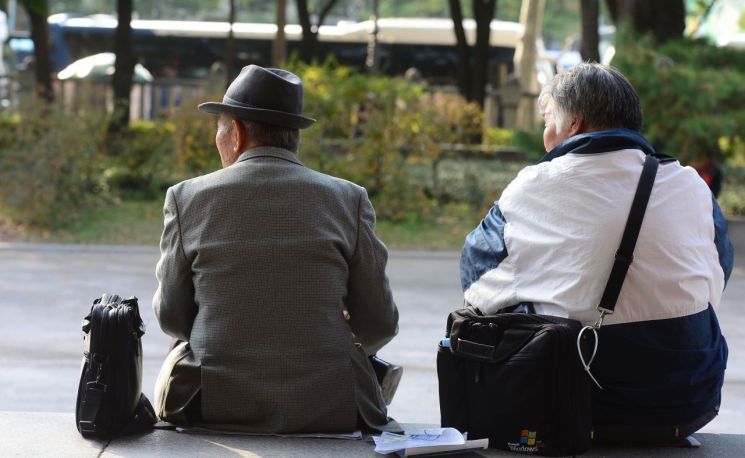
The gender ratio of the elderly population shows that 20.6% are women and 16.2% are men, with the proportion of elderly women being 4.4 percentage points higher than that of men. For every 100 elderly women aged 65 and over, the number of elderly men is projected to increase from 78.4 in 2023 to 86.2 in 2050.
Households headed by elderly individuals aged 65 and over numbered 5,491,000 this year, accounting for 25.1% of all households. By household type, single-person households are the most common at 36.3%, followed by couples (35.3%), couples with unmarried children (9.2%), and parents (mother or father) with unmarried children (5.5%). The number of elderly-headed households aged 65 and over continues to increase, expected to exceed 10 million households by 2039 and to account for nearly half (49.8%) of all households in Korea by 2050.
As of last year, the net assets of households headed by elderly individuals aged 65 and over amounted to 453.64 million KRW, an increase of 4.316 million KRW compared to the previous year. The net assets of elderly-headed households are similar to those of all households (456.02 million KRW). Real estate accounts for the largest share of assets at 82.4%, while savings account for 12.4%, which is lower compared to other age groups.
In 2021, the relative poverty rate among the retired population aged 66 and over was 39.3%, a decrease of 1.1 percentage points from the previous year. The Gini coefficient was 0.379, and the income quintile ratio was 6.92 times, both increasing compared to the previous year. As of 2020, the relative poverty rate among Korea’s retired population (aged 66 and over) was 40.4%, a high level among OECD member countries.
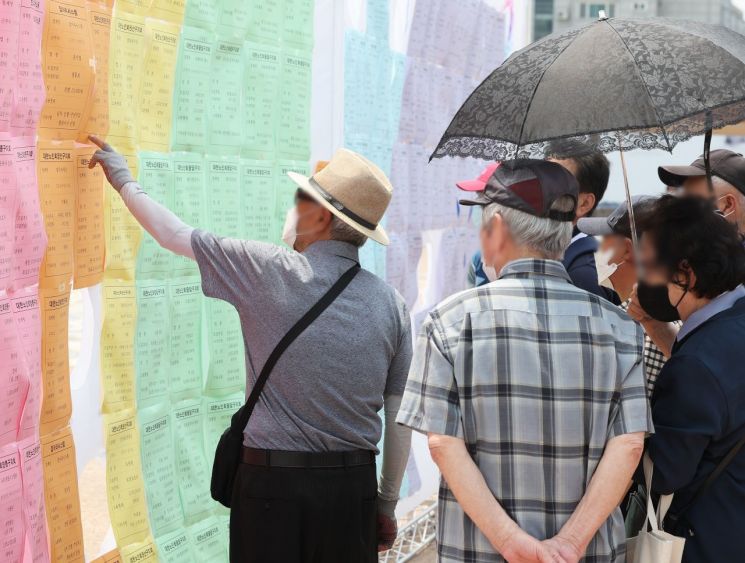
The employment rate of elderly people aged 65 and over was 36.2% last year, up 1.3 percentage points from 34.9% the previous year. Although the employment rate of the elderly is lower than the overall employment rate of the population aged 15 and over (62.1%), it has shown an upward trend since 2015. The unemployment rate among the elderly had been rising since 2016 but fell to 3.0% last year, a decrease of 0.8 percentage points from the previous year.
Among elderly people aged 65 and over, 37.5% who are working considered their health to be good as of last year, which is 15.6 percentage points higher than the 21.9% of non-working elderly. In 2021, the main sources of living expenses for working elderly aged 65 and over were self and spouse support (93.0%), government and social organizations (3.8%), and support from children and relatives (3.2%). For non-working elderly, the sources were self and spouse support (52.0%), support from children and relatives (24.6%), and government and social organizations (23.5%).
As of last year, the number of deaths per 100,000 elderly aged 65 and over by cause of death was recorded as follows: malignant neoplasms (cancer) 783.9, heart disease 337.9, COVID-19 331.3, and pneumonia 286.8. Deaths due to COVID-19 increased from 10.5 in 2020, to 50.7 in 2021, and to 331.3 in 2022. When comparing the mortality rates by cause of death among the elderly to those of the entire population, malignant neoplasms (cancer) were 4.8 times higher, heart disease 5.1 times higher, COVID-19 5.4 times higher, pneumonia 5.5 times higher, and cerebrovascular disease 5.1 times higher.
© The Asia Business Daily(www.asiae.co.kr). All rights reserved.
![Clutching a Stolen Dior Bag, Saying "I Hate Being Poor but Real"... The Grotesque Con of a "Human Knockoff" [Slate]](https://cwcontent.asiae.co.kr/asiaresize/183/2026021902243444107_1771435474.jpg)

















