Professor Jang Jaeyoung's Hanyang University Team Develops New Organic Dopant Material Group
Costs Tens of Times Less and Offers Superior Performance
Proposes New Growth Engine for Various Electronic Devices Including OLED and Solar Cells
Domestic researchers have attracted attention by developing a new strategy for ‘organic p-dopants,’ semiconductor materials considered more valuable than gold.
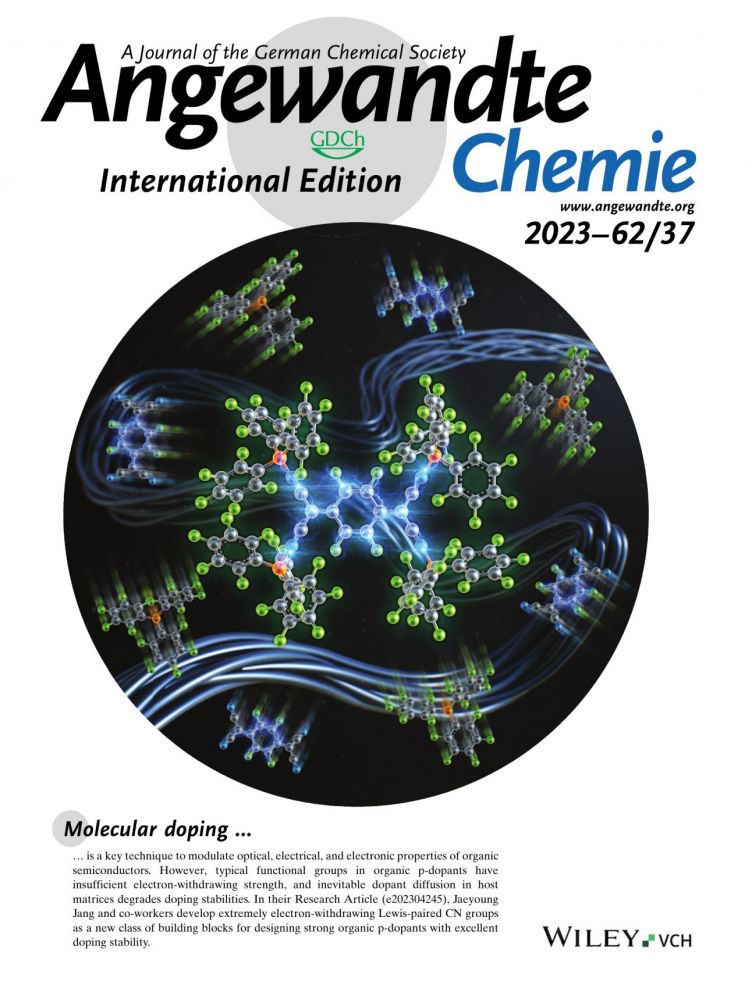
The National Research Foundation of Korea announced on the 25th that Professor Jae-Young Jang’s research team from the Department of Energy Engineering at Hanyang University has developed a new group of ‘organic dopant’ materials that overcome the limitations of existing development strategies.
Doping technology, which involves adding impurity atoms to improve the electrical, optical, and structural properties of semiconductors, is essential in the semiconductor industry. In particular, doping of lightweight and flexible organic semiconductors uses dopants in molecular form rather than atomic form. Such organic dopants (carbon-based organic molecular additives used to control semiconductor properties) are expected to see explosive demand in the future, as they are a core technology that aids light emission in the manufacture of organic light-emitting diodes (OLEDs).
Among organic dopants, ‘organic p-dopants’ that enhance the properties of p-type semiconductors are unstable, extremely expensive?costing hundreds of thousands of won per gram?and currently monopolized by patents held by specific companies. Therefore, there has been a growing need to improve the stability of organic p-dopants and to develop new chemical structures that avoid monopolistic technologies.
The research team changed the previously widely used strategy in developing organic p-dopants and approached it in a new way. They modified the electron-withdrawing groups attached like branches to the dopant molecules that control the material’s properties. In this process, they discovered that reacting the nitrogen (N) atom in the cyano (CN) group, a conventional electron-withdrawing group, with a Lewis acid can synthesize organic p-dopants that possess both strong oxidizing power and stability. After the Lewis acid-base bonding, the electron-withdrawing ability of the cyano group nearly doubled, exhibiting the strongest oxidizing power among known organic p-dopants to date, and the doping stability also improved dramatically.
Professor Jae-Young Jang explained, “The newly developed organic p-dopant material group allows free chemical structural modification, enabling versatile applications. The synthesis method is simple and uses inexpensive reagents, which can reduce the price by dozens of times, showing great potential. We are currently developing various processing technologies to maximize electrical performance.”
The research results were published as a cover paper on June 11 in the international chemistry journal ‘Angewandte Chemie International Edition.’
© The Asia Business Daily(www.asiae.co.kr). All rights reserved.

















