Optimization Algorithm 600 Times Faster Than Before
Confirmed Possibility of 'Ultra-High Performance and Ultra-Precision' Communication
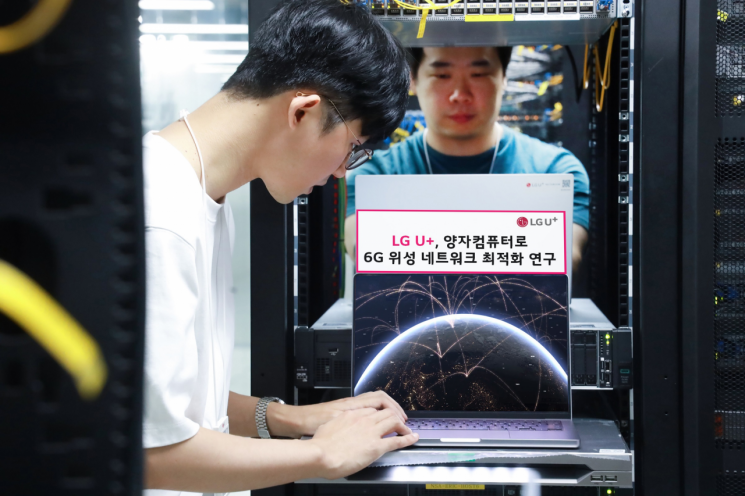
LG Uplus announced on the 25th that it has succeeded in optimizing the 6G low Earth orbit satellite network using quantum computers. This research was conducted in collaboration with the Korea Advanced Institute of Science and Technology (KAIST) and the domestic quantum computing software developer 'Qunova.'
The study was initiated to utilize quantum computers, which process information significantly faster than supercomputers, for network advancement tasks. The main goal is to expand satellite network optimization requiring high-level computation to an end-to-end scale.
The 'low Earth orbit satellite network' discussed in 6G refers to a service that provides communication using not only ground base stations but also satellites at altitudes ranging from 500 to 10,000 km. To provide smooth service, uninterrupted connections between ground stations (ground stations) and satellites, as well as between satellites themselves, must be guaranteed.
Connections between ground stations and satellites, and between satellites themselves, require technology that optimizes by reflecting various variables in real time. Unlike geostationary satellites with fixed positions, low Earth orbit satellites move at a speed of 7.8 km/s, requiring advanced technology to find the optimal network configuration in a short time. Additionally, technology is needed to track the real-time changing position of satellites during the connection process between low Earth orbit satellites and ground stations.
LG Uplus, KAIST, and Qunova have secured an algorithm that can optimize the entire end-to-end segment such as 'ground station-satellite-satellite-ground station' for satellite networks by utilizing the world's first commercialized quantum computer from D-Wave. Using this algorithm, network optimization paths can be calculated approximately 600 times faster than before, and the network reach distance connecting from ground stations through satellites back to ground stations can be reduced by about 18%.
As a result of this research, LG Uplus confirmed that it can implement ultra-high performance (user-perceived speeds over 1 Gbps) and ultra-precision (end-to-end latency under 5 ms) services in satellite communication environments comparable to terrestrial communication.
LG Uplus plans to expand the scope of research using quantum computers beyond 6G network optimization. Lee Sangheon, head of NW Advanced Development at LG Uplus, said, "As part of research to utilize quantum computers in communication networks, we achieved success in end-to-end connectivity by applying satellite communication, which is emerging as a key technology in 6G." He added, "We will continue to pursue research in 6G and quantum communication fields to secure network competitiveness."
© The Asia Business Daily(www.asiae.co.kr). All rights reserved.

















