The 4th Policy Finance Council Meeting Held
The government is restructuring the 'Growth Ladder Fund' to supply venture capital to sectors that are difficult for the private sector to invest in, such as deep tech (advanced technology based on engineering and scientific research and development) and climate response.
Kim So-young, Vice Chairman of the Financial Services Commission, attended the '4th Policy Finance Council' held on the 25th at Front1 in Mapo-gu, Seoul, and stated, "The new Growth Ladder Fund will play a more active role in many fields going forward."
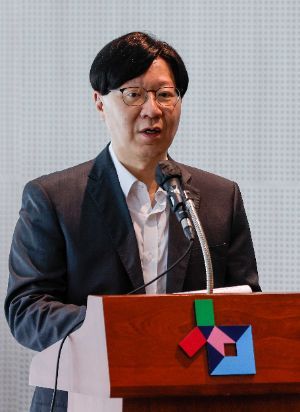 Kim So-young, Vice Chairman of the Financial Services Commission, is delivering opening remarks at the 'Dialogue between the FSC 2030 Advisory Group and the Financial Sector' held on the 24th at the Seoul Jung-gu Community Financial Promotion Agency. Photo by Kang Jin-hyung aymsdream@
Established in 2013 under the Capital Markets Act, the Growth Ladder Fund was created to discover promising ventures, small and medium enterprises, and mid-sized companies in need of growth capital and provide them with funding. The scale of domestic venture investment, which was 10.3 trillion won in 2013, grew to 51.2 trillion won last year, with the Growth Ladder Fund playing a 'primer' role in expanding venture investment.
However, while the existing Growth Ladder Fund allocated 60% of its investments to general companies in the growth stage, it was criticized for insufficient investment in relatively high-risk sectors or exit markets. Vice Chairman Kim said, "The Growth Ladder Fund has played a primer role in the growth of the venture market and greatly contributed to the activation of the venture capital market," but added, "With intensified global industrial and trade competition, rapid changes in supply chains, and the emergence of new investment capital demands, the demand for venture capital remains high in many areas."
Accordingly, the authorities have decided to restructure and operate the Growth Ladder Fund. Based on approximately 200 billion won of funds recovered annually from existing investments, they plan to raise more than 1 trillion won. The new Growth Ladder Fund will focus investments on sectors that are difficult for the private sector to enter due to challenging valuation and long investment periods, such as deep tech and climate response, secondary sectors supporting exit markets, and sectors related to industrial policy (matching), thereby serving as a primer in areas undersupplied by the market.
Meanwhile, policy financial institutions (Korea Development Bank, Industrial Bank of Korea, Korea Credit Guarantee Fund) have supplied 73.8 trillion won out of the 91 trillion won in policy finance planned for supply within the year as of August. The execution rate was 80.4%. Vice Chairman Kim stated, "Given concerns about economic slowdown originating from China and the possibility that the high interest rate and high oil price trends may continue for some time, we will carefully supply funds in consultation with industrial ministries to ensure that companies do not face financial difficulties during the remaining period."
Additionally, the authorities will strengthen the linkage between industrial policy programs and budgets to ensure the sustainability of policy financial support by industry. When each ministry secures policy fund support programs and budgets considering industrial policies and demands, policy financial institutions will support policy finance through special loans, agreement guarantees, and joint funds based on the budget, and prioritize allocating their own capacity to these programs to maximize effectiveness.
Vice Chairman Kim said, "With the launch of the Policy Finance Support Council, we have been able to secure the linkage between previously segmented industrial policies and policy finance supply," and added, "For sustainable policy financial support across various industrial sectors in the future, policy finance supply and fiscal resources must also be closely linked."
© The Asia Business Daily(www.asiae.co.kr). All rights reserved.
![Clutching a Stolen Dior Bag, Saying "I Hate Being Poor but Real"... The Grotesque Con of a "Human Knockoff" [Slate]](https://cwcontent.asiae.co.kr/asiaresize/183/2026021902243444107_1771435474.jpg)
















