104th Anniversary Academic Conference Held for Hwasun-born National Representative Yang Hanmuk's Martyrdom
An academic conference was held to commemorate the 104th anniversary of the death of Ji-gang Yang Han-mook, one of the 33 national representatives who shouted "Long live Korean independence" in 1919.
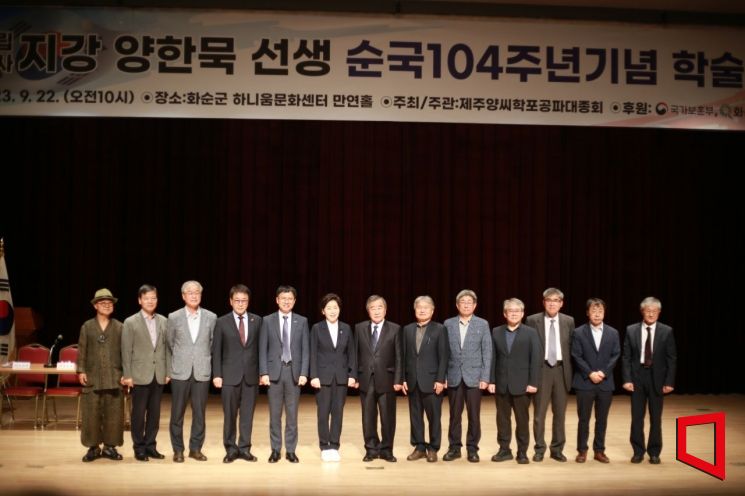 The "104th Anniversary Academic Conference Commemorating the Death of Teacher Yang Han-mook of Jigang" was held at Manyeon Hall, Hwanium Culture Center, Hwasun, Jeonnam, at 10 a.m. on the 22nd.
 [Photo by Min Hyun-ki]
According to the Jeju Yang Clan Hakpo Gongpa Grand Association on the 22nd, the 'Ji-gang Yang Han-mook 104th Anniversary Memorial Academic Conference' was held at 10 a.m. at the Manyeon Hall of the Haniyum Culture Center in Hwasun, Jeollanam-do.
About 100 people attended the conference, including Yang Yong-seung, chairman of the Jeju Yang Clan Hakpo Gongpa Grand Association; National Assembly members Shin Jeong-hoon and Yang Hyang-ja; Jeonnam Regional Veterans Affairs Office chief Jeong Hong-sik; Hwasun County governor Gu Bok-gyu; Hwasun County Council chairman Ha Seong-dong; and related members of the Jeju Yang Clan.
The event proceeded in the order of opening remarks, congratulatory speeches, commemorative speeches, followed by the first presentation titled 'Ji-gang Yang Han-mook and Cheondogyo Activities,' the second presentation titled 'Yang Han-mook's Enlightenment Movement and the Attempted Assassination of Lee Wan-yong,' the third presentation titled 'Yang Han-mook and the March 1st Movement,' and the fourth presentation titled 'A Study of Ji-gang Yang Han-mook's Classical Chinese Poetry: The Aesthetics of Cheongsan (靑山),' followed by a comprehensive discussion.
During the Japanese colonial period, Ji-gang (芝江) Yang Han-mook was an independence activist and educator, and the only one from Honam among the '33 National Representatives.'
Ji-gang, who signed the Declaration of Independence, was later assassinated in Seodaemun Prison at the age of 58. He is known to be the only one among the 33 national representatives who died in prison.
The first presentation, 'Ji-gang Yang Han-mook and Cheondogyo Activities,' was presented and discussed by Dr. Seong Ju-hyun, editor of 'Shin Ingan-sa,' and Professor Im Hyeong-jin of Kyung Hee University's Humanitas College.
Following that, the second presentation, 'Yang Han-mook's Enlightenment Movement and the Attempted Assassination of Lee Wan-yong,' was presented and discussed by former Suncheon University professor Hong Young-gi and Professor Park Min-young of Wonkwang University. The third presentation was conducted by former Independence Hall of Korea Independence Movement Research Institute director Kim Yong-dal and former senior researcher Kim Do-hyeong of the Independence Hall of Korea.
The final fourth presentation was handled by former Kookmin University professor Yang Hyun-seung and Professor Kim Dae-hyun of the Department of Korean Language and Literature at Chonnam National University.
National Assembly member Yang Hyang-ja, who attended the event, said, "Ji-gang overcame Joseon's Neo-Confucianism, which held that 'status is clear and absolutely unchangeable,' and lived a life leading the patriotic enlightenment movement. I am deeply moved just to be able to attend this passionate discussion following the footsteps Ji-gang has walked."
Lee Jong-chan, chairman of the Liberation Association, said, "When the Russo-Japanese War broke out and Lee Yong-gu's Iljinhoe transformed into a full-fledged pro-Japanese group, Yang Han-mook returned to Korea ahead of Cheondogyo leader Son Byeong-hui, who was exiled in Japan, and teachers Kwon Dong-jin and Oh Se-chang. Together with Lee Jun and Yoon Hyo-jeong, he organized the Jinbohoe and the Constitutional Research Society, advocated constitutional monarchy, authored 'Constitutional Essentials,' serialized it in the Hwangseong Newspaper, and presented the national spirit and political reform direction. Despite many materials on his independence movement achievements, research and promotion projects have been insufficient, and he is not widely known to the public. Therefore, research presentations on him are a very valuable opportunity to establish our independence movement history," he said.
© The Asia Business Daily(www.asiae.co.kr). All rights reserved.
![Clutching a Stolen Dior Bag, Saying "I Hate Being Poor but Real"... The Grotesque Con of a "Human Knockoff" [Slate]](https://cwcontent.asiae.co.kr/asiaresize/183/2026021902243444107_1771435474.jpg)











