James Bullard, former President of the Federal Reserve Bank of St. Louis and a prominent hawkish figure (favoring monetary tightening), stated that additional interest rate hikes are necessary to prevent the risk of inflation accelerating again.
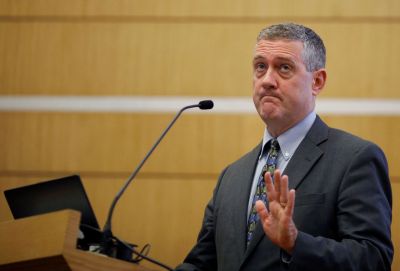
In an interview with Bloomberg TV on the 21st (local time), Bullard said, "I think (additional rate hikes) could be good as 'insurance' to ensure that core inflation falls at an appropriate pace and that the 2% price stability target can be achieved within a reasonable period." Bullard, who recently moved to become the dean of the Krannert School of Management at Purdue University, was known as a strong hawk during his time at the Federal Reserve (Fed), advocating for aggressive rate hikes.
At the September Federal Open Market Committee (FOMC) meeting held until the day before, the Fed kept the federal funds rate unchanged at 5.25-5.5% as expected by the market, while signaling that further rate hikes would continue within the year. Additionally, the new dot plot raised the median rate forecast for the end of 2024 from 4.6% to 5.1%, and for the end of 2025 from 3.4% to 3.9%. This suggests that even after the Fed begins cutting rates, a high level of interest rates will persist for a longer period than previously expected.
Regarding this, Bullard commented, "It makes sense," adding, "The outlook for a soft landing is very good. But we cannot land until inflation returns to 2%." There are two remaining FOMC meetings this year, in November and December.
Following the so-called hawkish pause decision at the September FOMC, some market analysts have suggested that the high level of interest rates could effectively become permanent. The Wall Street Journal (WSJ) reported, "At the September FOMC, officials surprised the market by indicating that rates would not fall as much as previously expected," and "some officials implied through their forecasts and comments that the current high rates could last forever."
The WSJ also attributed the recent surge in long-term Treasury yields and the sluggish stock market to a rise in the neutral rate. It analyzed, "If current rates do not slow demand or inflation, the neutral rate must be higher, and monetary policy is not restrictive," adding, "Higher rates are possible." The outlet reported last month that the neutral rate is rising due to strong U.S. economic growth and fiscal deficits, suggesting that the era of historically ultra-low interest rates may be ending. The recent FOMC meeting has again drawn attention to the prospect of high rates becoming entrenched due to a rising neutral rate.
Fed Chair Jerome Powell also cited the rise in the neutral rate as one reason why the economy and labor market remain resilient despite current rates. The neutral rate refers to the level of interest rates that allows economic growth to continue without accelerating inflation. However, Powell also noted that he does not fully understand the neutral rate. He has previously stated that he does not believe the neutral rate is clearly and precisely understood, emphasizing the need for caution in monetary policy based on such estimates.
© The Asia Business Daily(www.asiae.co.kr). All rights reserved.
![Clutching a Stolen Dior Bag, Saying "I Hate Being Poor but Real"... The Grotesque Con of a "Human Knockoff" [Slate]](https://cwcontent.asiae.co.kr/asiaresize/183/2026021902243444107_1771435474.jpg)
















