Jeonhap "Abandoning Precedent Requiring Resistance Difficulty... Established by Illegal Use of Physical Force Alone"
"Notification of Harm Causing Fear, Also Constitutes Forced Molestation if Assaulted"
The Supreme Court has changed its precedent for the first time in over 40 years by easing the criteria for applying the crime of forcible molestation. Previously, it was judged that the elements of forcible molestation were established only when the victim was in a state of 'incapacity to resist.'
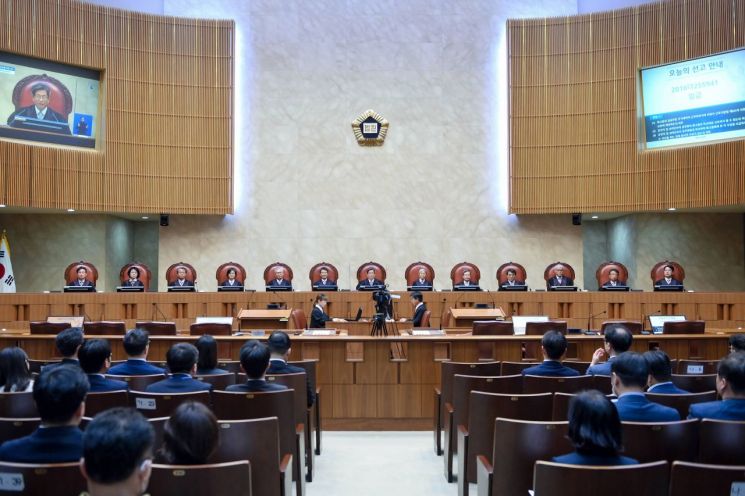 The Supreme Court en banc is delivering a verdict on a case involving violations of the Sexual Violence Punishment Act and others on the 21st at the Supreme Court Grand Courtroom in Seocho-gu, Seoul. /
 The Supreme Court en banc (Presiding Justice No Jeong-hee) on the 21st overturned the original ruling that sentenced Mr. A, who was indicted for violating the Sexual Violence Punishment Act (forcible molestation within a familial relationship), to a fine of 10 million won, and remanded the case to the Seoul High Court.
This ruling is expected to resolve the inconsistency between the current trial practice, which effectively applies a changed standard, and the traditional precedent jurisprudence.
The en banc stated, "We abolish the traditional precedent jurisprudence that requires the 'assault or intimidation' used as a means of molestation in the crime of forcible molestation to be to the extent that the victim finds it difficult to resist," and ruled, "The crime of forcible molestation is established when unlawful physical force is exercised on the other person's body or when harm is threatened to the extent that it can cause fear in the other person, thereby molesting them."
Mr. A was tried on charges of forcibly molesting his minor cousin by hugging her, knocking her down, and touching her body parts. The first trial court recognized the charge of forcible molestation as guilty and sentenced him to three years in prison, but the second trial court ruled that forcible molestation did not occur in a state of incapacity to resist and applied only the charge of molestation by deceit under the Act on the Protection of Children and Juveniles against Sexual Abuse, sentencing him to a fine of 10 million won.
Until now, the Supreme Court had ruled that for the crime of forcible molestation to be established, there must be assault or intimidation that precedes the molestation in time and to the extent that it makes resistance difficult for the other party.
However, the en banc, in judging this case, determined that it is not necessary for the assault or intimidation, which are elements of the crime of forcible molestation, to be to the extent that the other party finds it difficult to resist.
The en banc stated, "Considering the elements of the crime of forcible molestation, the protected legal interest, problems with the traditional precedent jurisprudence, social awareness of sexual violence crimes, and the need to clarify interpretative standards in light of changes in precedent jurisprudence and trial practice, the meaning of 'assault or intimidation' in the crime of forcible molestation needs to be redefined," and ruled, "The traditional precedent jurisprudence requiring incapacity to resist does not align with the protected legal interest of forcible molestation, which is the free and equal sexual self-determination of the individual."
Furthermore, it stated, "'Assault or intimidation' in the crime of forcible molestation should be clearly defined as the 'assault or intimidation' stipulated in the criminal law's assault or intimidation crimes, and this is necessary to enhance legal stability and predictability of rulings in light of changes in precedent jurisprudence and trial practice," and ruled, "Whether an act constitutes 'assault or intimidation' in the crime of forcible molestation should be comprehensively judged based on the purpose and intent of the act, the specific content of the act, the circumstances and context at the time of the act, the relationship between the perpetrator and the other party, and the presence and degree of pain caused to the other party."
© The Asia Business Daily(www.asiae.co.kr). All rights reserved.

















