President Yoon's Keynote Speech at the 78th UN General Assembly
Highlighting the Threat of Fake News to the International Community
Differentiated Strategy for Expo Hosting
President Yoon Suk-yeol, who attended the UN General Assembly for the second consecutive year, delivered a bolder message. While last year’s speech, his first since taking office, emphasized solidarity and cooperation among liberal democratic countries and conveyed the new administration’s diplomatic stance, this year he directly targeted the military cooperation between North Korea and Russia. Notably, President Yoon also expanded the agenda by raising concerns about 'fake news' to the international community.
On the afternoon of the 20th (local time), President Yoon attended the 78th UN General Assembly general debate and delivered a 15-minute keynote speech. The word he mentioned most frequently during the speech was 'Republic of Korea,' used a total of 20 times. Other key words included digital (15 times), Expo (14 times), peace (11 times), and freedom (10 times).
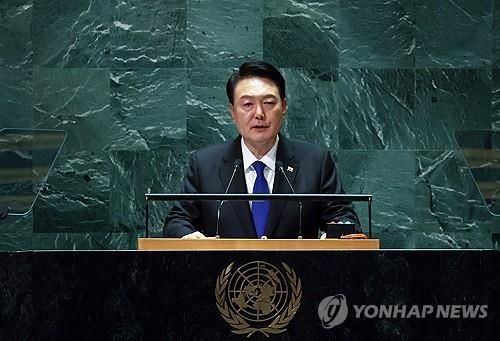 President Yoon Suk-yeol, visiting the United States, is delivering the keynote speech at the 78th United Nations General Assembly held at the UN Headquarters in New York on the 20th (local time).
 [Photo by Yonhap News]
This year, President Yoon delivered a more robust message than last year. He mentioned strengthening solidarity with liberal countries that share universal values and issued a strong warning to North Korea and Russia. Amid concerns that North Korea’s nuclear and missile technology could be enhanced through their military exchanges, he warned, "The Republic of Korea and its allies and partners will not stand idly by." He also delivered a direct blow, stating, "If North Korea gains information and technology necessary to enhance its weapons of mass destruction (WMD) capabilities in exchange for providing conventional weapons to Russia, the military transactions between Russia and North Korea will be provocations directly targeting not only Ukraine but also the security and peace of the Republic of Korea."
This reflects the perception that, following last month’s Camp David trilateral summit among South Korea, the United States, and Japan, which laid the groundwork for institutionalizing trilateral cooperation, the international community’s cooperation can be more actively mobilized. Unlike last year’s speech, which avoided directly naming China and Russia and used indirect expressions such as 'opposition to changes in the status quo by force,' this year President Yoon explicitly named North Korea and Russia. A presidential office official explained, "At this point, we are reviewing the list of sanctions and carefully considering effective actions, so we are consulting with allied and partner countries on this issue. We believe that cohesive actions can emerge within the solidarity of freedom centered on allies and partners, and we are proceeding with consultations."
The reason why the word 'freedom,' which was the most frequently mentioned last year, was used only about half as much this year is also related to this. It is interpreted as a judgment that the diplomatic stance of the Korean government, based on freedom and the rule of law, has already been conveyed multiple times during President Yoon’s overseas visits and that a consensus has been formed with the international community.
However, unlike President Yoon’s message, it is unlikely that sanctions or joint responses will be easily adopted at the UN level. Among the five permanent members of the UN Security Council, only U.S. President Joe Biden attended this year’s General Assembly. China and Russia continue to reject additional sanctions resolutions against North Korea and resolutions related to the war in Ukraine. When President Yoon was delivering his speech, footage showed Russian officials at the UN headquarters with expressionless faces, looking downward.
Nevertheless, it is clear that the scope of the agenda presented to the international community has broadened. After 'Republic of Korea,' President Yoon mentioned the word 'digital' 15 times, expressing strong concerns about the spread of fake news. He said, "The digital divide is essentially an economic divide," and added, "The Republic of Korea aims to take a leading role in reducing the digital divide by leveraging its strengths in information and communication technology (ICT)." He also highlighted the problem of "the spread of fake news caused by the misuse of artificial intelligence (AI) and digital technologies." Considering that he has raised this issue multiple times during previous overseas visits, this can be seen as an official declaration of his plan to support the establishment of related international organizations within the UN to counter fake news and to provide a network for communication and collaboration among experts worldwide.
He also continued his efforts to promote the bid for the 2030 Busan World Expo during his keynote speech. President Yoon said, "The 2030 Busan World Expo will provide a platform for global citizens to overcome crises together while expanding freedom through solidarity," and made a full effort to request support. He emphasized that the values pursued by the Busan Expo align with those of the UN, highlighting the differences from other competing countries such as Saudi Arabia and Italy. When requesting support for the Expo, President Yoon also added, "The diplomatic stance of the Republic of Korea government is based on freedom and solidarity."
© The Asia Business Daily(www.asiae.co.kr). All rights reserved.

















