Deputy Prime Minister and Minister of Economy and Finance Choo Kyung-ho dismissed concerns about the repayment burden on loans for self-employed individuals and small business owners on the 21st, stating, "There is absolutely no basis for the September self-employed crisis theory."
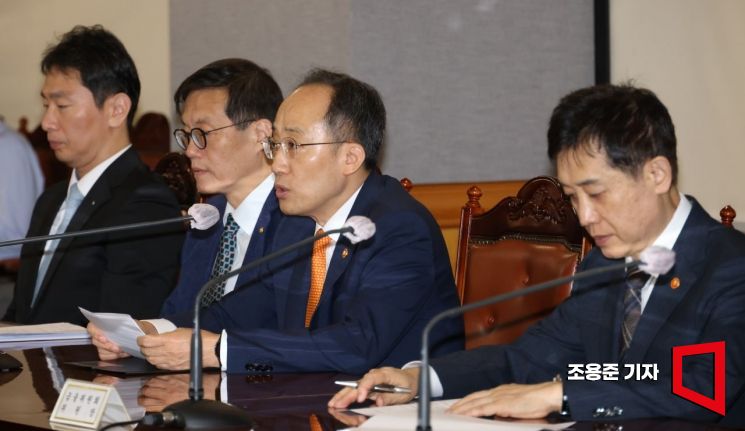 Deputy Prime Minister and Minister of Economy and Finance Choo Kyung-ho is delivering opening remarks at the Emergency Macroeconomic and Financial Meeting held at the Bankers' Hall in Myeong-dong, Jung-gu, Seoul on the 21st. The meeting was attended by Lee Chang-yong, Governor of the Bank of Korea, Kim Ju-hyun, Chairman of the Financial Services Commission, and Lee Bok-hyun, Governor of the Financial Supervisory Service. Photo by Jo Yong-jun jun21@
Deputy Prime Minister Choo made these remarks during the joint 'Emergency Macroeconomic and Financial Meeting' held at the Korea Federation of Banks building in Seoul that morning. He said, "The total debt of self-employed individuals and small business owners affected by COVID-19 has decreased from the initial 100 trillion won to 76 trillion won, indicating a smooth soft landing," emphasizing, "The September crisis theory is completely unfounded."
He added, "Regarding the loan repayment burden, according to government measures implemented last September, maturity extensions are supported until September 2025, and repayment deferrals allow for installment repayments over up to five years until September 2028." He also explained, "In the case of secondary financial institutions such as savings banks, although delinquency rates have risen somewhat rapidly due to the impact of interest rate hikes, recently, new delinquencies have decreased, slowing the rise in delinquency rates, and the situation is being managed stably."
Regarding real estate project financing (PF), Deputy Prime Minister Choo stated, "For projects that can be normalized through agreements with major creditors, support is provided for new funds and maturity extensions, while projects without viability are being orderly resolved through auctions and other means, ensuring a smooth soft landing." He added, "As a result, the recent rise in PF loan delinquency rates has significantly slowed, and risks are gradually easing."
Concerning the prolonged high interest rates, rising international oil prices, and the expanding uncertainties in the global economy, the government plans to closely monitor the situation and respond accordingly.
Deputy Prime Minister Choo said, "The U.S. Federal Reserve (Fed) held the policy interest rate at the upper bound of 5.5% at the Federal Open Market Committee (FOMC) meeting on the 20th (local time)," adding, "Fed Chair Jerome Powell mentioned that additional rate hikes within the year are not ruled out, emphasizing that the restrictive level will be maintained until inflation slows."
Fed officials have reduced their forecast for next year's rate cuts from 100 basis points (1bp = 0.01 percentage points) to 50 basis points, and global financial markets interpreted this FOMC decision as hawkish, resulting in stock price declines and increases in interest rates and the dollar index.
Deputy Prime Minister Choo emphasized, "As shown by the FOMC results, the possibility of prolonged high interest rates has increased, and the volatility of global financial markets may expand. The government and the Bank of Korea will respond closely with seamless cooperation and heightened vigilance."
He continued, "First, to prevent the recurrence of excessive competition for funds in the financial sector due to the maturity of high-interest deposits in the fourth quarter of this year, a daily liquidity inspection system will be activated, and proactive measures will be taken based on communication with the financial sector." He added, "We will carefully monitor market liquidity conditions, flexibly review bank liquidity regulations, and manage market liquidity through open market operations to ensure that short-term market interest rates do not deviate significantly from the base rate set by the Bank of Korea."
The government plans to promptly and appropriately implement market stabilization measures by utilizing the remaining liquidity supply capacity of over 30 trillion won, including corporate bond and commercial paper (CP) purchase programs, if necessary.
© The Asia Business Daily(www.asiae.co.kr). All rights reserved.


















