Announcement of Improvement Plan for Unfair Trading Response System in Capital Market
Promotion of New Articles in Capital Market Act...Can Enhance Effectiveness of Penalty System
The Financial Services Commission (FSC) is introducing a system to freeze the accounts of suspects during investigations of stock price manipulation cases. With the introduction of the asset freezing system, the effectiveness of the stock price manipulation penalty system, which is scheduled for legislative notice this month, can also be strengthened. It is expected that swift administrative sanctions will become possible for the three major unfair trading practices.
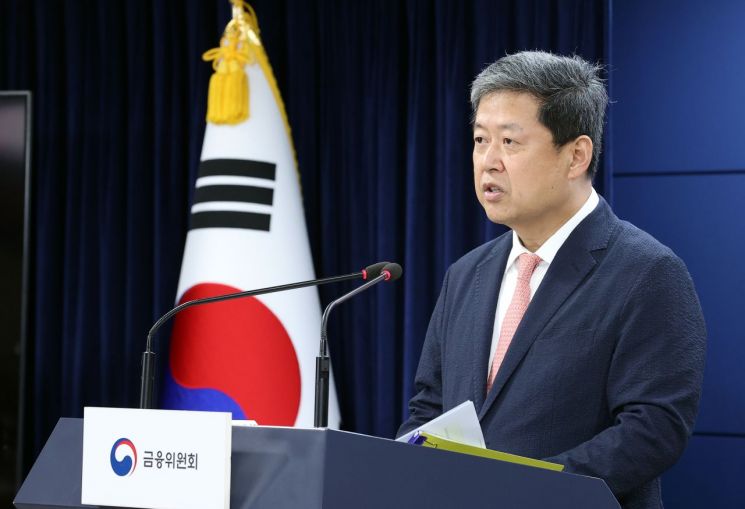 Kim Jeong-gak, Standing Commissioner of the Financial Services Commission and the Securities and Futures Commission, is announcing measures to improve the response system to unfair trading in the capital market on the morning of the 21st at the Government Seoul Office Joint Briefing Room.
 [Image source=Yonhap News]
On the morning of the 21st, the FSC announced the 'Improvement Plan for the Capital Market Unfair Trading Response System' at the Government Seoul Office, together with four institutions including the Seoul Southern District Prosecutors' Office, the Financial Supervisory Service, and the Korea Exchange. The improvement plan was discussed to significantly strengthen inter-agency cooperation in the investigation of illegal activities in the capital market, commemorating the 10th anniversary of the launch of the FSC Capital Market Investigation Unit.
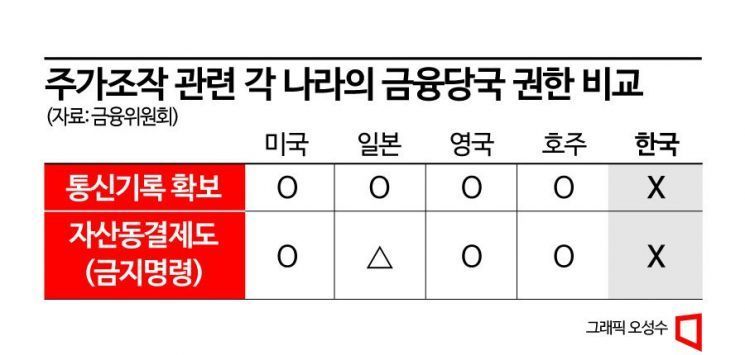
Asset freezing is a power held by investigative agencies such as the prosecution. The FSC explained that it has reached a consensus with the Ministry of Justice regarding the introduction of the 'asset freezing system.' This is significant in that it grants investigative authority to financial authorities during unfair trading investigations. Financial authorities in countries such as the United States, the United Kingdom, and Australia have introduced asset freezing systems. In Japan, the asset freezing system is used restrictively to prohibit business activities of unregistered financial investment businesses. FSC Chairman Kim Joo-hyun stated, "We are preparing to ensure that the penalty system and the legislation on the method of calculating unjust profits are implemented smoothly early next year," adding, "We plan to review the method of freezing suspect accounts together with related agencies."
For financial authorities to have asset freezing authority during unfair trading investigations, a new legal provision must be established within the Capital Markets Act. The FSC plans to discuss the details with the Ministry of Justice and then proceed with legislative amendments. However, it is expected to take considerable time until the bill is proposed, as many procedures such as research projects, public hearings, bill proposals, and bill reviews must be completed.
The background for the FSC's push to introduce the asset freezing system is the large-scale stock price manipulation incidents such as the Radukyeon Gate in April and the 'massive limit-down of five stocks' in June. As unfair trading methods evolve, it has been pointed out that it is difficult to detect suspects using existing methods. Therefore, the current stock price manipulation response system has been completely overhauled.
The improved unfair trading response system aligns with the FSC's ongoing policy to eradicate unfair trading. Earlier, President Yoon Seok-yeol pledged during his candidacy to strengthen responses to capital market crimes. To this end, the amendment to the Capital Markets Act, which includes the 'method of calculating unjust profits' to strengthen criminal penalties for stock price manipulators and the introduction of administrative sanctions such as penalties, was passed by the National Assembly. The FSC is currently coordinating the detailed enforcement ordinance with the Ministry of Justice and others. Legislative notice will be issued in September. An FSC official explained, "The asset freezing system is linked to the operation of the penalty system in the medium to long term," adding, "If the accounts of stock price manipulators, which have been transferred overseas or used for crimes, are frozen, administrative sanctions will be effective when penalties are imposed after the investigation."
However, the 'telecommunication inquiry,' which was mentioned alongside the introduction of the asset freezing system, is unlikely to be introduced immediately. 'Telecommunication inquiry' refers to the authority to check the call records of stock price manipulators' mobile phones in real time. Since the authority to secure telecommunication records involves amendments to the Information and Communications Network Act, broad discussions with related ministries are necessary.
There have been ongoing calls for the financial authorities to have the 'telecommunication inquiry' authority during stock price manipulation investigations. This is because telecommunication records that could be used as evidence during unfair trading investigations were deleted, making criminal prosecution difficult. The maximum retention period for telecommunication data is one year (365 days). However, when unfair trading incidents such as market manipulation occur, it takes an average of 1,121 days from the recognition of the incident to the resolution by the Securities and Futures Commission.
© The Asia Business Daily(www.asiae.co.kr). All rights reserved.
![User Who Sold Erroneously Deposited Bitcoins to Repay Debt and Fund Entertainment... What Did the Supreme Court Decide in 2021? [Legal Issue Check]](https://cwcontent.asiae.co.kr/asiaresize/183/2026020910431234020_1770601391.png)
















