International Airfare 26% Higher Than 2020 Last Month
Due to Rising Global Oil Prices and Increased Fuel Surcharges
Up to 48% Increase
Also Caused by Airlines' Supply Shortage Compared to Passenger Demand
International flight ticket prices will rise next month. Airlines have increased fuel surcharges due to the rise in international oil prices. Since there is no sign of oil prices stabilizing, ticket prices are expected to continue soaring for the time being. The explosive travel demand that airlines cannot handle is also playing a part.
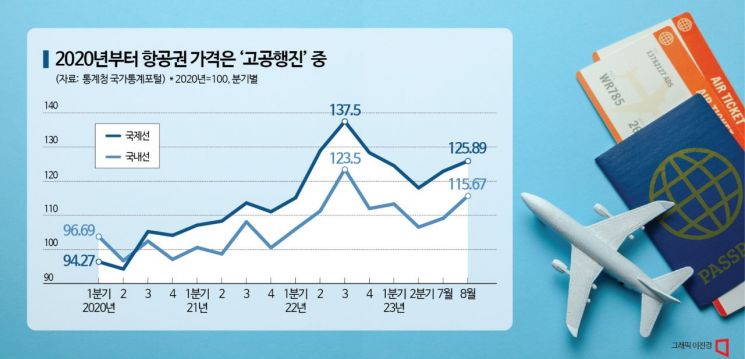
As the COVID-19 pandemic ended, soaring airfares have shown no signs of falling. According to the Statistics Korea's 'Airfare Consumer Price Index,' which tracks airfare price trends, last month's international airfare index was 125.89. This means ticket prices have increased by about 26% compared to the base year (2020). The domestic airfare index also recorded 115.67.
Why are airfares still expensive? First, fuel surcharges have increased as oil prices have risen. Airfare consists of the base fare, airport tax, fuel surcharge, and others. The base fare is the basic price paid to use the airplane. The fuel surcharge is an additional fee charged when the oil price surges and the base fare alone cannot cover fuel costs. This fee is internally adjusted by airlines according to the Ministry of Land, Infrastructure and Transport's distance-based system (pricing in 500-mile increments).
The standard is the price of Singapore jet fuel. For international flights, when the average price per gallon exceeds $1.50, fuel surcharges are applied in 33 stages. If the price is $1.50 or below, no fuel surcharge is charged. At stage 1, from $1.50 to $1.59 per gallon, short-haul routes (Japan routes are operated separately) are charged $2, and long-haul routes (America and Europe) are charged $5. The surcharge increases by 10 cents per gallon with each stage. The highest stage, 33, applies when the average price per gallon is $470 or more, charging $129 (about 170,000 KRW) for short-haul and $293 (about 388,000 KRW) for long-haul routes.
International oil prices began rising in July, and on the 18th (local time), the price of West Texas Intermediate (WTI) crude oil in the U.S. reached a yearly high of $91.48 per barrel. Consequently, fuel surcharges responded immediately. From last month 16th to this month 15th, which is the basis for October's fuel surcharge, the average Singapore jet fuel price was 286.43 cents per gallon, applying stage 14. The fuel surcharge, which was at stage 8 in August, has risen by 3 stages for two consecutive months (stage 11 in September).
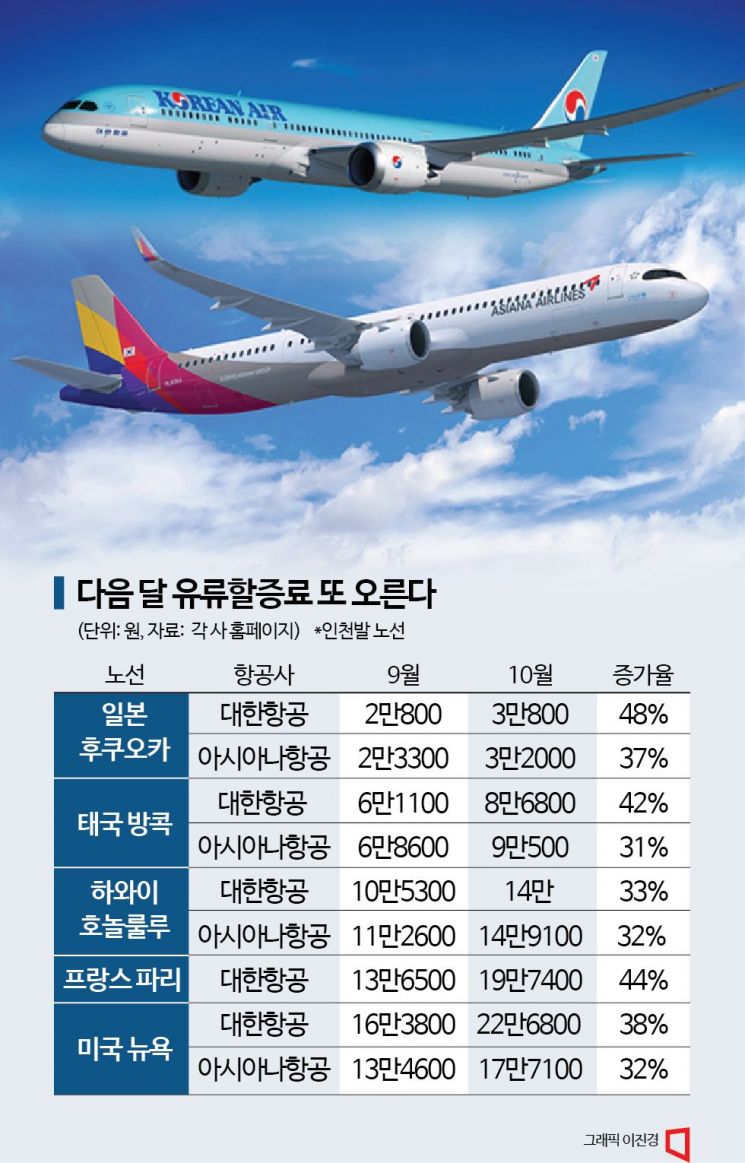
Airlines also acted swiftly. Korean Air's October international flight fuel surcharge ranges from 30,800 KRW to 226,800 KRW one-way depending on distance. For Asiana Airlines, it ranges from 32,000 KRW to 177,100 KRW. For example, flying round-trip between Incheon and New York with Korean Air requires paying 453,600 KRW in fuel surcharges alone. The cheapest ticket price for the same route last month was 1,849,300 KRW (base fare 1,400,000 KRW, fuel surcharge 327,600 KRW, taxes 121,700 KRW), which has now risen to about 2,000,000 KRW (1,975,300 KRW).
In terms of rate of increase, the routes with the highest rise are short-haul routes such as Incheon-Fukuoka. Compared to last month, Korean Air and Asiana Airlines increased by 48% and 37%, respectively. Routes to Europe and America, such as Incheon-Paris, which rose by 44%, follow.
The surge in passenger demand that airlines cannot handle is also affecting airfare prices. In August 2019, the number of international travelers was 8,183,084. It plummeted to 138,447 in May 2020. It has gradually recovered, reaching 6,408,146 in July this year, about 78% of the passenger volume in August 2019.
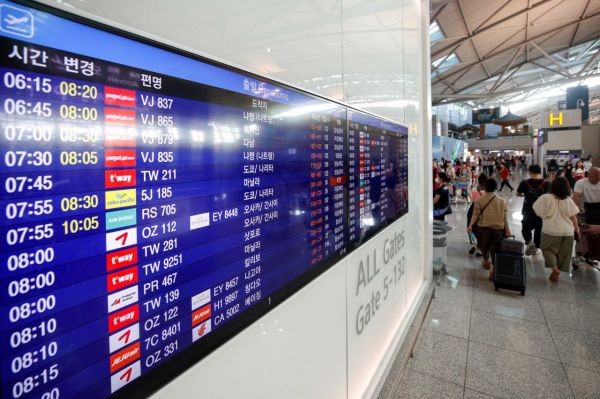 On the 28th, marking the start of the peak summer vacation season, international travelers visiting Incheon International Airport Terminal 1 are moving towards the departure hall. Photo by Jinhyung Kang aymsdream@
However, the number of aircraft, which decreased during COVID-19, has not recovered to that level. According to the Aircraft Registration Status from the Aviation Technology Information System, the number of domestic airline planes was 413 in 2019. It then dropped to 386 in 2020 and 362 in 2021. It increased again to 388 in August this year but is still 25 fewer than in 2019. The average monthly operating hours per passenger aircraft (pure paid transport time carrying passengers) have also been slow to recover except for Korean Air. According to the semi-annual reports of each airline, Asiana Airlines recorded 283 hours in the first half of this year, 69 hours less than 352 hours in 2019. Jeju Air and Jin Air also recorded 392 and 349 hours, respectively, failing to recover to 2019 levels (418 and 386 hours).
© The Asia Business Daily(www.asiae.co.kr). All rights reserved.



















