Activation of One-Stop Rapid Review and Relief System for Fake News
Cooperation in Establishing Autonomous and Rapid Regulatory System for Portal Operators
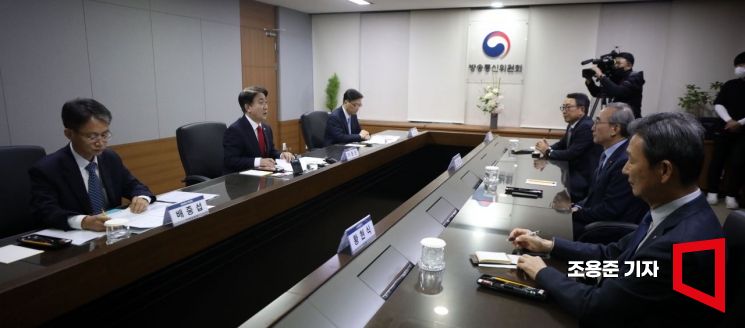 Lee Dong-kwan, Chairman of the Korea Communications Commission, is holding a meeting with representatives of the three major mobile carriers on the 15th at the Korea Communications Commission in the Government Complex Gwacheon, Gwacheon-si, Gyeonggi-do, to share the Commission's user protection and fair competition policies and to listen to the telecommunications industry's opinions on key issues.
The Korea Communications Commission (KCC) is making an all-out effort to strengthen the social responsibility of portal operators who wield enormous influence as de facto media. It plans to activate a one-stop "fast-track review and relief system" to eradicate fake news and provide swift damage relief, aiming for effective sanctions.
On the 18th, the KCC held a plenary meeting and announced measures to eradicate fake news.
First, the KCC will reorganize the current response systems and functions to actively promote rapid handling of fake news.
It will establish a fake news reporting channel at the Korea Communications Standards Commission (KCSC) and activate a fast-track system that processes rapid reviews and subsequent relief measures in one stop without waiting in order of receipt. Additionally, the KCC will share fake news reports and rapid review status with major portal operators and promote self-regulation by requesting proactive measures from operators when necessary.
For broadcasting operators, corrective orders and other measures will be taken when violations occur. The KCC is currently conducting fact-check verification system inspections focusing on KBS, MBC, JTBC, and others.
Furthermore, to enhance objectivity in re-licensing and re-approval evaluations, the KCC plans to shift the evaluation to a quantitative assessment basis and extend the validity period of licenses and approvals from 5 years to 7 years. However, in cases of urgent and serious violations, the validity period may be shortened below the current minimum of 3 years, considering effective and flexible sanctions.
The KCC requested participation in a fake news eradication response consultative body and various self-regulatory measures, considering that 69% of the public access news articles through portals and the growing influence of internet operators. Major internet operators such as Naver and Kakao have agreed to actively cooperate with the KCC's fake news eradication measures and continue consultations. The KCC also plans to actively request participation from overseas internet operators like Google.
Moreover, the KCC will actively cooperate with the National Assembly, relevant ministries, and related agencies to define fake news and judgment criteria, improve operator self-regulation and review systems, and support supplementary legislation to eliminate blind spots such as the one-strike-out system, as well as legislative support for related bills pending in the National Assembly.
It also plans to continuously discuss the concretization of the fake news response system and implementation plans to establish a "Comprehensive Plan for Fake News Eradication" within the year.
Lee Dong-gwan, Chairman of the KCC, said, "Despite the fact that serious fake news is becoming more sophisticated and emerging as a major social problem due to recent technological advances such as AI, the current legal system remains stagnant. We will prepare fundamental measures to eradicate fake news through legal system improvements, but first, we will activate the currently available fast-track system to eliminate fake news."
© The Asia Business Daily(www.asiae.co.kr). All rights reserved.
![Clutching a Stolen Dior Bag, Saying "I Hate Being Poor but Real"... The Grotesque Con of a "Human Knockoff" [Slate]](https://cwcontent.asiae.co.kr/asiaresize/183/2026021902243444107_1771435474.jpg)
















