All 7 Local NIMBY Facilities Including Korea Midland Power Seoul Power Headquarters Found with Soil Contamination
Results from Sampling at 8 Points Within 300m of Incinerator Site ... 7 Points Exceed Standards
District to Request Detailed Soil Investigation from Seoul City and Order Contaminated Soil Remediation
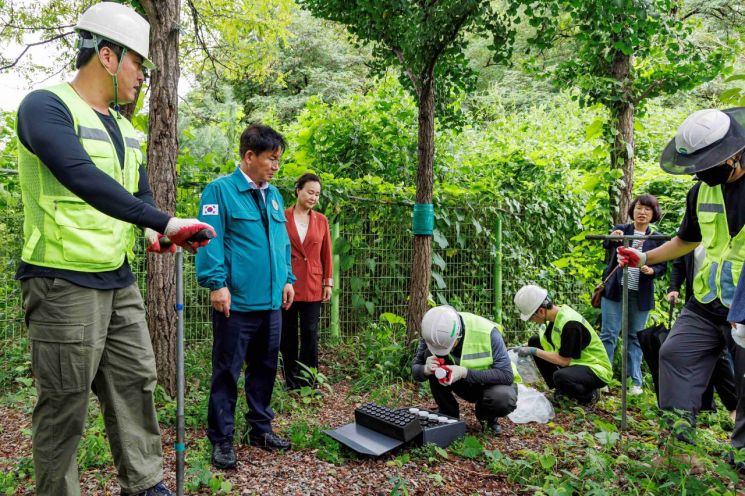
Mapo-gu (Mayor Park Gang-su) conducted a soil contamination survey at the planned site for the new waste incineration plant in Sangam-dong (around 481-6 Sangam-dong), revealing that residents' concerns about soil pollution have become a reality, and a strong backlash is expected.
On the 18th, Mapo-gu publicly disclosed the soil contamination survey results to the media, announcing that out of eight points within 300 meters of the planned waste incineration plant site, including the hydrogen charging station previously controversial for excessive fluoride detection, fluoride exceeding about 95% of the standard was detected at seven points except for one.
Park Gang-su, Mayor of Mapo-gu, stated, “The Seoul Metropolitan Government’s claim that there was no problem with soil contamination at the incineration plant site has been proven false,” adding, “Since areas exceeding the legal standard were found, we will strongly demand that Seoul, responsible for soil purification under relevant laws, conduct thorough soil precision investigations and take measures to remediate the contaminated soil.”
Ultimately, the results overturn Seoul’s claim, which stated no abnormalities based on soil contamination measurements at 14 points conducted by a professional measurement agency, making it inevitable to halt the city’s forced push to build the incineration plant.
Previously, the soil contamination survey conducted by the district on August 28 was carried out by the Korea Environmental Capital Research Institute, a designated professional soil contamination investigation agency, to ensure reliability. The survey covered 18 points across seven areas of local undesirable facilities, including Korea Midland Power Seoul Power Headquarters, the Oil Tank Culture Park (formerly the oil reserve base), Haneul Park, and the fuel cell power plant. (Photo)
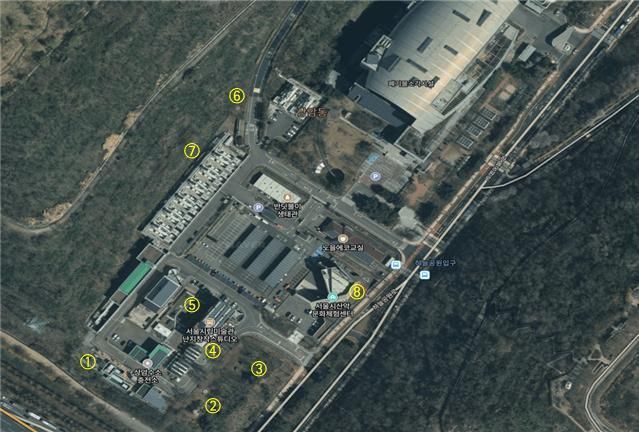
In particular, the survey points in the newly planned incineration plant site and nearby areas, which have recently become problematic due to contamination issues, included a total of eight points: one near the Sangam Hydrogen Charging Station, which was controversial for excessive fluoride detection in the media in July; two near the Nanji Creative Studio of the Seoul Museum of Art; two green areas at the new incineration plant site; two near Noeul Green Energy; and one near the Seoul Mountain Culture Experience Center.
Examining the disclosed survey results in detail, the point near the Sangam Hydrogen Charging Station detected 565 mg/kg of fluoride, which is below the soil contamination concern standard of 800 mg/kg.
This result applied the three-region standard following the district’s inquiry to the Ministry of Environment, which responded that classification is a matter for the local government to decide.
However, at two points near the Nanji Creative Studio of the Seoul Museum of Art, classified as region 2, fluoride levels of 779 mg/kg and 475 mg/kg were detected, exceeding the soil contamination concern standard of 400 mg/kg. Similarly, two points near Noeul Green Energy showed fluoride levels of 531 mg/kg and 504 mg/kg, also exceeding the region 2 standard.
At two green points classified as region 1 at the new incineration plant site, fluoride levels of 424 mg/kg and 476 mg/kg were detected, exceeding the soil contamination concern standard of 400 mg/kg. Additionally, one point near the Seoul Mountain Culture Experience Center showed 411 mg/kg of fluoride, revealing a serious level of soil contamination.
The district ensured fairness and reliability of the August soil contamination survey by allowing local residents, representatives of political parties, Seoul city officials, representatives opposing the additional incineration plant installation, district council members, and media to observe the process.
In particular, to dispel misunderstandings about sample analysis and preempt disputes over Seoul’s fairness, the district meticulously provided samples collected from the points to Seoul as well, drawing attention to how Seoul will respond to the excessive fluoride detection results in the future.
Park Gang-su, Mayor of Mapo-gu, pointed out, “We conducted soil contamination surveys not only at the planned waste incineration plant site but also at all undesirable facilities in the area, including Korea Midland Power Seoul Power Headquarters, the hydrogen fuel cell power plant, Haneul Park, and the Oil Tank Culture Park, and shockingly, fluoride was detected in excess at every single location without exception,” emphasizing, “This is the harsh reality that Mapo-gu and its 370,000 residents are suffering.”
He continued, “I hope that Seoul will no longer ignore the suffering and patience of Mapo-gu residents and face reality. Rather than being obsessed with the unjustified and pointless additional incineration plant construction, Seoul should immediately prepare policies to remediate the contaminated soil and alleviate residents’ suffering. In particular, fundamental waste policies such as promoting proper separation and disposal of household waste, installing pre-treatment facilities that can drastically reduce incineration waste, and expanding zero-incineration stores must be implemented.”
© The Asia Business Daily(www.asiae.co.kr). All rights reserved.
![Clutching a Stolen Dior Bag, Saying "I Hate Being Poor but Real"... The Grotesque Con of a "Human Knockoff" [Slate]](https://cwcontent.asiae.co.kr/asiaresize/183/2026021902243444107_1771435474.jpg)

















