Heritage Foundation Report
Possibility of US Primacy Again Under Republican Rule
A policy proposal from a U.S. conservative think tank has emerged, stating that if the Republican Party succeeds in a regime change in next year's presidential election, it should demand increased defense cost-sharing from allies including South Korea. Critics note that the foreign and security policy recommendations put forward by the conservative camp in preparation for the Republican Party's re-election next year evoke former President Donald Trump's 'America First' stance.
On the 17th (local time), the Heritage Foundation, a U.S. conservative think tank, published the 'Project 2025' report last month, outlining the next administration's national agenda. In the case of former President Trump, he actively embraced the report's content, implementing 64% of the policies recommended by the Heritage report in his first year in office in 2016.
Through this report, Heritage emphasized as a fundamental principle that allied countries must bear significantly greater costs in conventional defense.
The report stated, "U.S. allies must take much greater responsibility in conventional defense," and urged that "they must play their roles not only in countering China but also in addressing threats from Russia, Iran, and North Korea." It added, "Cost-sharing should be at the core of U.S. defense strategy," and emphasized, "The U.S. should not merely assist allies in doing so but strongly encourage them."
Based on this principle, the report made proposals concerning Taiwan, Japan, Australia, the North Atlantic Treaty Organization (NATO), Israel, and also South Korea, arguing that "South Korea should be enabled to lead conventional defense against North Korea."
Previously, former President Trump also demanded increased defense costs from allies. His argument was that allies should not free-ride on U.S. security support, and he particularly pressured South Korea by even threatening the withdrawal of U.S. troops stationed there.
The report stated that the U.S. needs to modernize and augment its nuclear arsenal to prepare for nuclear threats from China, Russia, and North Korea. It also urged increasing the purchase quantity of the next-generation interceptor missile (NGI), introduced to defend the U.S. mainland from North Korean missile provocations, to at least 64 units.
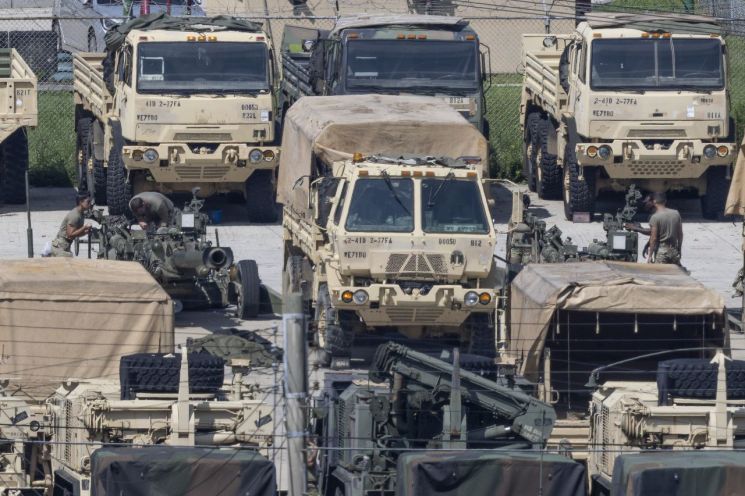
It further emphasized, "South Korea and Japan are extremely important allies in ensuring a free and open Indo-Pacific," and described them as "indispensable partners militarily, economically, diplomatically, and technologically."
The report noted that the ultimate goal of the defense cost-sharing principle is to more effectively check China, strongly calling for a tough stance against China. It evaluated the Biden administration's policy of competing with China while cooperating where possible as a failure.
The report stated, "China is not a totalitarian enemy, a strategic partner, or a fair competitor of the U.S.," and argued, "Economic relations with China should not be reconsidered but ended. Decoupling is necessary."
The report also included calls to ban Confucius Institutes and TikTok, which have been criticized as propaganda tools of the Chinese Communist Party, and to revoke accreditation of U.S. universities receiving funding from the Chinese Communist Party. It recommended coordinating support for developing countries in Asia alongside Japan, Australia, South Korea, and India to block China's influence through its Belt and Road Initiative (land and maritime Silk Road) projects.
Additionally, the report urged withdrawal from international organizations and agreements that do not serve U.S. interests. This recommendation follows the precedent set by the previous Trump administration, which withdrew from or stopped funding the United Nations Human Rights Council, UNESCO, and the World Health Organization.
© The Asia Business Daily(www.asiae.co.kr). All rights reserved.
![User Who Sold Erroneously Deposited Bitcoins to Repay Debt and Fund Entertainment... What Did the Supreme Court Decide in 2021? [Legal Issue Check]](https://cwcontent.asiae.co.kr/asiaresize/183/2026020910431234020_1770601391.png)
















