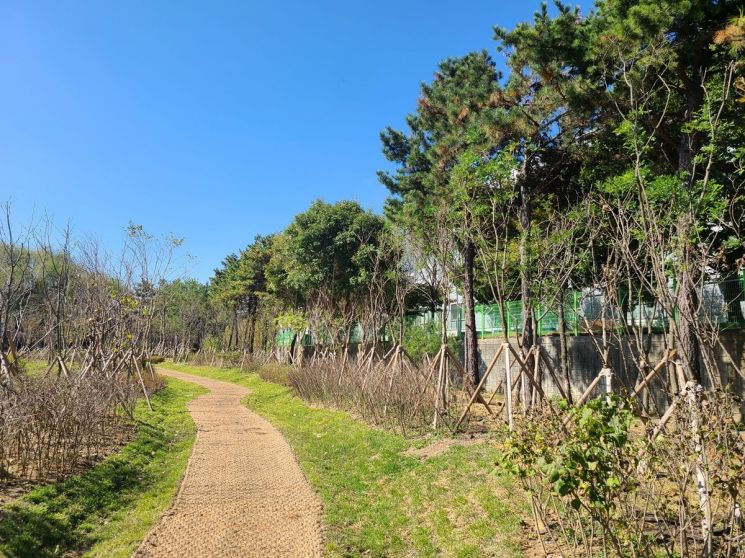
 Fine Dust Blocking Forest Established within Eoyeon Industrial Complex, Cheongbuk-eup, Pyeongtaek-si, Gyeonggi-do
Gyeonggi Province will invest 4.7 billion KRW next year to create an additional 9.4 hectares of climate-responsive urban forests in eight locations within the province, including Yeongtong-gu in Suwon City.
The urban forest development sites include eight cities and counties: ▲Iui-dong area in Yeongtong-gu, Suwon City ▲Yeongdeok-dong area in Giheung-gu, Yongin City ▲Ojeong-dong area in Bucheon City ▲Jinjeop-eup area in Namyangju City ▲Seonggok-dong area in Danwon-gu, Ansan City ▲Poseung-eup area in Pyeongtaek City ▲Wollong-myeon area in Paju City ▲Jeongok-eup area in Yeoncheon County.
Gyeonggi Province plans to establish a 9.4-hectare buffer forest in these areas to block the spread of fine dust in residential zones.
The province will plant approximately 16,920 trees near major fine dust sources such as railway lines and industrial complexes to prevent the spread into living areas. Utilizing the forest to adsorb and absorb fine dust and supply high-quality fresh air, it is predicted to absorb a total of 604 tons of fine dust annually (equivalent to the fine dust emissions of 223,000 vehicles per year).
Currently, the per capita urban forest area in living zones in Gyeonggi Province is 8.8 square meters, which is below the national average of 11.5 square meters. Accordingly, the province is creating fine dust blocking forests annually through securing national funding.
Since 2019, a total of 55.4 hectares of climate-responsive urban forests have been developed, including 7.9 hectares this year. The province is increasing urban forests in living zones by creating street forests, school forests, and small parks around residential areas.
Seol Jong-jin, Director of the Garden Industry Division of Gyeonggi Province, stated, "Through securing national funding annually for projects such as climate-responsive urban forest creation, we will not only purify the air in fine dust vulnerable areas but also respond to the climate crisis by mitigating the heat island effect and offsetting carbon. We will strive to contribute practically to improving urban landscapes and enhancing residents' health by planting trees around living zones."
© The Asia Business Daily(www.asiae.co.kr). All rights reserved.

















