Due to heavy concentrated rainfall this year weakening the ground, ground subsidence in Seoul has nearly doubled compared to previous years. As abnormal weather becomes commonplace and ground subsidence can lead to casualties, experts emphasize the need for thorough preparedness.
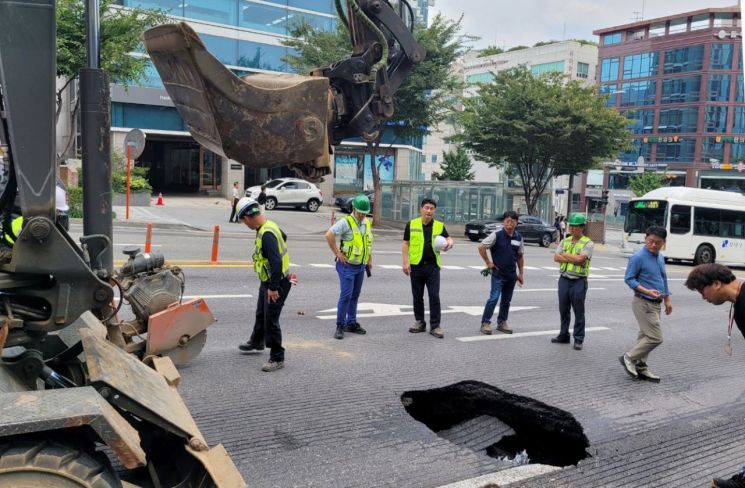 Sinkhole accident that occurred on the 12th at Bongeunsa-ro, Gangnam-gu, Seoul. [Image source=Yonhap News]
According to Seoul City on the 18th, a total of 17 cases of ground subsidence have been recorded from January to September this year. By region, Songpa-gu had 3 cases; Seocho, Jungnang, and Dobong-gu each had 2 cases; and Jung-gu, Yongsan, Seongbuk, Nowon, Eunpyeong, Seodaemun, Guro, and Gangnam-gu each had 1 case. On the morning of the 12th at around 10:45 AM, a ground subsidence approximately 1 meter in diameter and 1.5 meters deep occurred on Bongeunsa-ro in Gangnam-gu, Seoul, causing four lanes to be fully closed for over eight hours. The incident was identified as ground collapse caused by a ladder truck passing over a weakened ground due to damage to a nearby water supply pipe. Although the ladder truck's wheel fell into the hole, there were no casualties.
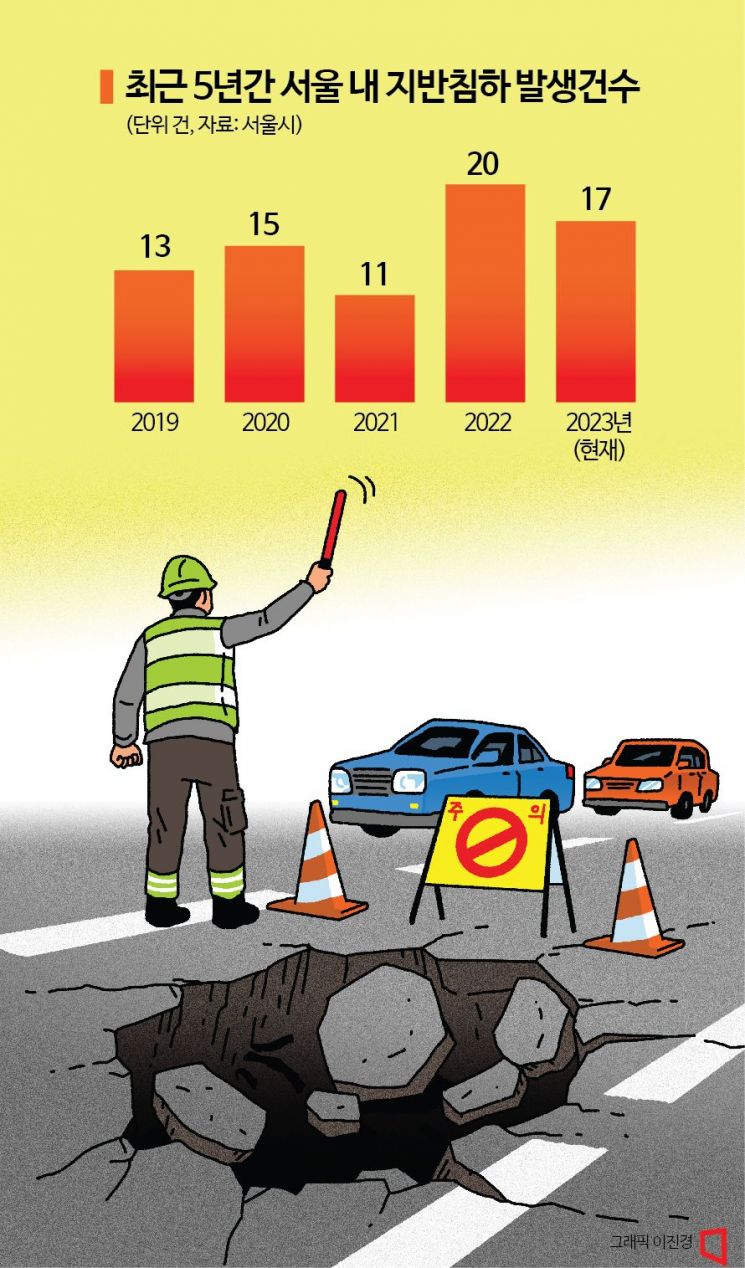
The number of ground subsidence cases in Seoul has surged since last year. By year, there were 13 cases in 2019, 15 in 2020, 11 in 2021, and 20 last year. Compared to before 2021, the numbers increased last year and this year. Seoul City counts ground subsidence cases when the subsidence area is at least 1㎡ (1m width × 1m length) and 1 meter deep or more, or when there are deaths, missing persons, or injuries. A Seoul City official explained, "The main reason for the increase in cases over the past two years is the impact of unexpected concentrated heavy rainfall during summer." Indeed, nationwide concentrated summer rains occurred last year and this year. Notably, on August 8-9 last year, Seoul recorded a daily maximum rainfall of 435mm, surpassing the previous record of 354.7mm set in August 1920. This year, the rainy season lasted 31 days from late June to late July, and Seoul experienced an extreme downpour with an hourly rainfall of 73.5mm on July 11, exceeding the 'extreme rainfall' threshold of 72mm per hour. The continuous rain weakened the ground.
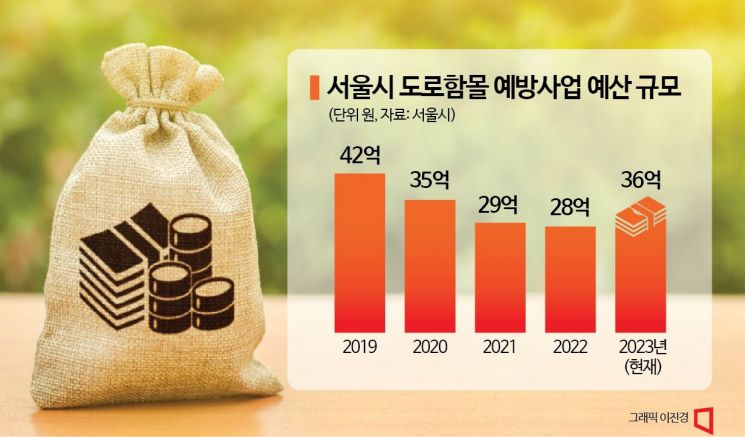
However, the budget for prevention remains stagnant. This year, Seoul allocated 3.6 billion KRW for road collapse prevention projects. By year, the budgets were 4.22 billion KRW in 2019, 3.583 billion KRW in 2020, 2.914 billion KRW in 2021, and 2.858 billion KRW last year. The year with the most ground subsidence cases in the past five years, last year, had the smallest budget. Future plans show budgets of 3.6 billion KRW in 2024, 2.8 billion KRW in 2025, and 3.3 billion KRW in 2026, showing little change from current levels. A Seoul City official said, "Investigations and restoration projects are conducted by dividing the city into five regions annually, and slight fluctuations in the budget occur due to additional equipment purchases. The budget is not decreasing."
According to Seoul City and experts, the causes of ground subsidence include ▲ insufficient compaction of soft ground ▲ changes in groundwater flow creating voids ▲ leakage caused by damage to water and sewage pipelines. In landfill areas, soft ground is mainly the cause, often due to soil not being compacted firmly during landfill. Voids form when groundwater flow changes during the construction of large-scale facilities such as subways, roads, commercial buildings, and parking lots. These voids collapse under load without warning signs, occurring suddenly and posing high risk. Leakage from water and sewage pipelines causes artificial groundwater flow, leading to ground subsidence. Leakage from aging pipelines can occur over long periods and in multiple locations.
Seoul City has strengthened underground safety management measures, but due to the nature of ground subsidence, precise prediction remains difficult. This year, Seoul expanded the scope of its annual comprehensive underground cavity survey from about 1,500 km to 2,700 km. Cavities are considered risk factors causing ground subsidence. From 2014 to August this year, a total of 17,292 km were surveyed, and 6,154 cavities were discovered and repaired. The inspection of underground safety evaluations at excavation sites deeper than 10 meters increased from 10 sample inspections to 219 full inspections, and additional ground-penetrating radar (GPR) survey vehicles were introduced. Since October 2021, Seoul has been building an integrated underground safety management system that includes underground information integration, accident response functions, and development of a ground subsidence risk analysis model.
Experts advise expanding the scope of ground subsidence investigations and increasing budgets. Jo Won-cheol, emeritus professor of Civil and Environmental Engineering at Yonsei University, said, "All disasters require prior preparation, and considering damage and recovery costs, early detection and prevention are more economical. Continuous investigations of subway construction, water and sewage pipeline installation lines are necessary." Moon Hyun-chul, professor of Disaster Safety Management at Soongsil University Graduate School, said, "Ground subsidence is a complex disaster caused by aging water supply systems, reckless development, and poor management. It cannot be solved by focusing on one area alone, so cooperation among related agencies such as the Ministry of Land, Infrastructure and Transport, Korea Electric Power Corporation, and local governments is essential."
© The Asia Business Daily(www.asiae.co.kr). All rights reserved.
!["I'd Rather Live as a Glamorous Fake Than as a Poor Real Me"...A Grotesque Success Story Shaking the Korean Psyche [Slate]](https://cwcontent.asiae.co.kr/asiaresize/183/2026021902243444107_1771435474.jpg)


















