The three major U.S. automakers?General Motors (GM), Ford, and Stellantis?are facing a large-scale strike crisis as wage negotiations with the United Auto Workers (UAW) union have broken down. The UAW, which represents about 400,000 workers in the automotive and machinery sectors nationwide, has 37% (146,000 members) of its union members employed by these three companies. Among them, 9% are participating in the strike, and the number of participants is expected to increase depending on future negotiation developments.
On the 14th (local time), the Wall Street Journal (WSJ) and others reported that the UAW members belonging to the Big Three automakers began striking at 11:59 p.m. that day. Sean Payne, UAW president, stated, "For the first time ever, GM, Ford, and Stellantis are simultaneously striking," adding, "There is much to be done in this strike to achieve social and economic justice."

The strike targets production lines at three plants located in three U.S. states. These include Ford's Bronco assembly plant in Wayne, Michigan; Stellantis's Jeep assembly plant in Toledo, Ohio; and GM's pickup truck assembly plant in Wentzville, Missouri. The number of UAW members participating in this strike totals 12,700, with 3,600 from GM, 3,300 from Ford, and 5,800 from Stellantis. This represents about 9% of the total union membership (146,000) across the three companies.
The social and economic impact of the strike is expected to be significant. The three plants selected by the UAW for the strike focus on producing highly profitable vehicles such as sport utility vehicles (SUVs) and pickup trucks. This strike could severely disrupt the production of cash cow models for the three companies. The UAW plans to add more strike locations depending on the progress of negotiations.
In the 88-year history of the UAW, this is the first time that all three companies have gone on strike simultaneously. The UAW has been negotiating wages and collective bargaining agreements with the three companies for two months but failed to narrow their differences. In particular, regarding wage increases, the companies proposed a raise of 17.5% to 20%, which did not close the gap with the union's demand of 36%. Other sticking points in the negotiations include strengthening pension and healthcare benefits for union members, expanding paid leave including a four-day workweek, limiting the hiring of temporary workers, and job preservation during the transition to electric vehicles, according to the WSJ.
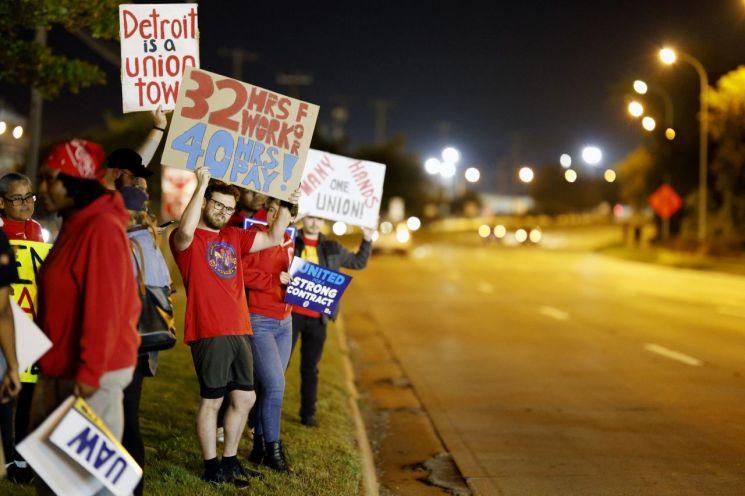
Foreign media view the impact of this strike as significant amid the market paradigm shift from internal combustion engine vehicles to electric vehicles.
Adam Hirsch, chief economist at the Economic Policy Institute (EPI), said, "The three companies have earned over $250 billion in additional net profits from 2013 to 2022, and an estimated $32 billion this year alone, so they have ample capacity to pay higher wages," but he added, "Wage increases could jeopardize the companies' efforts to expand investments in the electric vehicle transition, making it difficult for the stalled negotiations to reach an agreement."
Mary Barra, CEO of GM, said, "In a situation where we are investing hundreds of billions of dollars in the electric vehicle transition, accepting the union's demands could harm the company's business performance," adding, "We are at a crossroads in our journey to transform into an electric vehicle company."
Regarding the strike, Ford stated, "The UAW's proposals have not budged at all from the initial demands submitted on the 3rd of last month," and warned, "Accepting the union's proposals would more than double labor costs." Stellantis also said in a statement that day, "We will make appropriate structural decisions to switch the company to emergency mode and protect our North American operations."
As expectations grow that the strike will be prolonged, the WSJ reported that a tense atmosphere is spreading inside and outside the industry. Since the UAW is striking the Big Three companies simultaneously for the first time in history, the economic losses are expected to reach trillions of won. According to Oxford Economics, the strike could cause economic losses amounting to $5.6 billion (approximately 7.43 trillion won), potentially reducing the U.S. gross domestic product (GDP) by up to 0.3%.
© The Asia Business Daily(www.asiae.co.kr). All rights reserved.


















