‘Envlo,’ the 36th domestically developed new drug and a diabetes treatment, is set to be further developed as an eye drop for diabetic ophthalmic diseases caused by diabetic complications.
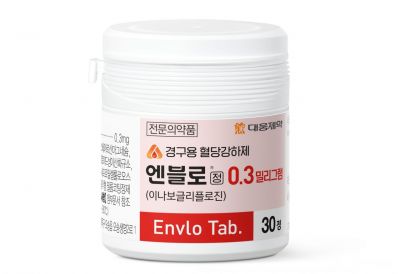 Daewoong Pharmaceutical's SGLT-2 inhibitor class diabetes treatment 'Envlo'
 [Photo by Daewoong Pharmaceutical]
Daewoong Therapeutics, a subsidiary of Daewoong, announced on the 15th that it received approval from the Ministry of Food and Drug Safety on the 8th for the clinical phase 1 trial plan (IND) of ‘DWRX2008,’ a candidate drug for diabetic retinopathy treatment. DWRX2008 is an additional development of Envlo (active ingredient: Inavogliflozin), an oral sodium-glucose co-transporter (SGLT)-2 class diabetes treatment, by changing the administration route to create the world’s first nano eye drop form candidate drug for diabetic retinopathy. In April last year, it was selected as a non-clinical support project by the Korea Drug Development Fund (KDDF).
Diabetic retinopathy is a diabetic complication that causes circulatory disorders in the retinal microvasculature due to diabetes, leading to vision loss and blindness. The fundamental causes of diabetic ophthalmic diseases such as diabetic retinopathy and diabetic macular edema are known to be high blood sugar and oxidative stress in the retina and posterior segment of the eye. However, currently, only antibody injection treatments that directly inject drugs into the eye to block neovascularization (new blood vessel formation), the final pathological mechanism of related diseases, have been developed.
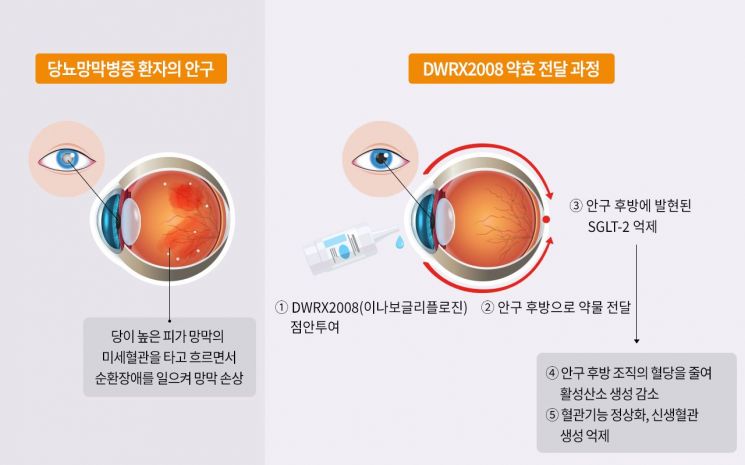 Mechanism of action of Daewoong Therapeutics' diabetic retinopathy treatment candidate 'DWRX2008 (active ingredient: Inavogliflozin)'
[Photo by Daewoong Therapeutics]
DWRX2008, being developed by Daewoong Therapeutics as a first-in-class new drug within its class, aims to treat diabetic ophthalmic diseases occurring in the retina and posterior segment of the eye by managing ‘ocular blood sugar,’ the fundamental cause. By administering Inavogliflozin as eye drops, it delivers the drug to the posterior segment of the eye, inhibiting SGLT-2 expressed there and lowering blood sugar in the posterior eye tissues. This normalizes abnormal energy metabolism, reduces reactive oxygen species production, and suppresses the secretion of vascular endothelial growth factor (VEGF), which induces angiogenesis.
In the non-clinical stage, two months of topical administration in naturally occurring diabetic retinopathy and diabetic macular edema models in primates showed a reduction in macular edema comparable to that of the control drug, ‘Aflibercept,’ an existing antibody injection treatment component. Adequate drug delivery to the posterior segment of the eye was also confirmed.
Although antibody injection treatments form a global market exceeding 10 trillion KRW, they have the disadvantage of requiring direct injection into the eye. DWRX2008 improves dosing convenience through topical administration while demonstrating similar efficacy to existing treatments, and combination therapy with existing treatments is also possible to increase treatment rates and reduce dosing frequency.
Daewoong Therapeutics plans to confirm the safety, local tolerability, and pharmacokinetic characteristics of DWRX2008 in this phase 1 clinical trial and secure the possibility of advancing to phase 2 clinical trials aimed at exploring efficacy. Clinical trials are scheduled to begin in the fourth quarter of this year. The clinical subjects have been expanded to include not only healthy Koreans but also Caucasians, considering future overseas expansion and multinational phase 2 clinical trials.
Kang Bok-gi, CEO of Daewoong Therapeutics, said, “DWRX2008 could be a game changer that can replace current antibody treatments, which are directly injected into the eye, in terms of treatment efficacy and ease of use for patients suffering from intractable eye diseases. We also expect to offer combination therapy options for patients who do not respond to existing antibody treatments or suffer from invasive administration methods.”
© The Asia Business Daily(www.asiae.co.kr). All rights reserved.



















