As international oil prices rise, concerns about inflation are resurfacing. The US Consumer Price Index (CPI) for August exceeded Wall Street expectations, reflecting the recent impact of rising oil prices. These oil-driven inflation concerns are expected to be a variable in the Federal Reserve's (Fed) interest rate decisions as it approaches the end of its tightening cycle. However, the core CPI, which excludes volatile energy and food prices, continued to slow down, making a rate hold at the upcoming September Federal Open Market Committee (FOMC) meeting likely.
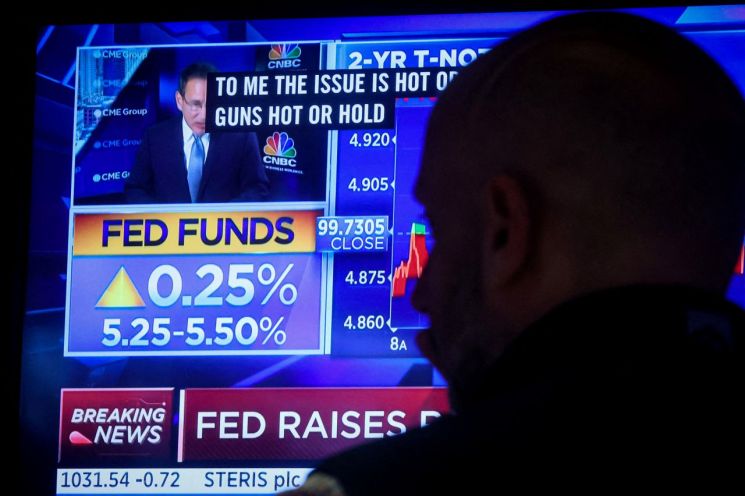
US August CPI Rises 3.7% Amid Oil Price Surge... Core Inflation Continues to Slow
According to the US Department of Labor on the 13th (local time), the August CPI increased by 3.7% year-over-year. This slightly exceeded Wall Street's forecast of 3.6%. The pace of increase accelerated compared to July's 3.2% rise. The month-over-month increase was 0.6%, matching expert expectations but larger than July's 0.2% rise. This is also the highest level since June last year.
This is analyzed as a result of recent international oil price increases leading to consumer price rises centered on gasoline. Gasoline prices jumped 10.6% compared to the previous month. Fuel oil used for transportation and heating soared 9.1%. Airfares rose 4.9% in one month, turning upward. Food prices also increased by 4.3%. Housing costs, including rent, rose 0.3% month-over-month.
However, the August core CPI, which excludes volatile food and energy prices, rose 4.3% year-over-year, continuing its slowing trend. The core CPI increased 0.3% month-over-month. Hugh Greaves, fund manager at Premier Milton US, said, "The headline inflation rate has risen, but the Fed will be relieved to see easing core inflation," adding, "Now the Fed's concern is whether rising energy prices will spread throughout the economy and reignite inflation worries by year-end."
Oil Prices as a Fed Tightening Variable... Rate Hold Still Likely in September
The rise in oil prices is a factor that stokes tightening concerns as it could accelerate inflation, which had recently shown signs of easing. Energy prices are not included in the Fed's preferred inflation gauge, the core Personal Consumption Expenditures (PCE) price index, but they indirectly and directly raise costs across all sectors of the economy. This not only increases inflationary pressure throughout the economy but could also prolong the Fed's tightening cycle beyond expectations.
Bloomberg reported, "The new momentum of rising oil prices is reigniting inflationary pressures," noting, "The Fed is optimistic it can lower inflation without a recession, but if inflation accelerates again, the need for rate hikes increases, raising the risk of triggering a recession in the process." West Texas Intermediate (WTI) and Brent crude oil prices recently hit their highest levels since November last year, currently trading around $88 and $92 per barrel, respectively. Concerns over supply shortages continue, with forecasts suggesting Brent crude could reach $100 per barrel within the year.
However, the confirmation of the core CPI's slowing trend in the recently released CPI report has led to expectations that the Fed will not raise rates immediately at next week's meeting. Krishna Guha, vice chairman at Evercore ISI, said, "It's not a good CPI report, but it's not enough to change the Fed's path." Shima Shah, chief global strategist at Principal Asset Management, stated, "The inflation figures do not lean toward a September rate hike. The headline CPI increase is not surprising given the recent rise in oil prices."
According to the Chicago Mercantile Exchange (CME) FedWatch, federal funds futures markets are pricing in over a 97% probability that the Fed will hold rates steady in September. The Wall Street Journal (WSJ) reported, "Fed officials previously signaled a rate hold at the September FOMC, and today's CPI data will not change that," adding, "The CPI briefly surprised investors, but those fears quickly subsided," reflecting the financial market sentiment.
Instead, the likelihood has increased that the Fed will present a more hawkish dot plot and messaging at the FOMC meeting on the 19th-20th. Since March last year, the Fed has been in a tightening cycle, raising the US benchmark interest rate to 5.25-5.5%, the highest since 2001. The previously released dot plot indicated the possibility of one more rate hike by year-end, but market analysis had increasingly suggested the Fed's hiking cycle might be over.
Greg Wilinski, head of US fixed income at Janus Henderson Investors, said, "(August CPI) does not change expectations for a rate hold at the September FOMC, but it will influence the tone of Fed Chair Jerome Powell's press conference and the Summary of Economic Projections (SEP)." Damian McIntyre, portfolio manager at Federated Hermes, commented, "Today's CPI supports another rate hold at the September FOMC, but Fed actions afterward are unclear. The November FOMC will be contentious." Ultimately, Fed decisions after November will depend on forthcoming economic data. The remaining FOMC meetings this year are in September, November, and December.
On the following day, the US Producer Price Index (PPI) for August, a wholesale price gauge, will be released. Since wholesale price increases typically pass through to consumer prices, this will also be closely watched. On the same day, August retail sales data, which reflects consumer spending, will be announced. Wall Street expects retail sales, which had rebounded earlier, to slow this time. On the 15th, the University of Michigan consumer sentiment survey will be released. James Knightley, chief international economist at ING, said, "As the labor market cools, consumers will feel more economic hardship in the coming months," adding, "This could slow consumer spending and support a slowdown in inflation."
© The Asia Business Daily(www.asiae.co.kr). All rights reserved.
![Clutching a Stolen Dior Bag, Saying "I Hate Being Poor but Real"... The Grotesque Con of a "Human Knockoff" [Slate]](https://cwcontent.asiae.co.kr/asiaresize/183/2026021902243444107_1771435474.jpg)

















