Seminar Held for Media Service Industry Development
Legal Framework Needed for Fair Competition in Pay TV and OTT
Relaxation of Ownership and Dual Operation Regulations... Improvement of Terrestrial Broadcasting Retransmission
In response to the rapidly changing media market environment, there has been a call for the establishment of a legal framework that comprehensively covers various media services such as paid broadcasting and online video services (OTT).
On the 13th, the office of Park Sung-joong of the People Power Party, the Korea Cable TV Broadcasting Association, and the Sogang University ICT Law and Economics Research Institute held a seminar titled "The Need for and Exploration of Legal Systems for the Development of the Media Service Industry" at the National Assembly Members' Office Building.
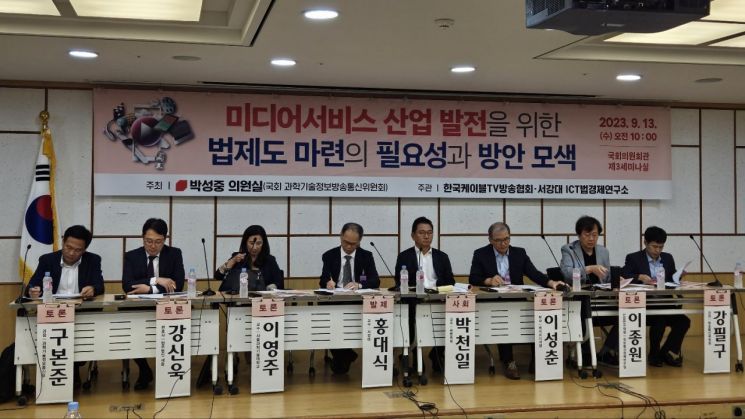 On the 13th, participants of the seminar on 'The Need for Legal and Institutional Arrangements for the Development of the Media Service Industry and Exploring Solutions' are engaged in discussion.
 [Photo by Oh Su-yeon]
Professor Hong Dae-sik of Sogang University, who delivered the keynote speech, stated, "The existing broadcasting legal system, which was centered on terrestrial broadcasting's public responsibilities, has been extended to the private service sector, acting as an obstacle to the autonomy and competitiveness of the private sector." He added, "With global media companies encroaching on the domestic market, it is urgent to establish a legal framework that enhances regulatory fairness and revitalizes the industry."
Currently, paid broadcasting is subject to various regulations such as entry, market share, fees, and prohibited acts, whereas OTT policies focus more on industry promotion rather than regulation. The paid broadcasting industry points out the "tilted playing field" environment and argues that regulations should be eased to enable fair competition. The government recognizes the need to integrate the Broadcasting Act and IPTV Act and is pushing for legal reforms, but these have yet to be concretized.
Professor Hong proposed the higher-level concept of "media service" to address these issues. Excluding broadcasting in the public domain, paid broadcasting and OTT, among others, would be grouped and defined as "media services." The platform area would be classified as "media provision services," and the content area as "media content services." This would create a horizontal regulatory system applying the same minimal regulations to the same tier.
In particular, to promote investment, he suggested converting the current system that restricts ownership and cross-ownership in paid broadcasting into a dominance restriction. The current law prohibits simple cross-ownership and ownership of more than 5% of shares, but he proposed loosening this to 30%, which is the standard for affiliate company inclusion under the Fair Trade Act. Additionally, conditions previously imposed as reauthorization requirements would be transferred to the post-regulation domain.
The concept of channels would be expanded to regulate real-time and online media provision services under a common framework. Furthermore, autonomy would be increased by abolishing the mandatory public and public interest channel programming in paid broadcasting, supporting the activation of local channels to enhance platform competitiveness. A basis for good-faith negotiation obligations regarding channel provision transactions would also be established.
He also recommended improving the mandatory retransmission system for terrestrial broadcasters. All channels of KBS and EBS would be subject to mandatory retransmission, while other terrestrial channels could contract voluntarily. Currently, only KBS 1TV and EBS are subject to mandatory retransmission, and paid broadcasters pay retransmission fees for KBS 2TV.
Moreover, he proposed that the government designate market-influential operators among facility-based service providers and require only those operators to obtain approval for their terms of use.
Professor Hong said, "It is necessary to reform the Broadcasting Act and IPTV Act to streamline non-economic regulations on private media services and reconstruct them into reasonable regulations focused on economic objectives such as competition and user protection."
The subsequent comprehensive discussion included participants such as Kang Shin-wook, attorney at law at Sejong Law Firm; Kang Pil-gu, director at the Korea Communications Commission; Koo Bon-jun, director at the Ministry of Science and ICT; Lee Sung-chun, Ph.D. at K-Media Lab; Lee Young-joo, professor at Seoul National University of Science and Technology; and Lee Jong-won, senior researcher at the Korea Information Society Development Institute.
Dr. Lee Sung-chun said, "Looking at Europe, which competed with global OTTs earlier, as of 2021, six of the top 20 European broadcasting companies by revenue are American companies," adding, "If the regulatory environment for paid broadcasting is not improved, this phenomenon could also occur in the Korean market."
Director Koo Bon-jun stated, "There has been much discussion recently about introducing an OTT regulatory system, but when discussing OTT regulation, it is important to consider that there are domestic indigenous companies," and added, "Rather than a normative approach, we need to discuss what systems are practically necessary for the Korean market and how to specifically introduce them."
© The Asia Business Daily(www.asiae.co.kr). All rights reserved.
![Clutching a Stolen Dior Bag, Saying "I Hate Being Poor but Real"... The Grotesque Con of a "Human Knockoff" [Slate]](https://cwcontent.asiae.co.kr/asiaresize/183/2026021902243444107_1771435474.jpg)











