Germany Penny Launches Campaign to Reflect Environmental Factors in Pricing
Olive Oil, Tomato, Durum Wheat Prices Expected to Rise Significantly
Food Supply Chain Itself May Undergo Changes
Climate anomalies shaking the Earth are gradually driving up so-called 'table prices.' For several years, abnormal weather such as heatwaves, heavy rains, and droughts have caused poor agricultural yields, triggering a rise in food prices throughout the supply chain. If the pace of global warming is not slowed, it is expected that consumers will have to pay higher prices not only for agricultural products but also for most foods including meat and dairy products.
"Reflecting environmental factors, cheese prices rise 94%"... An experiment by a German supermarket
Last month, an experiment conducted by a supermarket chain in Germany attracted worldwide attention. According to Deutsche Welle (DW) and others on the 13th (local time), the German supermarket chain Penny ran a 'True Cost (Wahre Kosten)' campaign at all 2,150 of its stores from July 31 to August 5. This campaign economically converted environmental factors such as climate change into consumer prices and reflected them in sales for nine products. Researchers from Nuremberg Institute of Technology and University of Greifswald predicted the price increases of consumer products based on environmental factors and applied these to actual sales during the event.
The price of Vienna sausages increased by 88%, from 3.19 euros (about 4,600 won) to 6.01 euros (about 8,600 won), and mozzarella cheese rose 74% to 1.55 euros. Maasdam cheese was priced at 4.84 euros, a 94% increase. For cheese, costs included 85 cents for methane and carbon dioxide emissions, 76 cents for soil degradation caused by intensive dairy farming and animal feed production, and 63 cents for pesticide use that negatively affects farmers' health.
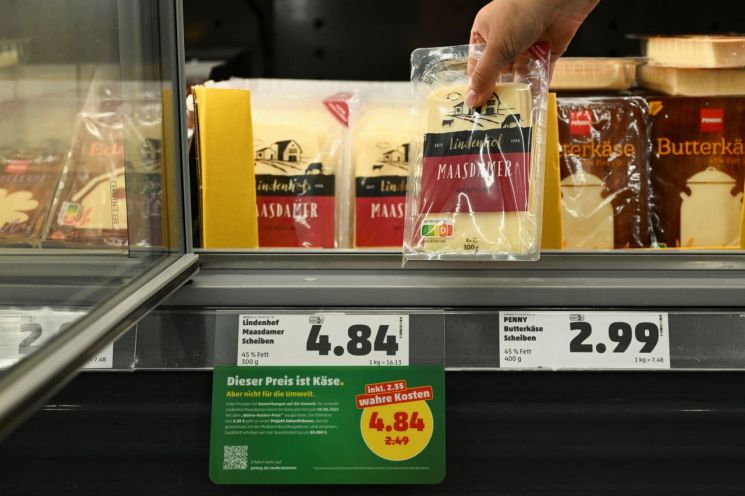 On the 1st of last month (local time), the German supermarket chain Penny was conducting the 'Real Price' campaign. [Image source=Reuters Yonhap News]
Penny’s experiment was an event that allowed consumers to tangibly feel how environmental factors impact the food supply chain through prices. When abnormal weather makes it difficult to produce agricultural products such as grains and fruits, prices of agricultural and food products naturally rise, and prices of foods using these as raw materials inevitably increase. Additionally, since large amounts of carbon dioxide are emitted during the production of meat such as beef and pork, as well as dairy products like milk and cheese, and various measures are currently being implemented to reduce these emissions, the related costs are increasing and need to be reflected in consumer prices.
The researchers involved in the experiment said that while it is unrealistic to broadly apply the true cost model Penny used to all products due to a lack of scientific evidence, the fact that such an experiment was conducted is meaningful. Penny stated in a pre-experiment interview that although a sales decline was expected, the campaign was implemented to convey a message, and profits from the increased prices would be donated to nearby farms struggling with climate issues.
Tomato, olive oil, and durum wheat prices rise... How will pasta be made?
Agricultural products are the first to be hit when abnormal weather occurs due to global warming. This year, prices of grains like wheat and rice, as well as vegetables such as tomatoes and oranges, surged rapidly as supply sharply decreased compared to demand due to poor yields. Retail prices of products using these agricultural goods as raw materials are also affected.
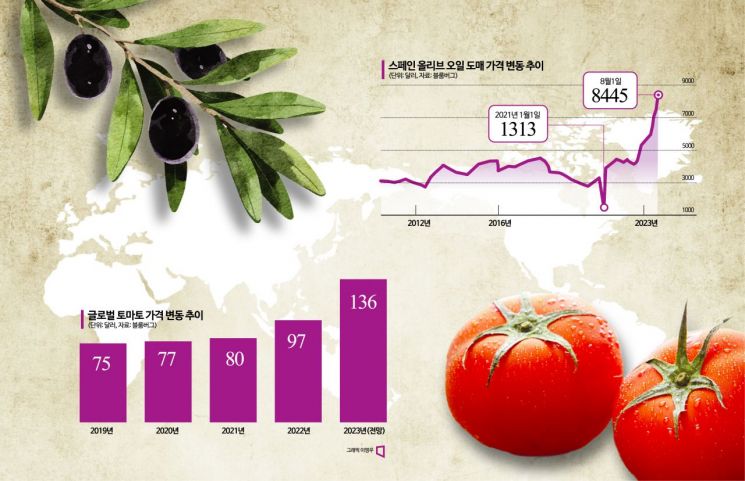
According to Bloomberg News, Italy, a major tomato producer in Europe, saw reduced production this year due to heatwaves. Italian tomatoes are mainly grown outdoors and are sensitive to climate change, used in canned goods, sauces, and ketchup. Bloomberg reported, "In May, farmers in northern Italy agreed to raise tomato prices by a record 40%. Since they account for a large part of the European supply chain, this could bring greater pain to retail prices."
Europe’s heatwave also caused difficulties for Spain, the world's largest olive oil producer. When temperatures rise excessively, olive trees drop fruit to conserve moisture or sacrifice the tree itself to provide moisture to the fruit. According to CNN, Spain’s olive oil production currently stands at about 620,000 tons, sharply down from the five-year average of about 1.3 million tons. Even after the harvest season in October and November, production is expected to end at around 700,000 tons, more than 30% below the five-year average. Prices are estimated to have doubled compared to last year.
Kyle Holland, who handles oils at market research firm Mintel, said, "At this price level, it is uncertain whether consumers will continue to buy olive oil or switch to other oils."
Durum wheat prices, a raw material for pasta, also surged this year. According to market research firm Nielsen, pasta retail prices rose about 12% in Europe and 8% in the United States. The International Grains Council (IGC) predicts that due to droughts and adverse weather in major producing countries such as Canada and Italy, global durum wheat production in 2023-2024 will hit its lowest level in 22 years, and global stocks will fall to their lowest in 30 years.
"Climate risks to food are greater than previously forecast"
Table prices are expected to continue rising. The extent of the increase is predicted to depend on how quickly global warming progresses. The slower the impact of abnormal weather on agricultural production, the less damage there will be and the more preparation will be possible.
According to a report released in May by the European Central Bank (ECB) and the Potsdam Institute for Climate Impact Research, food prices are expected to rise by 0.6 to 3.2 percentage points by 2060 due to climate change. NBC reported that Maximilian Kotz, a scientist at the Potsdam Institute, predicted that if carbon dioxide emissions remain high without reduction, food prices in the United States could rise by up to 7 percentage points by 2060.
As table prices rise, there is also a possibility that the food supply chain itself will change, such as shifts in major agricultural production regions or the emergence of substitutes. For durum wheat, Turkey has become a new supplier as Canada and Italy face production difficulties. The tomato variety 'Pomodorino di Manduria,' traditionally produced in southern Italy, has started to be grown in the north, and some related farms are considering relocation.
Cory Lesk, a climate researcher at Dartmouth College, said, "While the global food system has proven to be relatively resilient, abnormal weather is occurring earlier than expected, and climate risks appear to be greater and faster than forecast." He added, "We are standing on the edge of a cliff of risks that could change the game."
© The Asia Business Daily(www.asiae.co.kr). All rights reserved.
![Clutching a Stolen Dior Bag, Saying "I Hate Being Poor but Real"... The Grotesque Con of a "Human Knockoff" [Slate]](https://cwcontent.asiae.co.kr/asiaresize/183/2026021902243444107_1771435474.jpg)


















