Both Cards to Officially Launch Around Similar Time Next Year
'Gihudonghaeng Card' Advantageous for Usage Above 1850 Won
'K-Pass' Advantageous for Mainly Using Basic Fare Section
Seoul City's unlimited public transportation pass launching next year, the 'Climate Companion Card,' will compete with the government's K-Pass, which is released around the same time. Seoul citizens are expected to find it helpful to remember the figure '1850 won' when making their choice.
According to Seoul City on the 13th, the Climate Companion Card allows unlimited use of subways, city and village buses, and the public bicycle system 'Ddareungi' within Seoul for 65,000 won per month. The K-Pass offers a refund system where users receive between 20% and up to 53.3% (for low-income groups) cashback when using subways and buses. Both systems will only be available starting next year.
To compare these two cards, cases were assumed for three commuters: A, commuting from Gupabal Station to Gyodae Station; B, commuting from Gongdeok Station to Seoul City Hall; and C, commuting from Gochon-eup, Gimpo City, Gyeonggi Province to Yeouido. It was also assumed that they work 22 days a month, taking a total of 44 rides. Bus fares were set at 1,500 won, and subway fares at 1,550 won, considering this year's and next year's fare increases.
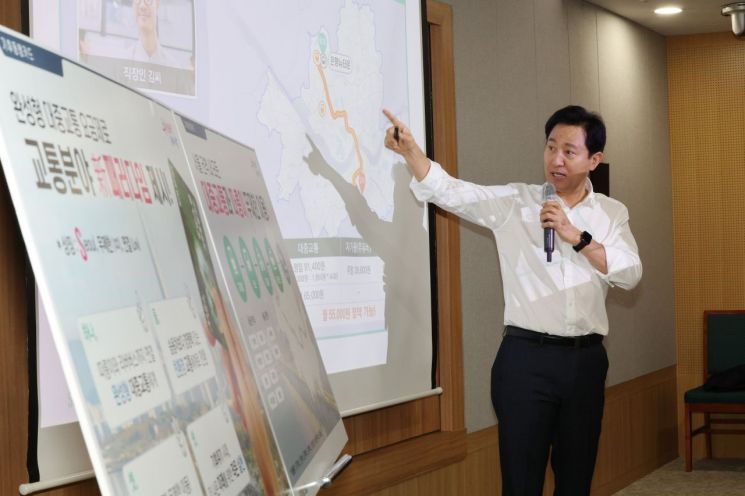 Seoul Mayor Oh Se-hoon is briefing at the press conference for the introduction and implementation of the Climate Companion Card held at the Seoul City Hall briefing room on the morning of the 11th. Photo by Yonhap News
◆Remember 1850 won= First, assuming a monthly public transportation usage of 81,400 won for the K-Pass, a 20% refund of 16,280 won would be received, resulting in a final expenditure of 65,120 won. In this case, there is little difference compared to the 65,000 won flat-rate Climate Companion Card.
The 81,400 won corresponds exactly to 44 subway rides at the 1,850 won fare segment. Since the subway fare from Gupabal Station to Gyodae Station is 1,850 won, commuter A will not suffer a significant loss regardless of which option is chosen.
Additionally, citizens who currently transfer between buses and subways for commuting should also remember the amount 1,850 won. Transfer fares are based on the highest basic fare among the public transportation used. Currently, the transfer fare is based on the higher bus fare of 1,500 won, but starting next year, the subway fare will be 1,550 won, effectively increasing the transfer fare by 50 won uniformly. If the current transfer fare is 1,850 won, it will become 1,900 won next year. At 1,900 won, the Climate Companion Card becomes 1,880 won more advantageous per month than the K-Pass.
◆If you use public transportation beyond commuting= Based on the calculations mentioned earlier, commuter B, who only pays the basic bus fare of 1,500 won, finds the K-Pass more advantageous.
However, there is a point to consider. If public transportation is used beyond commuting, the Climate Companion Card becomes more beneficial. This applies to citizens who use public transportation for church, exercise, appointments, and so on. For commuter A, even using public transportation just once more beyond commuting makes the Climate Companion Card much more advantageous. Also, the usage fee for Ddareungi cannot be ignored. The 30-day pass for the 1-hour Ddareungi rental costs 5,000 won. If public transportation and Ddareungi are used together, the 5,000 won is a direct saving.
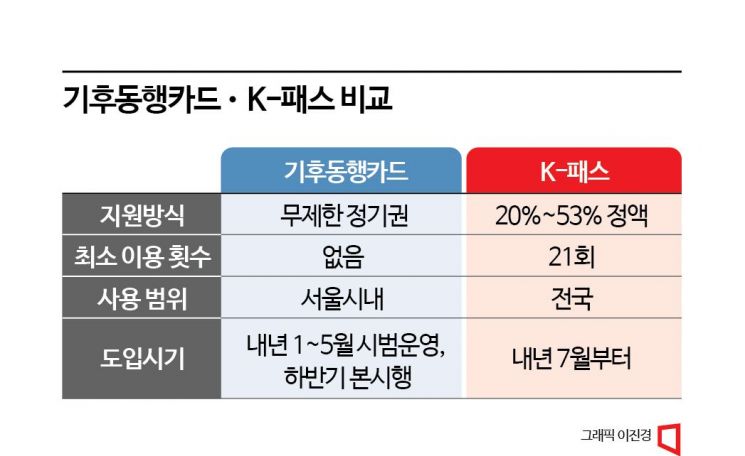
Even commuter B, who commutes at the minimum fare, needs to examine the details carefully. Forty-four rides at 1,500 won amount to 66,000 won, so using the Climate Companion Card is not a loss. However, the K-Pass refunds 13,200 won. Considering this amount, commuter B would need to take public transportation at least 11 more times beyond the 44 rides at 1,500 won each to benefit more from the Climate Companion Card than the K-Pass.
◆If the River Bus is introduced= Commuter C, a resident of Gyeonggi Province, cannot receive discounts from the Climate Companion Card.
However, the situation changes if the River Bus is introduced. Seoul City plans to launch the River Bus operating from Aragapmun, near Gochon-eup, to Yeouido in September next year. Although the fare has not yet been finalized, it is expected to be comparable to that of metropolitan buses. Currently, the fare for metropolitan buses in Gyeonggi Province is 3,000 won per ride.
If the River Bus fare is set at 3,000 won, commuter C would spend 132,000 won monthly on River Bus fares. However, using the Climate Companion Card could reduce this amount by more than half. It should be noted, though, that whether the K-Pass will offer discounts for the River Bus has not yet been decided.
© The Asia Business Daily(www.asiae.co.kr). All rights reserved.
![From Hostess to Organ Seller to High Society... The Grotesque Scam of a "Human Counterfeit" Shaking the Korean Psyche [Slate]](https://cwcontent.asiae.co.kr/asiaresize/183/2026021902243444107_1771435474.jpg)

















