The nationwide apartment occupancy rate in August rose by more than 2% compared to the previous month, reaching the highest level this year. In particular, as the housing price increase trend in the Seoul metropolitan area spreads, the occupancy rate in non-metropolitan areas also rose significantly.
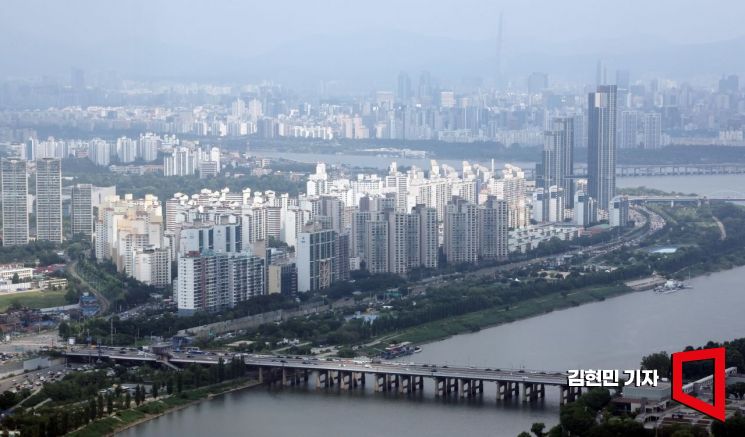 View of apartments in Ichon-dong, eastern Seoul, from the 63 Building observatory. Photo by Hyunmin Kim kimhyun81@
According to the Korea Research Institute for Human Settlements (KRHIS) on the 12th, the nationwide apartment occupancy rate in August was 71.5%, up 2.8 percentage points from the previous month.
In the Seoul metropolitan area, the rate fell by 0.9 percentage points from 82.0% to 81.1%, but the five major metropolitan cities rose from 67.6% to 68.3%, and other regions increased from 64.6% to 70.3%, resulting in an overall rise in non-metropolitan areas from 65.9% to 69.5%. KRHIS explained, "The occupancy rate in non-metropolitan areas is at its highest level this year."
The decline in the metropolitan area occupancy rate appears to be due to a drop in Seoul's occupancy rate. Seoul's rate fell by 4.2 percentage points from 89.5% to 85.3%. On the other hand, Incheon and Gyeonggi recorded their highest rate this year at 79.1%. KRHIS added, "Although the number of pre-sale units increased and the subscription competition rate was high compared to the previous year in Seoul, the occupancy rate slowed due to a decrease in sales transactions and accumulation of listings."
Looking at the non-metropolitan areas, only the Gangwon region fell by 1.3 percentage points to 62% compared to the previous month, while Daejeon-Chungcheong (71.8%), Gwangju-Jeolla (70.0%), Daegu-Busan-Gyeongsang (67.6%), and Jeju (75.1%) all showed upward trends. This is interpreted as a result of the expansion of the apartment price increase trend from the metropolitan area to non-metropolitan areas.
However, the non-metropolitan occupancy rate is still lower than the average of 83.3% during the hot real estate market period from 2020 to the first half of 2022, indicating the need for continuous monitoring.
The causes of non-occupancy were investigated in order of "delay in selling existing homes" (45.1%), "failure to secure tenants" (25.5%), and "delay in selling pre-sale rights" (13.7%).
In particular, the proportion of respondents citing "delay in selling pre-sale rights" increased by 9.9 percentage points from the previous month, which is interpreted as a decrease in existing home sales transactions due to housing demand concentrating in the subscription market.
Meanwhile, as warmth returns to the pre-sale market, the apartment occupancy outlook index for September was surveyed at 95.6, up 11.0 points from 84.6 in the previous month. If this index exceeds 100, it means that housing developers generally expect an increase in occupancy.
In particular, the Seoul metropolitan area recorded 107.1, the highest since July 2021 (119.8). In the metropolitan area, developers are seen to have a positive outlook on actual occupancy possibilities, given the forecast that the September occupancy volume will be the lowest since September 2021.
© The Asia Business Daily(www.asiae.co.kr). All rights reserved.

















