‘Han-US-Japan vs. North-China-Russia’ Catalyst
New Security Threats Rise Amid Arms Trade
Possibility of Realignments Along Global Supply Chains
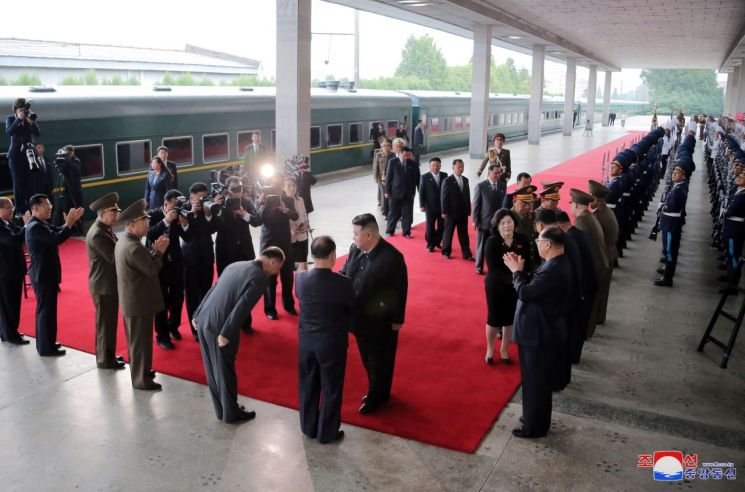
North Korean State Affairs Commission Chairman Kim Jong-un and Russian President Vladimir Putin are expected to plunge the Northeast Asian situation into turmoil following their summit in Vladivostok. This summit, held for the first time in about three years and five months since April 2019, was realized as the interests of Russia, suffering from a weapons shortage, and North Korea, needing to overcome a food crisis, aligned. Experts predict that this summit will act as a catalyst worsening the confrontation between the 'South Korea-US-Japan' bloc and the 'North Korea-China-Russia' bloc. There are also observations that Russia's strategy toward the Korean Peninsula, which had maintained equidistant diplomacy between South and North Korea for a long time, will be completely reversed through this summit.
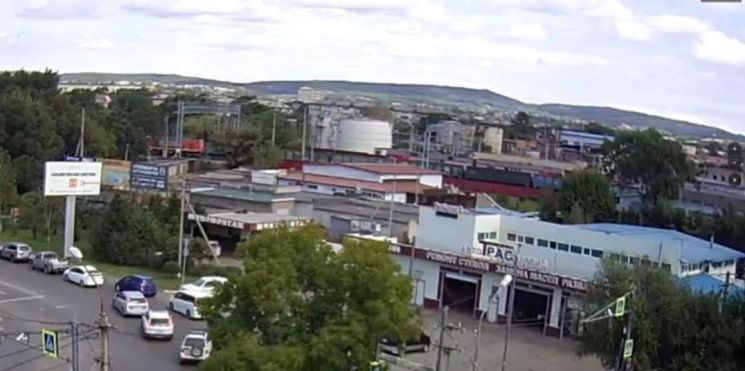 On the 12th (local time), the special train carrying Kim Jong-un, Chairman of the State Affairs Commission of North Korea, was passing northward near Ussuriysk Station in Primorsky Krai, Russian Far East. Exclusive [Image source=Yonhap News]
Alignment of Interests... Strengthening North Korea-Russia Closeness
Former Ambassador to Russia Wi Seong-rak said in a phone interview with Asia Economy, "If North Korea intervenes in the Ukraine war (such as by supplying weapons) depending on the summit's outcome, the likelihood of our involvement will increase, and the epicenter of the confrontation between South Korea-US-Japan and North Korea-China-Russia will approach the Korean Peninsula itself." Ambassador Wi added, "That does not mean we can neglect South Korea-Russia relations. We need to establish an integrated strategy for relations with the US and Russia overall and present predictable coordinates to have substantive dialogues with Russia." Cha Doo-hyun, senior research fellow at the Asan Institute for Policy Studies, also said in a phone interview, "If North Korea exports artillery shells to Russia, we need means to put brakes on such alliances, including our support for Ukraine's weapons. Just as we pay attention to South Korea-China relations amid the confrontation between South Korea-US-Japan and North Korea-China-Russia, we need to redefine our relationship with Russia."
The realization of Chairman Kim's visit to Russia is interpreted as a strong signal that despite international concerns, North Korea and Russia have found a point of contact for some kind of arms deal and have ultimately decided to take action. For Russia, surrounded by Western sanctions due to the prolonged Ukraine war, receiving weapons such as artillery shells from North Korea is crucial, while North Korea desperately needs to secure allies through food, fertilizer, and energy support from Russia. Former Minister of Unification Jeong Se-hyun appeared on the radio that day and said, "Chairman Kim Jong-un going all the way to Vladivostok to meet President Putin can be seen as a kind of response to the decision by the three leaders of South Korea, the US, and Japan at Camp David to strengthen pressure on North Korea, China, and Russia."
Matching the Image of Dispelling Isolation... Character of Alliance and Realignment
Senior Research Fellow Jo Han-beom of the Korea Institute for National Unification said, "We should consider that a new normal era of North Korea-Russia relations has opened," adding, "North Korea's foreign trade was mostly with China, and North Korea-Russia trade had never exceeded 100 million dollars. But now, the need to operate a weapons and food exchange program between North Korea and Russia is being fulfilled," predicting that the Ukraine war could be prolonged due to the strengthened North Korea-Russia partnership. Senior Research Fellow Cha also said, "I think the urgent need to externally convey the message that both sides are no longer isolated coincided," and interpreted, "North Korea probably needed an event to give its people a message of hopeful torment as the second economic development plan was likely to end in failure."
However, due to the reorganization of global supply chains, alliances and realignments can occur at any time, so there is a view that the nature of this summit should not be interpreted as a new Cold War confrontation of 'socialism' versus 'liberalism.' During the US-Soviet Cold War era, capitalist and socialist supply chains were separated, and there was no trade between the two, but currently Russia exports oil and China exports goods worldwide. Research Fellow Jo said, "We should not view this through ideologically divided camps but see it as a clear confrontation where cooperation and competition coexist," and predicted, "Such relationships can always undergo alliances and realignments." The interpretation is that by finding gaps in the North Korea-China-Russia linkage through supply and trade networks, it is possible to escape new security threats.
© The Asia Business Daily(www.asiae.co.kr). All rights reserved.


















