SK Ecoplant's Transformation in Progress
From Water Treatment to Spent Battery Recycling
Green Hydrogen Production Accelerates with Wind Power
Over the past three years, SK Ecoplant has poured more than 4 trillion won into mergers and acquisitions (M&A) and equity investments, changing its signboard from a 'construction company' to a 'climate change solution company.' With the dawn of the carbon-neutral era, many companies realized that their existing businesses are no longer sustainable. SK Ecoplant was no exception. Driven by the urgency to survive through transformation, the company is attempting a metamorphosis for the future.
Since 2020, SK Ecoplant has invested over 4 trillion won in the environment and energy sectors. These areas were unrelated to its existing core businesses such as housing construction represented by 'SK View,' plant projects pursued with SK Hynix for over a decade, and infrastructure construction projects like roads and ports. To transform, the company had to change fundamentally from the roots.
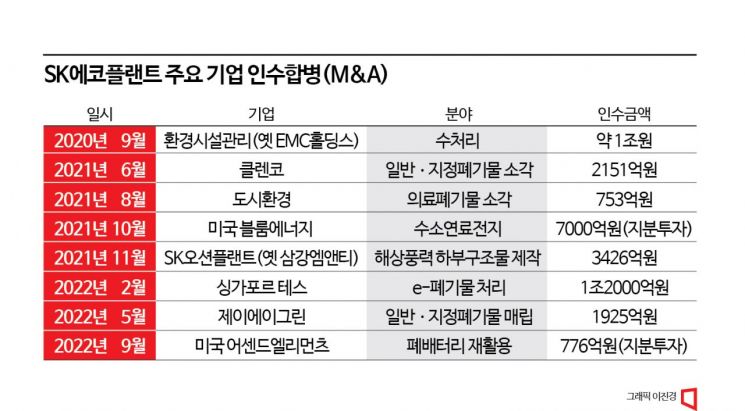
The largest recent M&A undertaken by SK Ecoplant was the acquisition of TES in Singapore. In February last year, it purchased 100% of TES shares for 1.2 trillion won.
TES is a company specializing in the treatment of electrical and electronic waste, commonly known as 'e-waste.' Through the acquisition of TES, SK Ecoplant instantly secured business sites in 22 countries, including advanced nations in North America and Europe. To handle electrical and electronic waste across borders, a 'Basel Permit' is required, and TES holds permits in over 20 countries.
Using TES as a foothold, SK Ecoplant has also entered the waste battery treatment market. It plans to secure battery recycling facilities in regions where the battery industry is expected to grow, such as Europe and the United States. Domestically, it will build a recycling facility in Gyeongju by 2026. On the 8th, SK Ecoplant signed a memorandum of understanding (MOU) with Gyeongsangbuk-do Province and Gyeongju City to promote the 'Gyeongju Secondary Battery Recycling Project.'
Additionally, to add battery recycling technology, SK Ecoplant invested 77.6 billion won in Ascend Elements, a U.S. waste battery recycling technology company. This business involves extracting key raw materials such as nickel, cobalt, and lithium by dismantling and crushing scraps generated during battery production or used secondary batteries.
SK Ecoplant's environmental business is not merely about waste disposal. The goal is to reuse and recycle waste. In September 2020, it acquired Environmental Facility Management (formerly EMC Holdings), the top water treatment company in Korea, for about 1 trillion won, and has since acquired more than ten waste incineration companies. It is engaged in water treatment businesses that reuse wastewater and sewage, as well as waste incineration businesses that reduce pollutants.
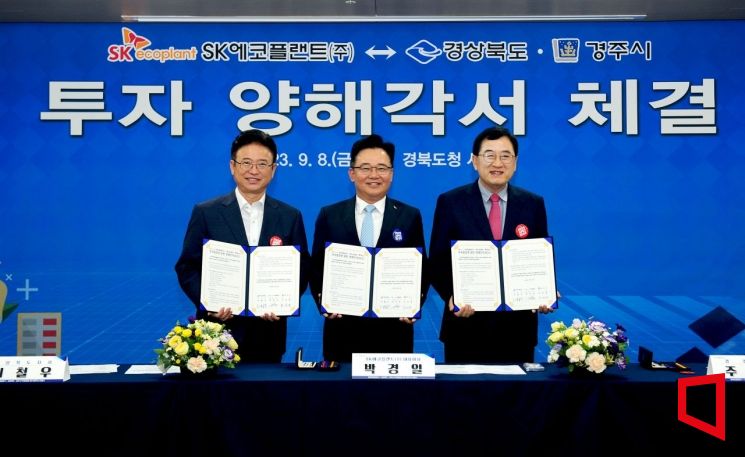 On the 8th, SK Ecoplant signed a tripartite investment memorandum of understanding (MOU) with Gyeongsangbuk-do and Gyeongju City at the Gyeongbuk Provincial Office to promote the 'Gyeongju Secondary Battery Recycling Project.' Park Kyung-il, President of SK Ecoplant (center), Lee Cheol-woo, Governor of Gyeongsangbuk-do (left), and Joo Nak-young, Mayor of Gyeongju City (right), are taking a commemorative photo. Photo by Park Kyung-il
In particular, SK Ecoplant is accelerating its 'green hydrogen' business produced from renewable energy. In 2021, it invested 342.6 billion won to acquire a 30.61% stake (about 16.3 million shares) in SK Oceanplant (formerly Samkang M&T), Asia's number one offshore wind substructure manufacturer. SK Oceanplant developed the first ultra-large industrial pipes (thick-walled steel pipes) in Korea, bending thick steel plates to a maximum diameter of 10 meters.
Based on this, the company plans to expand its business scope to offshore wind floating bodies, offshore substations, and the entire offshore wind sector. Currently, it is developing a 2.6GW scale floating and fixed offshore wind project in five regions including Ulsan and Jeonnam, in collaboration with global offshore wind specialist Corio, TotalEnergies, and local governments.
SK Ecoplant is also advancing its green hydrogen business based on offshore wind power. It has established a cooperative system by investing 700 billion won in Bloom Energy, a leading fuel cell company. The business plan to produce electricity from wind and create green hydrogen is becoming a reality in Canada. The 'New GeoHonic Project,' in which SK Ecoplant holds a 20% stake, involves building wind power and hydrogen production facilities on state-owned land on Newfoundland Island in eastern Canada. Last month, the project received approval from the provincial government to use the state-owned land for wind power generation.
Although SK Ecoplant's transformation is ongoing, its results have begun to show in numbers. In the second quarter, the company recorded consolidated sales of 3.9272 trillion won and operating profit of 177.3 billion won. Among sales, the environment and energy business accounted for 1.2648 trillion won, more than doubling from last year's 551.3 billion won. The sales proportion exceeded 30%.
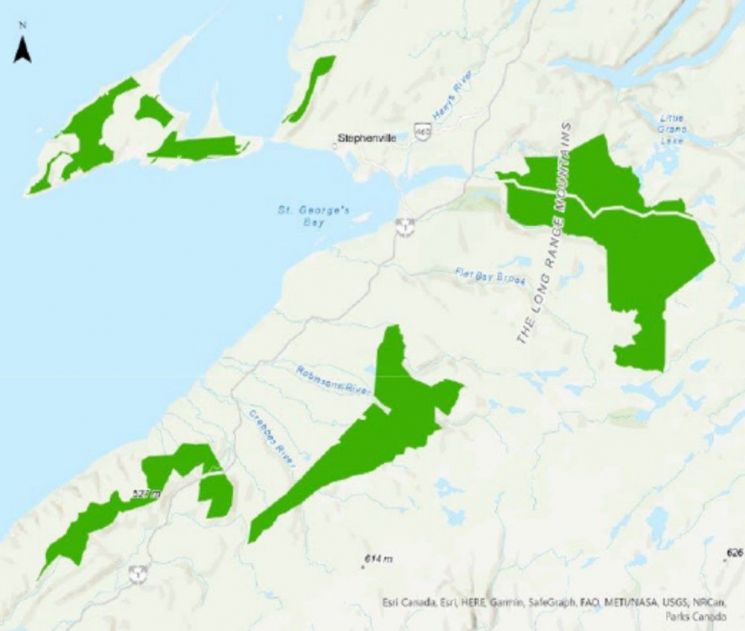 The New Geohonic Project, a Canadian green hydrogen initiative involving SK Ecoplant, has received approval for the use of public land from the provincial government of Canada. The area is capable of supporting approximately 4GW of wind power generation, which is 1.8 times the total area of Seoul. A map showing the four sites where the New Geohonic Project has obtained land use approval.
© The Asia Business Daily(www.asiae.co.kr). All rights reserved.
![Clutching a Stolen Dior Bag, Saying "I Hate Being Poor but Real"... The Grotesque Con of a "Human Knockoff" [Slate]](https://cwcontent.asiae.co.kr/asiaresize/183/2026021902243444107_1771435474.jpg)


















