On the occasion of U.S. President Joe Biden's state visit, the United States and Vietnam elevated their bilateral relationship to the highest level of 'Comprehensive Strategic Partnership.' This move is analyzed as part of efforts to check China's ambitions in the Indo-Pacific region.
On the 10th (local time), President Biden held talks with Nguyen Phu Trong, the Communist Party General Secretary and the top-ranking official in Vietnam, in Hanoi, the capital of Vietnam, and agreed to upgrade the bilateral relationship accordingly. This is Biden's first visit to Vietnam since taking office. Notably, this visit took place amid expanding cooperation between the U.S. and Vietnam and escalating conflicts in the Indo-Pacific region surrounding the South China Sea. After the meeting with General Secretary Trong, President Biden stated at a press conference, "We have strengthened another important relationship in the Indo-Pacific region," adding, "a crucial partner at a critical time every week."
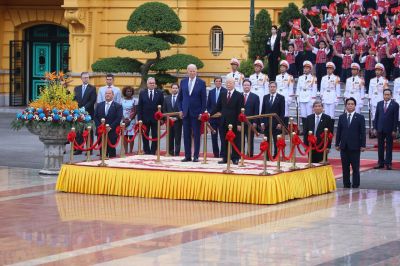
With this visit, the United States has elevated its relationship with Vietnam to the highest level for the first time in 10 years since former President Barack Obama established the lowest level 'Comprehensive Partnership' with Vietnam in 2013. Vietnam, which advocates 'non-alignment,' has so far maintained comprehensive strategic partnerships only with four countries: South Korea, India, Russia, and China.
Accordingly, the U.S. expects that upgrading diplomatic relations with Vietnam will further expand its base for checking China in the Indo-Pacific region. Following the Quad, AUKUS, and the South Korea-U.S.-Japan alliance, the U.S. is emphasizing containment of China by strengthening its influence over the Association of Southeast Asian Nations (ASEAN) with Vietnam as a foothold.
American media, including The New York Times (NYT), described the 'Comprehensive Strategic Partnership' as "a symbolic and important status long coveted by the U.S.," and reported that "since taking office, President Biden has been working to strengthen relations with Southeast Asian countries as a tactical value to counter China in the Indo-Pacific region." On this day, Biden's remark at the press conference that "America is a Pacific nation, and we are not going anywhere" was also interpreted as a warning to China.
President Biden emphasized, "Vietnam is a friend, a trusted partner, and a responsible member of the international community." Regarding questions about relations with China, he responded, "We are not trying to contain China. We just want to clarify our relationship with China."
However, in an official statement on the same day, Vietnam expressed hope that the U.S. would "continue to guarantee the legitimate interests of Southeast Asian countries" regarding the South China Sea issue, while also urging "not to use or threaten force, to refrain from actions contrary to international law, and to resolve disputes peacefully."
China is also closely watching President Biden's visit to Vietnam. Earlier, the Chinese Foreign Ministry, when asked about this visit, urged the U.S. to "abandon Cold War mentality and zero-sum game thinking," and to abide by the basic norms of international relations and not undermine regional stability. The NYT noted that "Vietnam is unlikely to join an alliance against China," but emphasized that "Vietnam is one of the few Southeast Asian countries that openly oppose China's claims in the South China Sea."
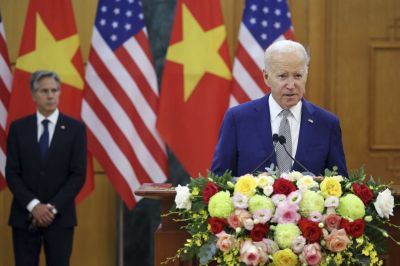
Alongside this, economic cooperation between the two countries is expected to strengthen as the U.S. shifts China-centric supply chains to Vietnam as part of so-called friendshoring. Specific discussions on the supply of rare earth elements used in smartphones and electric vehicle batteries are also anticipated. Vietnam has the second-largest rare earth deposits after China. Accompanying President Biden on this state visit were senior officials from U.S. companies such as Intel, Google, Amkor Technology, and Boeing. A bilateral business meeting is scheduled for the 11th. Major foreign media reported that Boeing is expected to sign a contract to sell 50 units of the 737 Max to Vietnam Airlines, worth about $7.5 billion.
Additionally, the U.S. is likely to actively pursue exporting military equipment and other defense materials to Vietnam following this visit. Once among the world's top 10 arms importers, Vietnam has long relied on Russian-made weapons. The NYT cited internal Vietnamese government documents reporting that despite strengthening ties with the U.S. in recent months, Vietnam plans to purchase weapons from Russia in violation of U.S. sanctions. John Finer, Deputy National Security Advisor at the White House, said, "The new partnership will enable Vietnam to import weapons from the U.S. and our allies."
Ahead of President Biden's state visit, attention was also focused on whether he would raise human rights issues in Vietnam. Vietnam is considered one of the most authoritarian countries in Southeast Asia. Local media reported that during the talks, President Biden raised human rights concerns, and General Secretary Trong emphasized the importance of non-interference in internal affairs, indicating some tension.
Meanwhile, at the press conference, President Biden was asked about the G20 summit statement that did not explicitly name Russia as the aggressor in the Ukraine war. After tense negotiations among G20 members, a joint statement was adopted, but it excluded direct condemnation of Russia's invasion of Ukraine.
In response, President Biden called it "a wedge issue," explaining that both Russia and China are G20 members. On the same day, U.S. Secretary of State Antony Blinken appeared on CNN and, when asked the same question, said, "All G20 leaders except Russia showed a united stance on the importance of territory and sovereignty," adding, "They are clear not only that this war must end but that Russia must be held accountable."
© The Asia Business Daily(www.asiae.co.kr). All rights reserved.


















