Jikganggapjil119, Survey of 1,000 Office Workers
Discrimination against female workers in the workplace remains prevalent, according to a recent survey.
Workplace Gapjil 119 and the Beautiful Foundation commissioned the public opinion research firm 'Embrain Public' to conduct a survey on gender discrimination and related issues among 1,000 workers nationwide aged 19 and older from the 2nd to the 10th of last month, the results of which were announced on the 10th.
The survey found that 31.3% of workers had heard inappropriate gender-specific terms while working.
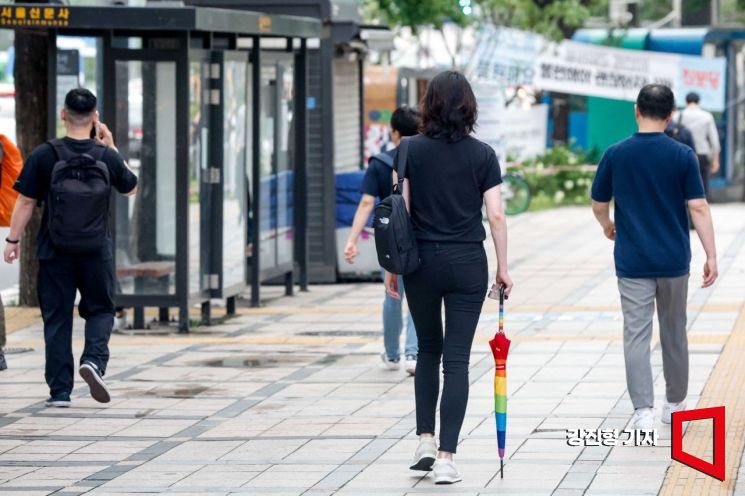
Among them, more than half (55.9%) were women, and particularly, 6 out of 10 female non-regular workers reported being called inappropriate terms such as "agassi" (miss) or "ajumma" (middle-aged woman). The figure for male workers was much lower at 12.4%.
Additionally, 27.6% of workers reported hearing hateful remarks based on gender-biased stereotypes starting with phrases like "Women are~" or "Men are~," and 26.4% said they were forced to perform gender role tasks based on stereotypes, such as making coffee or acting cute.
The rates of hearing hateful remarks or being forced to perform gender roles were significantly higher among women, at 45.1% and 44.8% respectively, compared to 14.2% and 12.2% for men?over 30 percentage points higher.
Unwanted advances were also a problem. Eleven percent of female workers experienced "unwanted advances," more than three times the 3.4% reported by men. Among female non-regular workers, 14.7% experienced this, which is 5.8 times higher than the 2.5% of regular male workers.
Furthermore, 44.5% of workers responded that employment rules banning private relationships between supervisors and subordinates are necessary to prevent unwanted advances.
There is a deeply rooted belief that victims of sexual crimes or gender-based violence in the workplace will not be protected by their companies or the government. Half of the workers (48.2%) believed that their company would not protect them after experiencing sexual crimes in the workplace. Seven out of ten (73.8%) responded that they would not be protected by the government.
This perception was higher among women than men. Among women, 64.1% expected a lack of company protection, and 87.4% anticipated a lack of state protection, each more than 20 percentage points higher than men.
Yeosu Jin, a labor attorney at Workplace Gapjil 119, stated, "Behind one extreme case of gender violence, there are numerous instances of gender-discriminatory harassment such as inappropriate titles, harassment through unwanted advances, and misogynistic remarks. If such harassment is left unchecked, it can lead to greater harms such as sexual harassment, employment discrimination, and stalking, threatening the safety of everyone."
© The Asia Business Daily(www.asiae.co.kr). All rights reserved.
![Clutching a Stolen Dior Bag, Saying "I Hate Being Poor but Real"... The Grotesque Con of a "Human Knockoff" [Slate]](https://cwcontent.asiae.co.kr/asiaresize/183/2026021902243444107_1771435474.jpg)
















