Yoon Attends G20 Summit Session 1 'One Earth'
Contributes $300 Million to Green Climate Fund for Developing Countries
Supports Clean Energy Transition and Green Shipping Route Development
Expands South Korea's Influence as a Global Key Nation
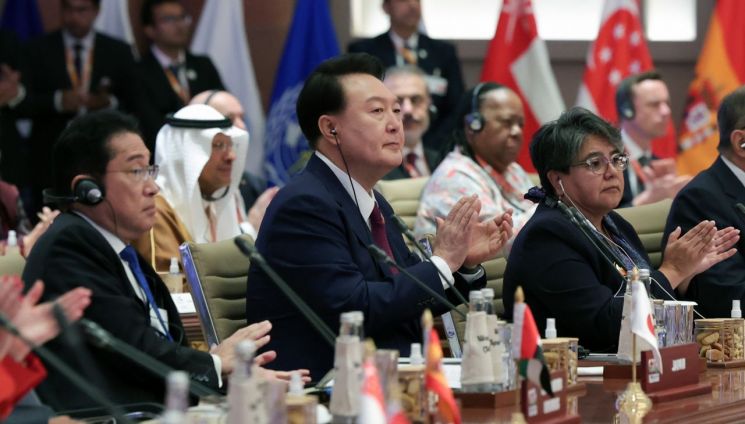
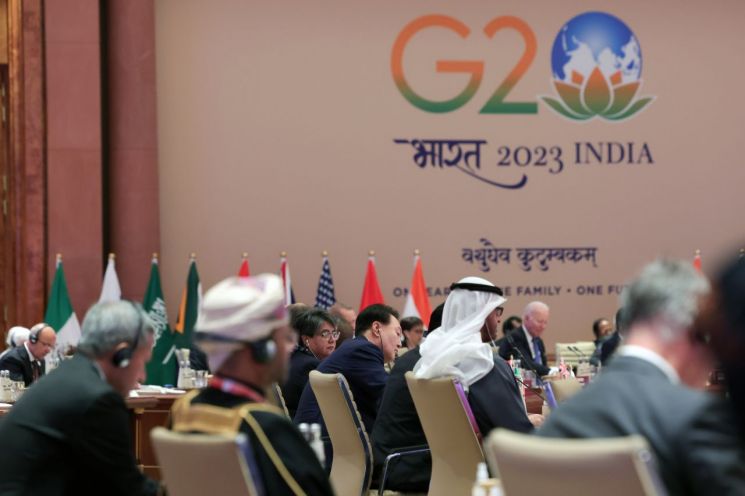
President Yoon Suk-yeol announced at the G20 summit on the 9th that South Korea will take the lead in helping countries struggling to establish climate response systems and cooperate in green energy and development, aiming to become a 'global green ladder' through decarbonization and eco-friendly responsible diplomacy. This strategy seeks to expand South Korea's influence as a global hub connecting developing and developed countries through the G20 summit. In particular, it is interpreted as an intention to form an export base by responding to the climate crisis with developing countries through nuclear power, hydrogen vehicles, and green shipping.
First, to overcome the global climate crisis, South Korea plans to contribute $300 million to the Green Climate Fund (GCF), matching the amount it has contributed so far, to reestablish itself as a leading country in climate change response. The GCF was established at the 16th Conference of the Parties (COP16) to the United Nations Framework Convention on Climate Change held in Cancun, Mexico, in 2010. South Korea contributed $100 million of the initial $10.3 billion fund and supported $200 million during the first replenishment phase from 2020 to 2023, which aimed to raise $10 billion. As a climate response hub hosting the three major climate crisis response institutions?the GCF, the Global Green Growth Institute (GGGI) headquarters, and the Climate Technology Centre and Network (CTCN) overseas office?South Korea intends to play a leading role.
Kim Tae-hyo, First Deputy Director of the National Security Office, explained at a press briefing held in a hotel press room in New Delhi, "This means that South Korea can take the lead in providing financial and technical support to countries that cannot develop green technology alone or find it difficult to establish climate response systems at the level of developed countries without financial, fiscal, and infrastructure support." He added, "By reclaiming the position of green growth and global climate change leadership, South Korea believes it can perform a leading climate role on a global scale." Choi Sang-mok, Senior Secretary for Economic Affairs, also emphasized, "While developed countries are setting and implementing high-level climate change goals such as the 2050 global carbon neutrality target, emerging countries criticize their responsibilities during industrial development and strongly demand climate finance contributions from developed countries. In this context, President Yoon declared South Korea's role as a green ladder to support the efforts of countries vulnerable to climate change, gaining support from major countries."
South Korea's plan to actively cooperate on nuclear power with countries aiming to reduce greenhouse gas emissions while strengthening energy security as a leading nation in nuclear and hydrogen energy development is not only about its role as a global hub but also reflects future industrial cooperation and export enhancement. South Korea is leading the development of small modular reactors (SMRs) alongside nuclear power exports and holds the world's top position with 30,000 hydrogen vehicles in circulation. Based on this technological capability and product strength, South Korea aims to assist developing countries in decarbonization and anticipates that as these countries' economies develop and purchasing power rises, they will naturally become customers. Kim explained, "By leading the global expansion of nuclear power and hydrogen industries, which are representative zero-carbon energy sources, we expect to contribute to carbon neutrality efforts and the creation of new export markets."
The establishment of green shipping routes through eco-friendly maritime solutions also reflects the growing importance of carbon taxes in the marine economy, which is closely related to export economics. Carbon reduction has become necessary in shipping and port operations for exports. Senior Secretary Choi stated, "As seen in the French version of the Inflation Reduction Act (IRA), carbon emissions generated during manufacturing and transportation processes can become obstacles to our future exports. Now, decarbonization of international shipping is not an option but a necessity," emphasizing the need to establish green shipping routes.
Last year, at the 27th COP meeting, South Korea announced that it would discuss and declare the establishment of green shipping routes connecting Busan and Seattle, as well as major port cities including Seattle on the U.S. West Coast, in cooperation with the United States. Led by South Korea and the U.S., a preliminary feasibility study on the use of eco-friendly fuels and the establishment of eco-friendly port infrastructure is underway, with results to be announced at the 28th COP meeting to be held this year in the UAE. Regarding this, Kim said, "By presenting a vision for the expansion of Korean-style eco-friendly shipping solutions, we expect to enhance South Korea's global status as a leading country in climate crisis response and to create new industries and growth engines in related fields."
© The Asia Business Daily(www.asiae.co.kr). All rights reserved.
![Clutching a Stolen Dior Bag, Saying "I Hate Being Poor but Real"... The Grotesque Con of a "Human Knockoff" [Slate]](https://cwcontent.asiae.co.kr/asiaresize/183/2026021902243444107_1771435474.jpg)

















