'Huh Sam-gwan's Blood Donation' More Popular Than 'Life' Only in Korea
"Due to High Literary Sophistication"
Korea Was the First to Embrace 'Life' as Literature, Not Film
"So far in Korea, the novel 'Insaeng' has sold 100,000 copies, and 'Heo Sam-gwan Maehyeolgi' has sold 250,000 copies. Korea is the only country where 'Heo Sam-gwan Maehyeolgi' has sold more than 'Insaeng,' which I believe is because Koreans have a high literary literacy."
At a press conference held on the 8th at a creative space in Seochon, Jongno, Seoul, author Yu Hua (63) did not hide his affection for Korea. The conference was organized to commemorate the 40th anniversary of his literary debut and the publication of revised editions of 'Insaeng' and 'Heo Sam-gwan Maehyeolgi.' Yu Hua expressed his gratitude repeatedly, saying, "Chinese publishers take good care of royalties but do not celebrate anniversaries, so I am very thankful that Korean publishers are celebrating my 40th anniversary."
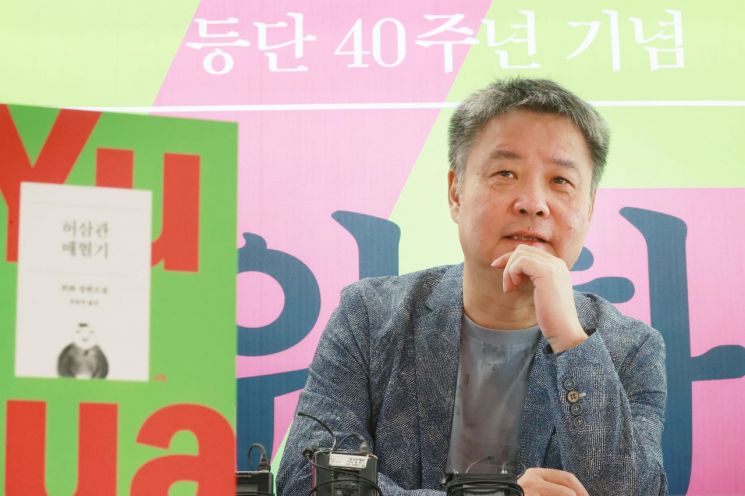 Chinese writer Yu Hua, celebrating his 40th anniversary since debut this year
 [Image source=Yonhap News]
Yu Hua is a representative author of modern Chinese literature alongside Mo Yan, who won the Nobel Prize in Literature, and Yan Lianke, a Lu Xun Literature Prize laureate. He gained attention for depicting the turbulent 20th-century China through works such as 'Original Green,' 'Brothers,' 'Insaeng,' and 'Heo Sam-gwan Maehyeolgi.' In particular, the novel 'Insaeng,' which portrays the harsh life of the people who had to endure the revolutionary period through the tragic life of the fallen landlord family 'Pu Gui' in the 1950s, is also well known as a film of the same name directed by Zhang Yimou and starring Gong Li. 'Heo Sam-gwan Maehyeolgi' warmly captures the arduous family love through the life of 'Heo Sam-gwan,' who sells his blood to support his family, and was produced as a film directed by actor Ha Jung-woo in Korea. He smiled and said, "Since it was not released in China, I had no choice but to watch a pirated version. I think director Ha Jung-woo will understand this well."
His work 'Insaeng' was first published in Korea in 1996. After that, 'Heo Sam-gwan Maehyeolgi' was published in 1999, and by early 2000, four works had been introduced. He explained, "'Insaeng' was published earlier in France, Greece, and the Netherlands than in Korea, but that was largely due to the influence of the film. Korea was the first to pay attention to it purely as a literary work," adding, "That is why I often visit Korea, which loves my work."
As a memorable Korean author, he mentioned Lee Mun-yeol. He said, "When Korean authors were not well known in China in the past, the first work I saw was a novel by Lee Mun-yeol. I met him a few times at overseas literary events, and we communicated well," joking, "When I tried to meet him in Korea, people around him said he was right-wing, so left-wing acquaintances discouraged me, making it difficult to meet him."
He is currently preparing two new works. He said he is working on a heavy novel that captures the weight of life, following his usual tone, and a short story that breaks away from that tone and includes humor.
When asked if he expects to win the Nobel Prize in Literature this year, as he is frequently mentioned as a strong candidate in China every year, he trailed off, saying, "I haven't even received an award in Korea yet, so a global award..."
© The Asia Business Daily(www.asiae.co.kr). All rights reserved.

















