Analysis of Impact from Lee Jae-myung's Hunger Strike, Regular National Assembly, and Hong Beom-do Controversy
President Yoon's Approval Rating Steady at 33% Last Week
Next Leader: Lee Jae-myung Leads with 19%, Han Dong-hoon Second with 12%
A public opinion poll showed a significant increase in support for the Democratic Party of Korea, while President Yoon Suk-yeol's approval rating for his administration remained in the low 30% range.
According to Gallup's regular survey conducted on the 8th, the Democratic Party's support rose by 7 percentage points from the previous week to 34%. The People Power Party also maintained 34%, resulting in a tie between the two major parties.
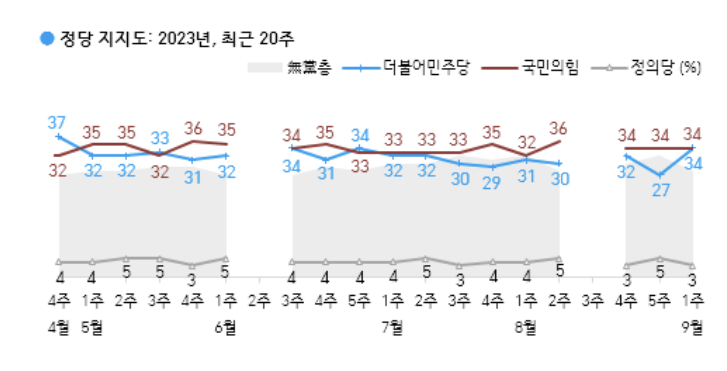
The political offensives by the opposition party using the National Assembly's question sessions since the opening of the regular session?such as Democratic Party leader Lee Jae-myung's hunger strike, historical controversies surrounding the relocation of independence activist General Hong Beom-do's bust, and allegations of pressure on the Marine Corps investigation?are analyzed as factors influencing this trend.
Gallup stated, "The gap and trends between the two parties fall within the margin of error (up to 6 percentage points), where statistical superiority cannot be determined. Last week slightly exceeded this range by 1 percentage point, but this week the parties are tied again." It added, "Since June last year, changes in party support have mainly originated from centrist voters. Based on presidential job approval and various current issue opinions, their views tend to lean closer to the opposition than the ruling party. When fluctuations are large like these days, the Democratic Party's support base is relatively soft, whereas the People Power Party's support base, with smaller fluctuations, is considered hard." This explains that the Democratic Party's fluctuating support is due to the flow of centrist-leaning supporters.
Regarding next year's general election, 37% of respondents expect a majority win for the ruling party, while 50% expect a majority win for the opposition. Compared to the previous survey, support for a ruling party majority rose by 1 percentage point, and support for an opposition majority rose by 2 percentage points. Gallup explained, "In the March survey, government support (42%) and checks and balances (44%) were nearly equal, but since April, when checks and balances became dominant, this trend has continued for half a year." People aged 50 and below tend to believe the opposition should win a majority, whereas those aged 60 and above tend to support a ruling party majority.
President Yoon's approval rating remained at 33%, the same as the previous survey. Negative evaluations dropped by 1 percentage point to 58%. Those who positively evaluated his job performance cited diplomacy (26%) and defense/security (7%) as main reasons. Those who gave negative evaluations pointed to the Fukushima contaminated water discharge issue (16%) and diplomacy (12%).
In the poll asking about the next leader, Lee Jae-myung ranked first with 19%, down 3 percentage points from the previous survey conducted from May 30 to June 1. Justice Minister Han Dong-hoon rose by 1 percentage point to 12%, the highest within the ruling party and second overall. Daegu Mayor Hong Joon-pyo and former Prime Minister Lee Nak-yeon each scored 3%.
This survey was conducted from the 5th to the 7th of this month via telephone interviews with 1,000 adults nationwide aged 18 and over. For detailed information, please refer to the website of the National Election Survey Deliberation Commission.
© The Asia Business Daily(www.asiae.co.kr). All rights reserved.
![Clutching a Stolen Dior Bag, Saying "I Hate Being Poor but Real"... The Grotesque Con of a "Human Knockoff" [Slate]](https://cwcontent.asiae.co.kr/asiaresize/183/2026021902243444107_1771435474.jpg)
















